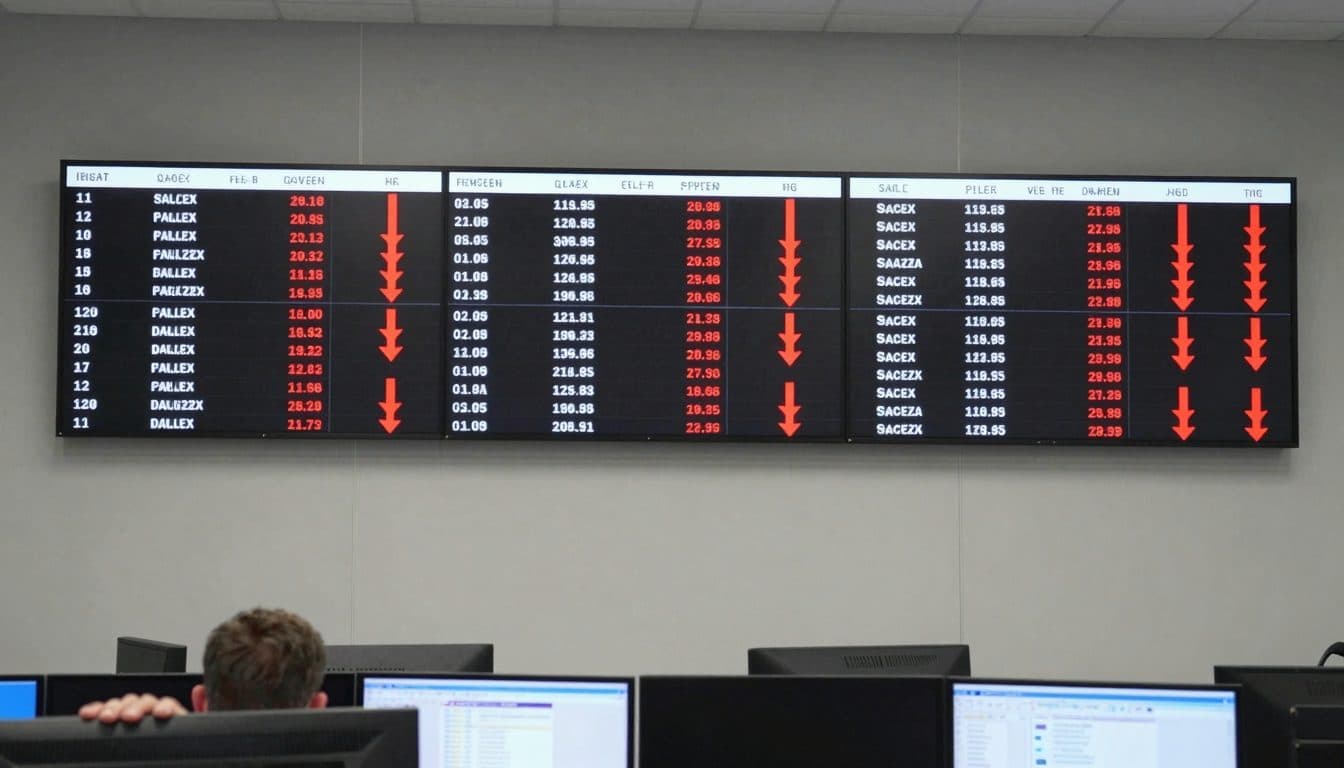
SpaceX stock falls below issue price nearly one month after IPO
New York, July 16, 2026
AI-generated image (z-image via Kie.ai)
Summary
Barely a month after its IPO, the SpaceX stock on the NASDAQ temporarily fell below the issue price of $135. On Wednesday, the share traded intermittently at around $133, triggered by the surprise announcement of a bond of at least $20 billion.
New York, July 16, 2026
The stock of US space company SpaceX has fallen below the issue price of $135 roughly one month after its IPO on the NASDAQ, trading intermittently at around $133 on Wednesday.
Trigger: Surprise bond
The price drop coincided with a surprise announcement by the company: SpaceX is planning a bond of at least $20 billion to refinance a bridge loan — even though the company says it still has around $100.8 billion in liquid funds. The news caused uncertainty on Wall Street and pushed the share price below the $135 mark during the day.
"End of a high-flying ride: Just over a month after the IPO of US space company SpaceX, the share price has fallen back below the issue price." This is how the editorial team of finanzen.ch describes the development. The issue price of $135 corresponds to around €118 and was set in June. On Wednesday evening, the stock was down 1.26 percent at around 7 p.m. CEST.
From issue price to high-flying ride and back
The IPO on June 12, 2026 was the largest IPO in history. SpaceX (Space Exploration Technologies) raised $75 billion. Already at the issue price, the company was valued at $1.77 trillion — more than the Meta group. On the first trading day, the stock closed up around 19 percent at approximately $161, pushing the valuation to around $2 trillion. "At the start of trading on the NASDAQ, the valuation rose to about $2 trillion on the same day."
Driven by purchases from private investors, the price subsequently climbed to as high as $225. "On June 23, 2026, the stock fell back below its initial closing price for the first time." Since then, the share has been in decline. Over three trading days, SpaceX lost around 23 percent, or roughly $600 billion in market value. Since the IPO, the stock is down around seven percent.
"The inclusion in the Russell 1000 took effect before the start of trading on July 6, 2026, with inclusion in the Nasdaq 100 following one day later." These index inclusions are considered important supports for further price development, as they oblige passive investors to buy. Nevertheless, this has so far been unable to stop the downward trend.
Russell and Nasdaq 100 inclusion
The fundamental valuation is, according to The Motley Fool, at a "historically high" level: "Based on 2025 annual revenue of $18.7 billion and a valuation of around $2.1 trillion as of July 2, 2026, this results in a price-to-sales ratio of around 110, a historically high level for listed companies, according to The Motley Fool." In fact, SpaceX generated $18.67 billion (around €16 billion) in revenue last year — with a loss of approximately $4.94 billion.
"According to the report, the global economy generates gross domestic product of $123.6 trillion; a valuation well beyond $20 trillion would make SpaceX larger than many national economies." This means the current market capitalization depends substantially on the expectation of future business success.
Valuation far above fundamentals
According to The Motley Fool, Goldman Sachs expects SpaceX revenue of $474 billion by 2030, "driven primarily by the AI business, which is expected to grow from the current around $3 billion to $322 billion." Morningstar, by contrast, comes up with only $67 billion in revenue by 2030 and around $500 billion by 2045 in its own discounted cash flow model — "significantly more conservative and stretched out over a long period." "Even a middle scenario outlined by The Motley Fool of around $200 billion in revenue in the mid-2030s would still require a price-to-sales ratio of 50 for a $10 trillion valuation" — lower than today, but still high.
Despite the price slump, analysts mostly see potential: "According to TipRanks, nine analyst ratings yield a moderate buy recommendation for the SpaceX stock (4x buy, 4x hold, 1x sell)." "The average price target is $246.43 and corresponds to upside potential of 77.11 percent versus the last price of $139.14 (as of July 13, 2026)."
"On Wall Street on Wednesday, fewer than the originally set $135 (around €118) per share were paid at times." With that, the stock lost significant value within a month. Over three trading days, the loss amounted to around 23 percent — the most severe phase of the price slump so far.
The IPO meanwhile made major shareholder Elon Musk, according to the report, the "first person with a trillion-dollar fortune." "In The Motley Fool's assessment, SpaceX has already produced numerous millionaires in the past, but exclusively on the private market — for example through employee participations and specialized funds before the IPO." With the IPO, retail investors now also gained access to the stock.
Analysts see potential — comparison with Tesla
For comparison, The Motley Fool points to the sister company: "Electric car maker Tesla has delivered a return of around 23,000 percent since its own 2010 IPO, turning $1,000 into around $230,000." Whether SpaceX will write a similar success story remains open given the current business figures and valuation.
The text is by Evelyn Schmal from the finanzen.ch editorial team and "serves exclusively for informational purposes and does not constitute an investment recommendation. finanzen.net GmbH excludes any claims for recourse."
Questions & Answers
Why has the SpaceX stock fallen below the issue price?
According to the report, the price slump was triggered by the surprise announcement of a bond of at least $20 billion to refinance a bridge loan, even though SpaceX still had around $100.8 billion in liquid funds.
What has been the SpaceX stock's highest price to date?
Driven by purchases from private investors, the price rose after the IPO on June 12, 2026 to as high as $225, but already on June 23, 2026 fell back below its initial closing price for the first time.
How do analysts rate the SpaceX stock despite the price slump?
According to TipRanks, nine analyst ratings yield a moderate buy recommendation (4x buy, 4x hold, 1x sell); the average price target is $246.43, corresponding to upside potential of 77.11 percent versus the price on July 13, 2026.