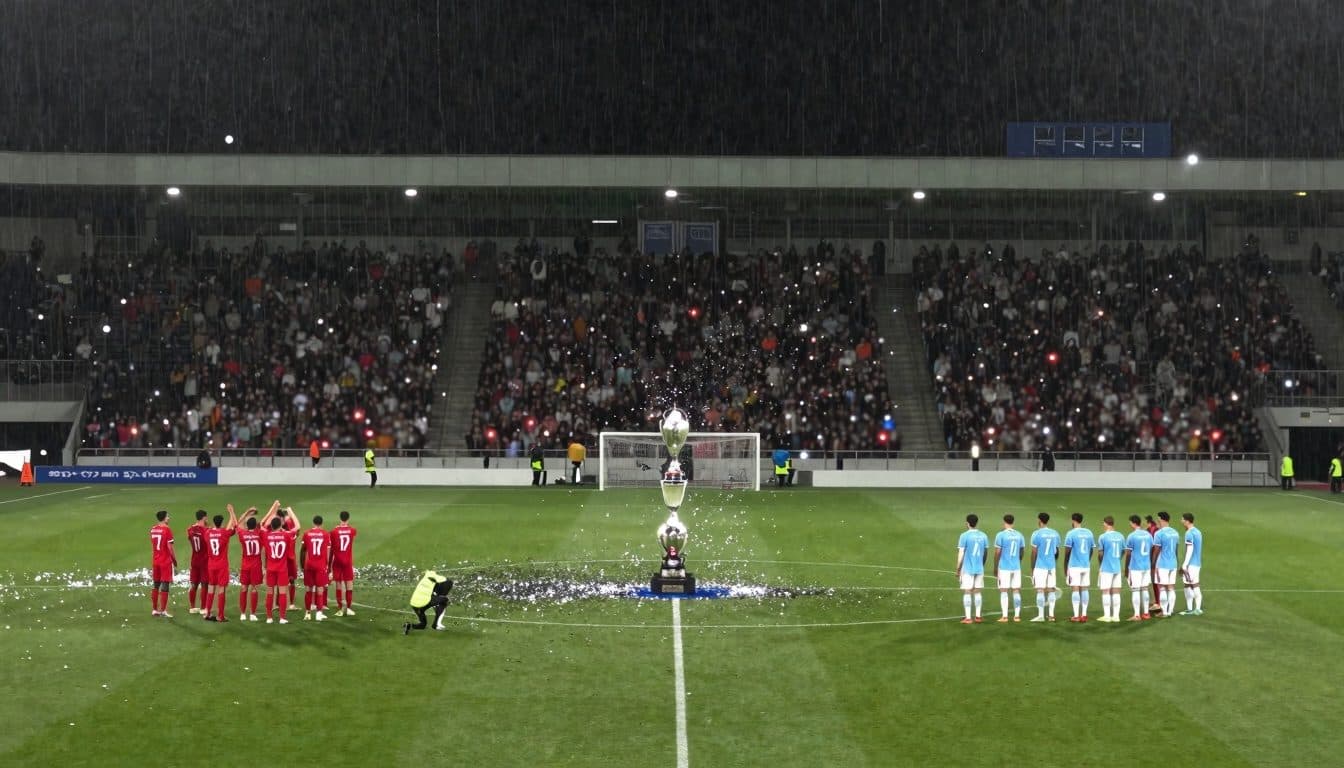
Spain wins 2026 World Cup final against Argentina, claims second world title
7/19/2026
AI-generated image (z-image via Kie.ai)
Summary
Spain won the 2026 World Cup final in East Rutherford 1-0 after extra time against Argentina, claiming its second world title after 2010. Ferran Torres scored the decisive goal in the 106th minute, while Lionel Messi was unable to defend Argentina's title.
Spain won the 2026 FIFA World Cup final in East Rutherford 1-0 after extra time against Argentina, securing its second World Cup title after 2010.
Extra time and the decisive strike
At the MetLife Stadium in East Rutherford, the 104th and final match of this first mega-World Cup came to an end on Sunday afternoon shortly after 3 p.m. local time. In front of more than 80,000 predominantly blue-and-white-clad spectators, Ferran Torres decided the game in the 106th minute. After a fine headed knockdown from Nico Williams, Torres hammered the ball into the net and sealed Spain's victory against the defending champion from Argentina.
Spain entered as reigning European champion and relied on the same starting eleven that had abruptly ended France's title dreams. Luis de la Fuente, who according to available information is 65 years old and thus the oldest coach ever to win a World Cup, turned to trusted players – and his team, which had conceded only one goal throughout the entire tournament (in the 2-1 quarter-final win over Belgium), delivered another outstanding defensive performance in the final.
2026 World Cup final: Spain defeats Argentina 1-0 | allfacts360
Argentina's toothless attack and Yates' role
Argentina, by contrast, remained unusually flat for long stretches of the encounter. In the first half, the South Americans did not manage a single shot on goal – a negative record at this World Cup that previously had only been matched by New Zealand, Paraguay, Ghana and Haiti. Even as the game progressed, it took until the 115th minute before Argentina managed a shot on the opponent's goal at all. Spain's first chance had already come in the 4th minute, when Lamine Yamal's low drive was parried by goalkeeper Emiliano Martínez.
The feeling-out phase had now lasted well over half an hour. Neither team wanted to make the first mistake and fall behind. The Argentinians continued their hard-nosed approach in the World Cup final: Mac Allister charged in and took out Dani Olmo with a sliding tackle. Argentina head coach Lionel Scaloni had made three changes compared to the semi-final against England, but the offensive punch was largely missing.
Shortly before the break, Lisandro Martínez picked up an injury and had to be substituted off in the 44th minute; Nicolás Otamendi came on in his place. In first-half stoppage time, Mikel Oyarzabal struck from around 18 meters, but Emiliano Martínez safely dealt with the effort. After the roughly 25-minute halftime break featuring performances by Shakira, Madonna, BTS, Justin Bieber, the Muppets and other artists – the first-ever halftime show at a World Cup final – the Spaniards emerged the better side from the extended break.
Alex Baena had the first opportunity of the second half in the 46th minute. In the 64th and 67th minutes, Dani Olmo and Ferran Torres had further good chances. In the 90th+3 minute, the game tipped decisively in Spain's favor: Enzo Fernández received a second yellow card after a foul on Pau Cubarsí in midfield. Earlier, the Argentine had already been booked for protesting by the Slovenian refereeing team led by Slavko Vinčić.
Red card and VAR drama
In the 96th minute, the ball did end up in the net, but Spain's celebration was short-lived, as the goal was disallowed for a foul in the build-up. No VAR review took place in that incident. It was not until extra time, in the 106th minute, that the decisive goal fell: Pedro Porro crossed from the right side of the penalty area, Nico Williams headed the ball down, and Ferran Torres scored. A potential second goal by Torres was ruled out in the 113th minute for offside.
Ferran Torres, whose name had kept cropping up as a scorer throughout the tournament, capped a strong season with his final goal. Lamine Yamal, who repeatedly threatened the Argentine goal during the match, was denied several times by Emiliano Martínez, who for long stretches remained Argentina's only bright spot. In the end, Spain had its second World Cup title after 2010 in South Africa – back then, Andrés Iniesta had scored the decisive 1-0 in extra time against the Netherlands in the final.
Messi, Mbappé and the history books
After the end of regular time, the score had stood at 0-0. Argentina had come in as defending champion and had hoped to build on the successes of 2022. Only Italy (1934, 1938) and Brazil (1958, 1962) had previously successfully defended a World Cup title. This feat was not achieved by the team around captain Lionel Messi: the 39-year-old, who had lifted the trophy in Qatar in 2022 and was the tournament's second-top scorer with eight goals, remained largely ineffective in the final.
Messi played in his sixth World Cup and was thus the first player in World Cup history to start three finals. In the goalscoring charts, however, he was overtaken by Kylian Mbappé, who after the third-place play-off against England (4-6 for France) moved past Messi with 22 World Cup goals to Messi's 21 and claimed the Golden Boot. Mbappé finished with ten tournament goals.
When Spain received the trophy, the US President pushed his way into the picture: Donald Trump presented the World Cup trophy. Alongside FIFA President Gianni Infantino and in front of 80,663 spectators, numerous celebrities such as Tom Cruise, Rihanna, David Beckham and Jay-Z also watched the action in the stands. SRF commentator Sascha Ruefer reported that the FIFA document listing the celebrities at the stadium ran to 12 pages.
Celebrities, halftime show and trophy presentation
Alongside the action on the pitch, the final also produced curious scenes off it. At ORF, the commentary of the neighboring broadcaster was repeatedly audible through its own transmission, although it could not be clearly determined whether it was a Spanish or Argentine commentator. Because the working areas of the various TV teams overlapped on site due to the tight spatial conditions, the foreign commentary came through clearly alongside Thomas König and Andreas Herzog especially during emotional match scenes.
Curious scenes behind the scenes
Even before kick-off, ORF presenter Rainer Pariasek and Andreas Herzog were standing on the touchline right next to the ZDF team with presenter Jochen Breyer as well as experts Per Mertesacker and Christoph Kramer. Because of the enormous media presence at the World Cup final, the commentators sat much closer together than at ordinary international matches. The cause of the overlap, however, was not a technical malfunction.
The triumph was rewarded accordingly financially: Spain received 50 million US dollars from FIFA as world champion, while Argentina received 33 million as runner-up. For Spain, it is the second star on the jersey after 2010. The news of the title win was broadcast on 20.07.2026 on Deutschlandfunk.
Questions & Answers
Who decided the 2026 World Cup final for Spain?
Ferran Torres scored the only goal of the final in the 106th minute, after Nico Williams had headed down a cross from Pedro Porro.
Why was Argentina unable to defend the 2022 title?
Argentina was largely toothless in attack for long stretches and did not manage a single shot on goal in the first half; down a man after Enzo Fernández's second yellow card in the 90th+3 minute, the team conceded the decisive goal in extra time.
What records did Messi and Mbappé set at this World Cup?
Lionel Messi was the first player in World Cup history to start three finals, and Kylian Mbappé overtook Messi with 22 World Cup goals in the all-time scoring list and won the Golden Boot.