Swiss voters make it harder to switch from military to civilian service
Bern, 14 June 2026
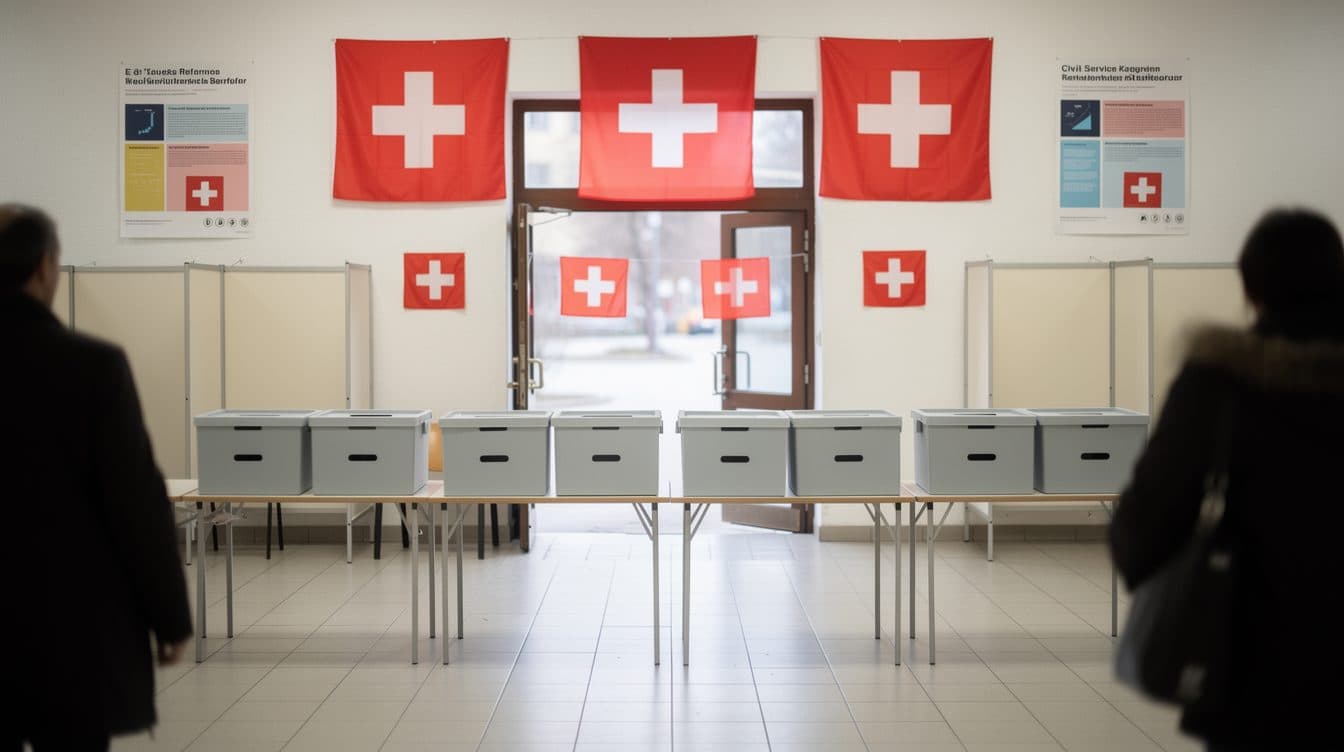
AI-generated image (flux-2/pro-text-to-image via Kie.ai)
Summary
On 14 June 2026, Swiss voters approved by 53 percent a reform of the Civilian Service Act that significantly tightens the switch from military to civilian service. In future, those switching will have to complete at least 150 days of service, assignments will become an annual obligation, and medical professionals will no longer be allowed to serve in roles related to their field.
Bern, 14 June 2026
Swiss voters on 14 June 2026 approved, by 53 percent yes votes, a revision of the Civilian Service Act that noticeably tightens the switch from military service to civilian service.
The SRG forecast at 1 p.m. showed 53 percent yes and 47 percent no votes, with a margin of error of ±2 percent. In the official count in the evening, 41,043 yes stood against 28,055 no on the federal ballot. The proposal from the Federal Council and Parliament thus prevailed over the referendum launched by an alliance of young parties, trade unions, and civilian service associations.
Starting point and voting result
In the National Council, the amendment to the law had previously been approved by 120 to 76 votes, backed by a bourgeois majority of SVP, FDP, and The Centre. The Council of States also approved it clearly, by 33 to 10 votes. The referendum committee then filed the request for a popular vote.
The reform introduces six new hurdles for army members who want to switch to civilian service. Those who switch in future must, among other things, complete at least 150 days of civilian service, regardless of the military service still outstanding. The factor of 1.5 for civilian service days per military service day now expressly also applies to non-commissioned officers and officers.
Until now, the rule was that those switching had to complete 1.5 times as many days of civilian service as the military service days they would still have had to serve. From now on, a uniform minimum of 150 days applies to all switchers after recruit school. If the switch request is approved during recruit school, the extended service must be completed by the end of the year following admission — significantly earlier than today.
Content of the reform
Anyone who has already completed recruit school and all training days will in future no longer be able to switch to civilian service and thereby avoid the obligation to shoot. The law thereby closes one of the loopholes most frequently used to date. The Confederation is responding to the ongoing trend of rising numbers of switchers.
Last year, 7,211 men opted for alternative service — a record figure. 40 percent of switchers decided during recruit school, and one-third even after completing basic training. These figures had fuelled the debate about the burden on the army.
Impact on civilian service
The reform makes civilian service an annual obligation. Assignments already completed can in future be called up on an annual basis, similar to repeat courses in the army. This is intended to ensure that the 60,000 Zivis can actually be called up in an emergency.
Until now, civilian service personnel could only be mobilised in a crisis in a piecemeal fashion and never as a unit. The responsible federal office had also acknowledged that there was a need for action regarding labour market neutrality for certain civilian service positions. The reform is therefore intended to make the service more reliable and manageable.
Another innovation concerns medical professionals. They may continue to switch to civilian service, but must perform the service outside their field — that is, no longer in medical facilities. This is intended to prevent doctors and nursing staff from circumventing their medical training.
For the Federal Council, the reform is one element of a broader security policy. Recently, the Federal Council had warned that Russia is already waging a covert conflict against the West today and that Switzerland, too, is vulnerable. In this context, the question of how many service days the army can reliably plan for gains in weight.
Security policy context
The Swiss army, unlike civilian service, has a constitutional mandate: it must defend the country and its population and support the civilian authorities in serious threats and emergencies. It is precisely this mandate that is weakened by the high number of switches, the Federal Council and Parliament argued during the vote campaign.
Parliament therefore plans to merge civilian service and civil protection into a single disaster relief service. This is intended to create a joint pool for disaster and emergency deployments out of the two previously separate instruments. The Zivis would thus become a fixed part of national crisis management.
In terms of content, the proposal was difficult for voters to categorise. Urs Bieri of GFS Bern said: «Wenn man nicht genau weiss, um was es geht, stimmt man eher Ja.» In fact, the Civilian Service Act was barely discussed compared with the "No to a Switzerland of 10 million" initiative, which was also on the ballot at the same time. Bieri sees this as a reason why the yes recommendation from the Federal Council and Parliament carried the day.
Lukas Golder, political scientist at GFS Bern, explained that the yes had been expected in conservative German-speaking Swiss municipalities, but the strong mobilisation in the cities tipped the balance. The bourgeois camp had mobilised, but at the same time the SP and the Greens had brought voters to the polls in urban areas.
Opponents of the proposal had argued during the campaign that the new rules would lead to around 40 percent fewer civilian service personnel. They saw this as a weakening of civic engagement, for example in hospitals, nursing homes, and rescue services, and criticised the reform as bureaucratic.
Arguments of supporters and opponents
Supporters countered that a study from 2024 had shown that even significantly higher hurdles did not deter many men from quitting armed service. The need for reform therefore remains high, the Federal Council and the bourgeois majority argued.
The Swiss Constitution does not recognise a free right to choose between military and civilian service; rather, military service is the rule and civilian service the exception. With the revision, this exception is defined more narrowly, without being abolished.
In the medium to long term, the vote on civilian service hurdles is only a prelude: the real heavy lifting comes with the vote on additional billions for re-equipping the army. Should the financing, as proposed by the Federal Council, take the form of a higher value-added tax, the people would also have to decide on that at the ballot box.
Outlook on army financing
At the same time as the civilian service proposal, the popular initiative "No to a Switzerland of 10 million" was put to the vote. That vote dominated the public debate, while the Civilian Service Act stood more on the margins of media attention. This also explains why turnout and attention for the civilian service proposal were lower.
On voting Sunday, it also became apparent that switching to civilian service remains a broadly accepted option. Even under the new rules, it is possible to switch service, albeit under more difficult conditions. The voters have thereby confirmed a compromise between the needs of the army and individual freedom of choice.
The civilian service reform is part of a broader security-policy reorientation of Switzerland, at the centre of which is the question of how the country can secure its defence capability in the face of growing threats. Further decisions, in particular on army financing, will follow in the coming months.
With the yes of 14 June 2026, Switzerland will adapt its defence structures to the changed security-policy realities. The outcome is a political signal: military readiness is to be strengthened, while civilian service is to be clearly defined as an exception — without being abolished altogether.
Questions & Answers
What did the Swiss population decide on civilian service on 14 June 2026?
Voters approved, by 53 percent yes, a revision of the Civilian Service Act that significantly tightens the switch from military to civilian service.
What new hurdles will apply in future to those switching from military to civilian service?
In future, switchers must complete at least 150 days of service, assignments become an annual obligation, medical professionals may only be deployed outside their field, and anyone who has fully completed their military training can no longer switch.
Why did the Federal Council and Parliament push the civilian service reform forward?
They wanted to curb the rising number of switches, strengthen the army as the constitutionally anchored defence institution, and integrate civilian service in future into a joint disaster relief service together with civil protection.
Civilian service vote 14 June 2026: 53 percent yes | allfacts360