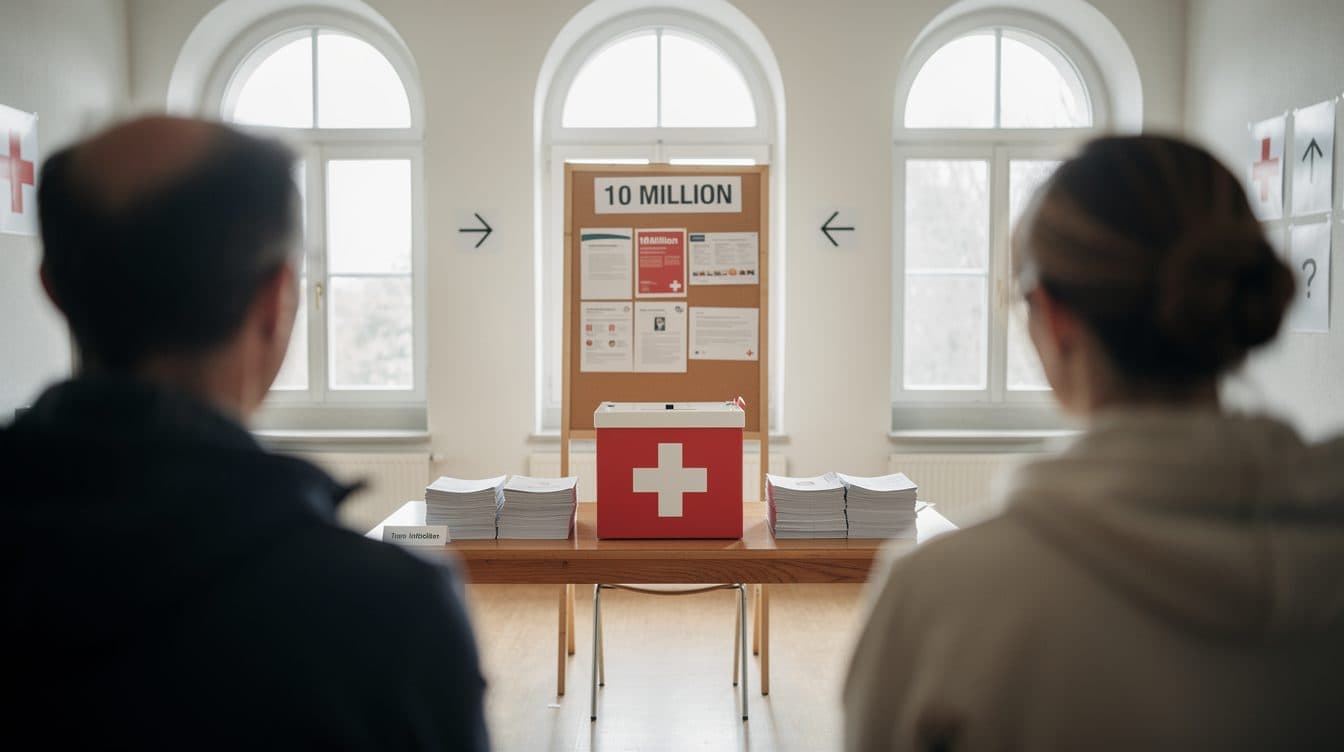
Switzerland rejects SVP initiative for a ten-million cap
Bern, 15 June 2026
AI-generated image (flux-2/pro-text-to-image via Kie.ai)
Summary
Swiss voters rejected the SVP's initiative for a population cap of ten million with around 55 percent. This leaves the agreement on the free movement of persons with the EU untouched, although 45 percent voted in favor of the proposal.
Bern, 15 June 2026
In a popular vote on Sunday, Swiss voters rejected the right-conservative SVP's initiative for a rigid population cap of ten million people with around 55 percent no votes.
Background of the initiative
With its so-called «Nachhaltigkeitsinitiative» (sustainability initiative), the SVP had demanded that Switzerland's permanent resident population remain below ten million before 2050. Following the defeat of the proposal in last Sunday's popular vote, initial projections pointed to a clear no. As Swiss public broadcaster SRF reported later in the afternoon, citing the polling institute Gfs.bern, around 55 percent of the strongly mobilized voters voted against the initiative, while around 45 percent voted in favor. The outcome was therefore somewhat clearer than many observers had expected.
The initiative provided for a graduated mechanism: upon reaching 9.5 million inhabitants before 2050, the Federal Council and Parliament would have had to take measures, particularly in the area of asylum and family reunification. If the ten-million threshold had been exceeded before 2050, Switzerland would have had to denounce these agreements and, after two years, the free movement of persons with the European Union as well. According to the initiators, Switzerland would thereby have become «the first country in the world» to write a fixed population cap into its constitution.
Arguments of the supporters
The SVP officially presented the proposal as a «Nachhaltigkeitsinitiative» and argued with the protection of resources, the preservation of undeveloped landscapes, the relief of overcrowded trains and buses, the reduction of road traffic, and the lowering of crime rates. Pollster Lukas Golder of the research institute Gfs.bern explained on SRF that the SVP had «this time declared its concern as a sustainability initiative», but that the core of the matter had been the limitation of migration. SVP president Marcel Dettling said after the projection: «Die Schweiz hat heute nichts zu feiern [...]. Ich sehe, dass das Land zustimmt und dass die Städte das Land bei der Meinungsbildung einfach ausradieren.»
The supporters pointed to so-called «Dichtestress» (density stress): the strong immigration has, according to widespread perception, led to a housing shortage in urban agglomerations, overcrowded trains on the main lines, and daily traffic jams on the motorways between Bern, Zurich, and Basel. Surveys showed that these burdens are real for a majority of the population. In the predominantly rural canton of Appenzell Innerrhoden, which has few foreign residents, the initiative was approved with almost 66 percent. Overall, according to observers' assessment, the proposal found support «allerdings weit über nationalistische Lager hinaus» (well beyond nationalist circles).
Business and politics against the proposal
The opponents of the initiative, by contrast, warned of a «Brexit moment» and severe economic damage. Justice Minister Beat Jans explained that the country's hospitals and nursing homes could no longer function without foreign staff. The share of employed persons with foreign nationality is 35 percent; according to official figures, the foreign workforce is concentrated in construction, industry, the hotel and restaurant trade, and in highly qualified professions such as doctors, managers, and scientists. Many of the foreign workers in Switzerland come from Germany – an estimated 330,000 Germans live in the country, and tens of thousands commute across the border daily. Cédric Wermuth, co-president of the Social Democrats, said: «Im Abstimmungskampf habe ich gespürt, dass viele Menschen die Nase voll haben von dieser andauernden Spalterei, wonach die Migrantinnen und Migranten an allem schuld sind. Diese Sündenpolitik sei – zum Glück – an ihre Grenzen gestoßen.»
Business also spoke out clearly against the proposal. Monika Rühl, head of the business association Economiesuisse, welcomed the result and stressed: «Wir brauchen weiter Zugang zu Fachkräften.» Rühl also pointed to the threat of an aging population if immigration were restricted. Yvonne Bürgin, a National Council member of the Centre Party from the canton of Zurich, explained that Switzerland's success had led to growing pains: «Am Schluss haben die Argumente überzeugt, dass ein starrer Deckel keine Lösung ist. Das will das Volk nicht.» The Centre politician called for making greater use of domestic potential, «damit es weniger Zuwanderung braucht».
Broad alliance of opponents
Politically, the SVP stood largely isolated with its initiative. Almost all parties, the Federal Council, and business representatives had fought the proposal in advance. In the National Council, 123 members spoke out against it, 67 in favor; in the Council of States, the initiative was rejected by 30 to 9 votes. The two SVP Federal Councilors also had to take a position, as part of the government, against the concerns of their own party. The Social Democrats spoke of a «historic victory for a social and open Switzerland». Lukas Golder spoke on SRF of an «Allianz von moderater Mitte und von linker Seite gegen die SVP», which in uncertain times had viewed bilateral relations with the EU and security-relevant aspects such as the Schengen cooperation critically.
In terms of content, the voting campaign was, in the view of many observers, rather one-sided. The initiators had hoped for a momentum in opinion formation as in 2014, when the mass immigration initiative was adopted despite mediocre polls. But in 2026 the starting point was different: the opponents of the initiative were far more present, the uncertain geopolitical environment argued more for stable relations with the EU, and the cap of ten million people would have been more rigid than the 2014 solution. SVP National Council member Thomas Matter, who is regarded as the «father» of the initiative, criticized after the defeat: «Die Gegner hatten keine Fakten-Argumente, es war eine reine Angstmacherei-Kampagne.»
Historical line of «Überfremdung» initiatives
Historically, the failed proposal fits into a long line of similar initiatives. The «Überfremdungsinitiative» (over-foreignization initiative) by James Schwarzenbach from 1970 failed with 54 percent no votes, the fourth initiative of the Swiss Republican Movement in 1977 with 70 percent. The SVP's initiatives against illegal immigration in 1996, against abuse of the right of asylum in 2002, for democratic naturalizations in 2008, and the Ecopop initiative in 2014 were also rejected by the voters. The party did record successes with the minaret ban in 2009, the burqa ban in 2021, the expulsion initiative in 2010, and narrowly with the mass immigration initiative in 2014.
That the majority of cantons was not achieved was confirmed once the Geneva results became known: 11.5 of 23 cantons said no to the initiative. In the nationwide trend, the proposal was clearly rejected in the cities, while in rural areas it was in some cases approved decisively. The Freiburg contemporary historian Damir Skenderovic critically classified the proposal: «Allerdings transportiert die SVP in einer neuen ökologischen Verpackung ihre alte nationalistische und fremdenfeindliche Politik.» Right-wing populists in Europe have been watching the SVP for years and applauding its successes, while in Germany the AfD, in France the Rassemblement National, and in Austria the FPÖ have addressed similar themes.
Politically, the debate is not over with Sunday's no. The Bern political scientist Urs Bibili explained on SRF that the topic of migration was «nicht vom Tisch» (not off the table). Lukas Golder warned that one should not read too much out of today's result for further stages in the relationship with Europe. Yvonne Bürgin formulated it similarly: the no should not be a final line under the debate, but rather a mandate for politics to take the growing pains seriously. Predictably, the discussions on the neutrality initiative and the vote on the new bilateral treaties with the EU will continue to shape the migration-political debate in Switzerland.
Outlook: Further votes to come
The economic consequences of the no are likely to remain manageable. Relations with the European Union, Switzerland's most important trading partner, remain intact. The agreement on the free movement of persons of 2002, which formed the basis for the strong population growth to today's approximately 9.1 million inhabitants, remains in force. Since its introduction, according to the SVP, a net 1.5 million people have moved to Switzerland, excluding asylum. At the same time, according to projections, the foreign population share will rise from 20 to 28 percent in 25 years if immigration continues.
Overall, it was not the bourgeois camp that decided the vote, but the centre-left, as SRF parliamentary correspondent Urs Leuthard analyzed. The no to the «Bevölkerungsexperiment mit unsicherem Ausgang» (population experiment with uncertain outcome), as it was called in a first assessment, testified to a pragmatism on the part of the Swiss voters. The SVP announced that it would continue to pursue the topic – and found prominent support for that: In the future, Dettling said, there will also be «Profiteure der Massenzuwanderung» who «mithelfen wollen, dass die Zuwanderung künftig nicht gebremst werde».
The second vote on this weekend is now awaited with excitement: the reform of civilian service, against which
Switzerland: No to the SVP's 10-million initiative | allfacts360