The EU resumes accession negotiations with Ukraine and Moldova after the end of the Hungarian blockade
Brussels, June 15, 2026
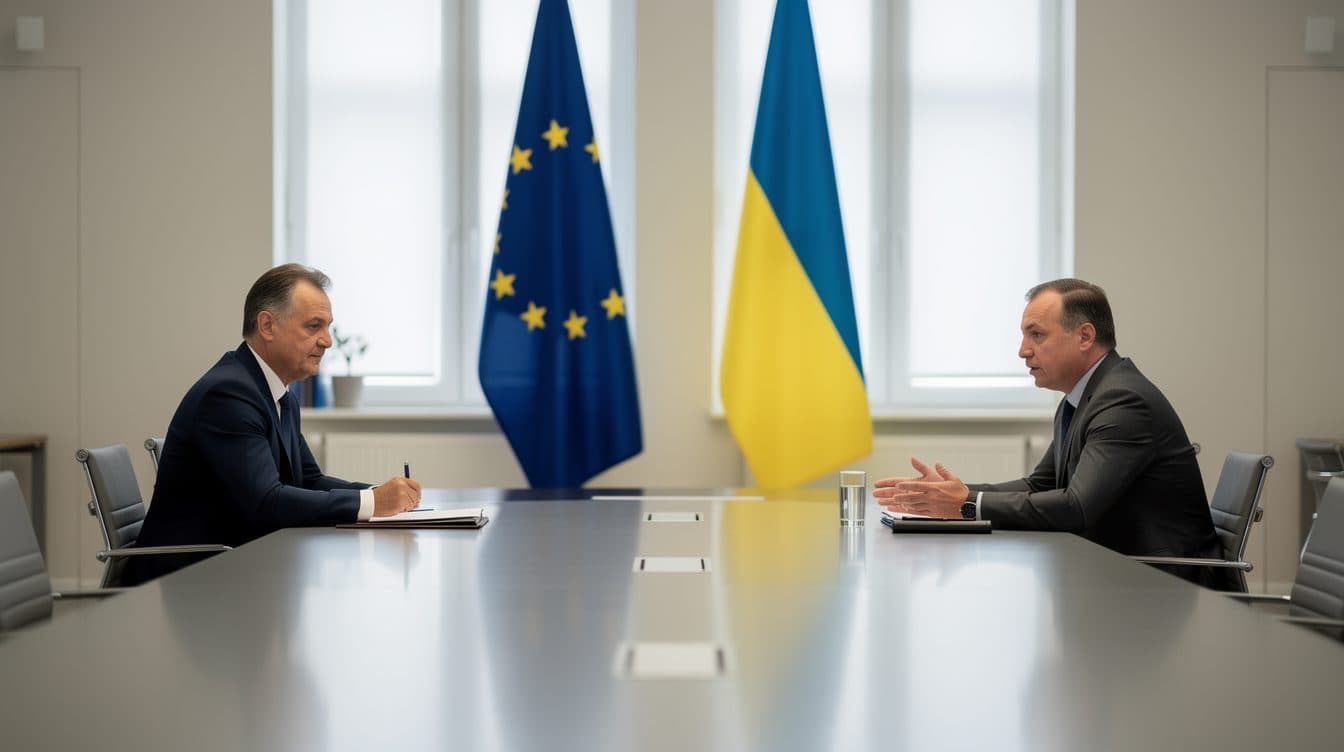
AI-generated image (flux-2/pro-text-to-image via Kie.ai)
Summary
The European Union resumed accession negotiations with Ukraine and Moldova this Monday, following the lifting of the Hungarian veto led by the new Prime Minister Peter Magyar. Ukrainian President Volodymyr Zelensky welcomed the progress and described the opening of the first chapter as significant political and moral support.
Brussels, June 15, 2026
The European Union resumed accession negotiations with Ukraine and Moldova this Monday, ending a years-long blockade led by Hungary, whose new Prime Minister Peter Magyar withdrew the veto in exchange for a bilateral agreement on the rights of the Hungarian minority in neighboring Ukraine.
What's new since June 13
The resumption of talks was confirmed by European Commission President Ursula von der Leyen and European Council President António Costa, who stressed that the enlargement of the bloc responds to a common interest in a world marked by growing uncertainty. According to a Deutschlandfunk report aired on June 13, 2026, the ambassadors of the Twenty-Seven cleared the way for negotiations to formally begin this week.
The unblocking was made possible by a change of government in Budapest. Hungarian Prime Minister Peter Magyar reached an agreement with Kyiv last week to strengthen the rights of the Hungarian ethnic minority in Ukraine, a condition he had imposed to lift the veto. His predecessor, Viktor Orbán, had kept the process paralyzed for years, which Austrian Foreign Minister Beate Meinl-Reisinger described as a mere blocking tactic.
Von der Leyen and Costa stressed that Ukraine and Moldova had shown determination, courage and constant work in implementing reforms despite enormous difficulties. In the words of the European leaders, quoted in the Deutschlandfunk report, both countries have met the political and technical requirements to advance in the integration process.
An unblocking after years of Hungarian paralysis
Ukrainian President Volodymyr Zelensky thanked the EU via Telegram and congratulated neighboring Moldova on the opening of the first negotiation chapter, which he described as "bedeutende politische und moralische Unterstützung" (significant political and moral support) for his country. For her part, Moldovan President Maia Sandu stated, according to press reports, that her country has done the necessary work and will continue implementing reforms.
The accession negotiations with Kyiv had been formally opened in June 2024, more than two years after the start of the Russian war, but the opening of the first thematic block was blocked by the Hungarian veto. Now, the first stage of the resumed talks will focus on the fundamental values and principles that both countries must respect to join the Community club.
The accession process requires the negotiation of six "clusters" or thematic groups covering dozens of chapters on issues ranging from agriculture and energy security to the rule of law and the fight against corruption. Even after their conclusion, the entry of both countries must be approved unanimously by the 27 member states and individually ratified by each of them.
The calendar: six thematic groups and unanimous approval
In general, EU accession negotiations drag on for years and do not always end successfully. The case of Turkey, whose talks opened in 2005 and remain completely frozen due to backsliding on democracy, the rule of law and fundamental rights, illustrates the difficulties of the process.
Minister Meinl-Reisinger, of the liberal NEOS party, explicitly celebrated the start of talks and assessed the "wesentlich konstruktiver" (substantially more constructive) course of the new Hungarian executive. In a media appearance, she stated that "Wir müssen den Beitrittsprozess insgesamt beschleunigen" (we must accelerate the accession process as a whole) and argued that "Die Annäherung ist in unserem Interesse" (rapprochement is in our interest).
The head of Austrian diplomacy insisted that accession negotiations "kein Gnadenakt der EU gegenüber einem Land" (are not an act of grace by the EU toward a country), but provide the necessary pressure to carry out reforms in candidate countries. She also stressed that "Es darf nicht immer blockiert werden" (it must not always be blocked) and warned of the risk of a "Selbstlähmung" (self-paralysis) when processes drag on for ten to twenty years.
Vienna bets on acceleration and qualified majorities
Meinl-Reisinger recalled that Ukraine presents "anhaltende Defizite bei der Rechtsstaatlichkeit" (persistent deficits in the rule of law), an area that will need to be addressed in the coming phases. In her assessment, the pressure of the process "wirkt" (works) and constitutes the main driver of institutional transformation in candidate countries.
In parallel with the opening of negotiations, EU foreign ministers are debating this Monday a twenty-first package of sanctions against Russia, which according to the Deutschlandfunk report targets the energy, trade, financial services and cryptocurrency sectors. The Austrian minister came out in favor of tightening measures in light of recent Russian attacks on Ukrainian territory.
On Russia, Meinl-Reisinger stated that the country's economic situation is "katastrophal" (catastrophic) and that there is a "reine Kriegswirtschaft" (a purely war economy), with declining oil and gas revenues. These elements, in her view, justify a firm and sustained European response over time.
The head of Austrian diplomacy also described the withdrawal of Christian Schmidt as High Representative of the international community in Bosnia and Herzegovina as "keine gute Nachricht" (not good news), whose future will be analyzed at the Foreign Affairs Council at Austria's initiative. While acknowledging European support for Sarajevo, she warned of the current "innenpolitische Blockade" (internal political blockade) the country is going through.
Sanctions on Russia and the situation in Bosnia and Herzegovina
Austria advocates greater recourse to qualified majority decisions in the accession process to avoid repeated blockages. Meinl-Reisinger recalled that currently the process requires "unendlich viele einstimmige Beschlüsse" (an infinite number of unanimous decisions) and that, under Orbán's mandate, "inhaltlich hatte die vorherige ungarische Regierung aber jeglichen Fortschritt blockiert" (in terms of content, the previous Hungarian government blocked any progress).
Regarding the case of Orbán, the minister was blunt: "Bei Magyars Vorgänger Viktor Orbán sei es nicht um die Sache, wie um Lösungen für die ungarische Minderheit gegangen, sondern nur um eine Blockade" (with Magyar's predecessor Viktor Orbán, it was not about the substance of the matter, namely solutions for the Hungarian minority, but only about a blockade).
In December 2023, the EU heads of state and government had already decided to open accession talks with Ukraine and Moldova, but the process remained frozen until now. Kyiv submitted its membership application just days after the start of the Russian war of aggression in February 2022, in an unprecedented geopolitical turn since the bloc's 2004 eastern enlargement.
The effective resumption of negotiations therefore marks a turning point after years of impasse. Although the path to membership remains long and uncertain, the lifting of the Hungarian veto paves the way for the opening of the first thematic group and allows Ukraine and Moldova to formally begin the examination of the fundamental values and principles that define belonging to the European project.
The EU insists that the process is not a favor, but an instrument of transformation. As Meinl-Reisinger summarized, "Der Druck wirkt" (pressure works), an idea that encapsulates the Community philosophy according to which the very dynamics of accession forces candidate countries to strengthen their institutions, their economy and their respect for fundamental rights.
Questions & Answers
Why is the EU now resuming accession negotiations with Ukraine and Moldova?
The resumption was made possible because the new Hungarian Prime Minister, Peter Magyar, withdrew the veto that his predecessor Viktor Orbán had maintained for years, after reaching a bilateral agreement with Kyiv to strengthen the rights of the Hungarian ethnic minority in Ukraine.
What stages must Ukraine go through to become an EU member?
Ukraine must negotiate six "clusters" or thematic groups covering dozens of chapters on the rule of law, agriculture, energy and corruption, among others, and at the end of the process accession must be approved unanimously by the 27 member states and ratified by each country.
What position do Austria and the EU hold on sanctions against Russia in parallel with the negotiations?
Austrian Foreign Minister Beate Meinl-Reisinger supports tightening sanctions, and on Monday EU foreign ministers are debating a twenty-first package affecting the energy, trade, financial services and cryptocurrency sectors.
EU resumes accession of Ukraine and Moldova after blockade | allfacts360