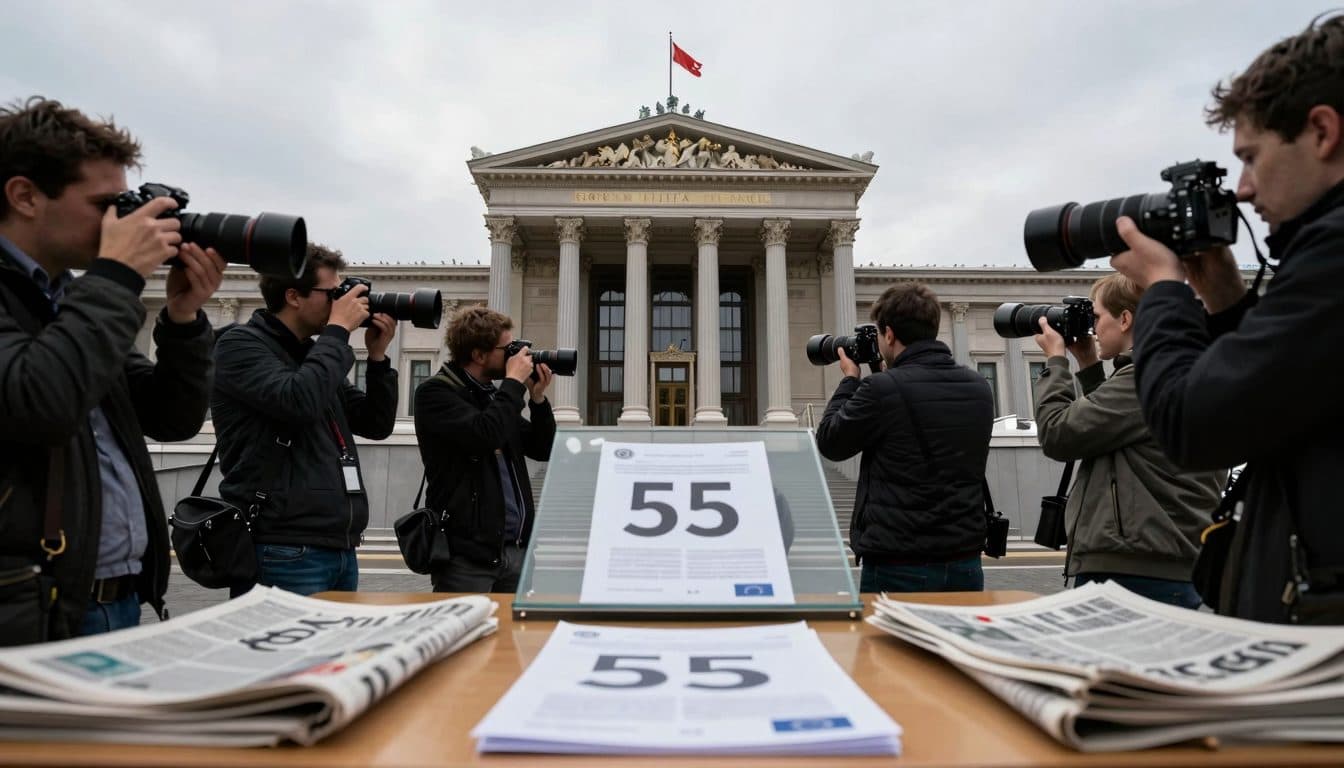
Three governing parties agree on new media funding package worth 55 million euros
Vienna, July 20, 2026
AI-generated image (z-image via Kie.ai)
Summary
The turquoise-red-pink federal government agreed on Sunday on a package of new media subsidies. In total, around 110 million euros per year are to be distributed in the future, 55 million of which in fresh money.
Vienna, July 20, 2026
The three Austrian governing parties SPÖ, ÖVP, and Neos agreed on Sunday on a package of new media subsidies, which according to the Media Ministry is endowed with 55 million euros in fresh money.
Vice Chancellor Andreas Babler (SPÖ) spoke at the presentation of the package on Monday of a "sehr neuen Zeitalter der Medienförderung" ("a very new era of media funding"). The ministry had reached the agreement the weekend before, as reported by "Standard". With the resolution passed by circulation, a weeks-long dispute within the coalition was settled, in which the SPÖ had accused the coalition partner ÖVP of a "Blockade-Haltung" ("blockade stance").
Delivery funding as the core element
Media Funding 2026: Agreement on 55 million euros | allfacts360
The core of the package is a new delivery subsidy for daily and weekly newspapers that are delivered to subscribers' house or apartment doors. From 2027, 25 million euros per year are earmarked for this, with the subsidy allowed to cover up to 50 percent of proven delivery costs. Per delivered subscription copy, there are 16 cents up to an annual circulation of nine million copies, above that and up to 26 million annual circulation seven cents per copy, and above that 1.6 cents. The highest-circulation newspaper, the Kronen Zeitung, is likely to receive around 4.8 million euros according to initial rough calculations.
The delivery subsidy is to be awarded by the media authority KommAustria, as has previously been the case for press funding, quality journalism funding, and publicist funding. The exclusion criteria for the new funding are oriented towards those of the quality journalism funding: excluded are accordingly media that call for violent struggle against democracy or the rule of law, repeatedly call for disregard of the legal order, advocate violence as a means of politics, or have been convicted of incitement to terrorism or Wiederbetätigung (renewed Nazi activity).
In return, the delivery subsidy for subscribed copies will be reduced by 2.5 to 22.5 million euros per year from 2027 compared to previous plans. The freed-up 2.5 million euros will be shifted into the digital transformation funding, which can also go to free media. The digital transformation fund, which was initially endowed with only 20 million euros for 2026, will thus be extended by two years and will receive 20 million euros for both 2026 and 2027.
Funding for young target groups
A new funding for media literacy as well as media offerings for young people, which Babler considers particularly important, is to be endowed with a total of ten million euros. The new funding areas are to "Medienhäusern einen Auf- und Ausbau von Medienkompetenzmaßnahmen ermöglichen und Einrichtungen für Medienkompetenz bei der Erfüllung ihrer Aufgaben unterstützen" ("enable media houses to develop and expand media literacy measures and support media literacy institutions in fulfilling their tasks"), according to the Media Ministry.
Specifically, from 2027, seven million euros will be newly awarded for "qualitätsvolle journalistische Formate, die junge Menschen erreichen" ("high-quality journalistic formats that reach young people"). The funding is "allen Medienunternehmen, von Medien-Startups bis hin zu etablierten Medienhäusern offen" ("open to all media companies, from media startups to established media houses") and will be awarded "im Wettbewerbsverfahren an Medienunternehmen" ("to media companies in a competitive process"), explained the ministry. The quality journalism funding for media literacy offerings will be increased from the current 700,000 euros to three million euros.
For 2027 and 2028, the digital fund will be endowed with 22.5 million euros each, with the Media Ministry announcing a revision of the funding guidelines. The broadcasting and telecom regulation RTR is responsible for this, which also awards the funding. The direction of the "Überarbeitung" ("revision") is defined by the ministry as "Fokus auf die Qualität der Einreichung" ("focus on the quality of the submission"), with "vorrangig" ("primarily") "konkrete Digitalisierungsprojekte unterstützt werden" ("concrete digitalization projects should be supported"). For small and non-commercial media companies, the required minimum project sum is to be "gesenkt" ("lowered").
Conflicts in the coalition
Politically, the agreement was not a foregone conclusion: According to the SPÖ, the ÖVP had wanted to "ein großes Stück vom Förderkuchen" ("reserve a large slice of the funding cake") "reservieren" ("for themselves") for free media and had initially "quer gelegt" ("put up resistance") regarding the planned delivery subsidy. The Media Ministry now emphasizes that – contrary to ÖVP demands – there are no fixed funding budgets for free newspapers. The draft law on the funding package could therefore not be introduced as planned.
In total, 110 million euros – significantly more than before – are to be distributed annually. Babler had presented a major "Reformpaket" ("reform package") in April to support media houses that had fallen into financial difficulties. Creating new framework conditions for media subsidies is based on "politischer Überzeugung" ("political conviction"), but is also a "europäischer Auftrag" ("European mandate") with the European Media Freedom Act, Babler said. The "unkontrollierte Hinausschießen von (öffentlichen) Inseraten" ("uncontrolled explosion of public advertising") he had "schon beenden können" ("already been able to end").
Outlook on the 2028 reform
For 2028, the federal government is announcing a fundamental reform of media subsidies that is to standardize existing funding and, according to the announcements, is to particularly support journalism with a quality focus. In addition to a basic funding tied to quality criteria for all journalistic media, targeted innovation programs are planned. Babler wants to entrust the examination of funding eligibility and the awarding of funds to an independent commission.
The government program also announced 30 million euros for a "Meine-Zeitung-Abo" ("My-Newspaper-Subscription") for young people. This is intended to facilitate young readers' access to printed newspapers. The exact modalities of this subscription were not initially part of the detailed package presented on Monday.
Questions & Answers
What have SPÖ, ÖVP and Neos agreed on?
The three governing parties have agreed on a package of new media subsidies endowed with 55 million euros in fresh money. In total, around 110 million euros per year are to be distributed in the future.
Who is Andreas Babler and what role does he play?
Andreas Babler is SPÖ chairman and Vice Chancellor. In addition to culture, sport, and housing, he is also responsible for media and presented the reform package to support media houses that had fallen into financial difficulties.
What funding is specifically planned for young people?
From 2027, seven million euros will be newly awarded for high-quality journalistic formats that reach young people. In addition, media literacy funding is to be increased from 700,000 to three million euros, and the government program provides for 30 million euros for a "Meine-Zeitung-Abo" ("My-Newspaper-Subscription") for young people.