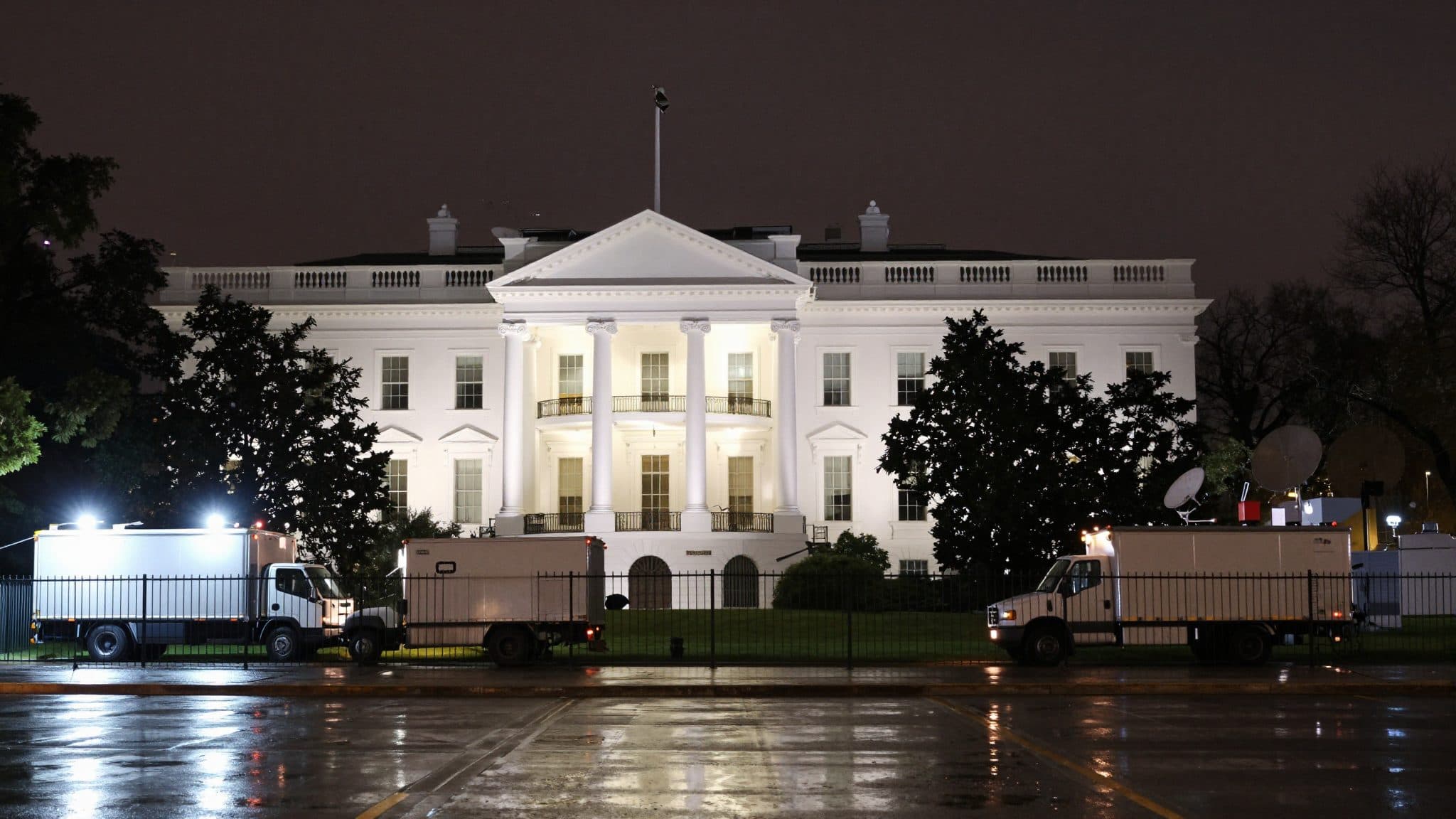
Trump Accuses China of Election Manipulation and Announces Measures for Congressional Election
Washington, July 17, 2026
AI-generated image (z-image via Kie.ai)
Summary
In a televised address from the White House, US President Donald Trump accused China of having manipulated the 2020 presidential election in favor of Joe Biden. At the same time, he announced measures by the Department of Homeland Security to make the congressional midterm election on November 3 "honest." Critics and fact-checkers rejected the allegations as unsubstantiated.
Washington, July 17, 2026
US President Donald Trump accused China on Thursday evening in a roughly 30-minute televised address from the East Room of the White House of having influenced the 2020 presidential election in favor of Joe Biden through the theft of 220 million voter records, and simultaneously announced measures to safeguard the congressional midterm election on November 3.
Allegations from the White House
The address was broadcast from the White House late Thursday evening (local time) and lasted approximately 27 to 30 minutes. Trump described the Chinese operation as the "presumably largest theft of election data in history" and spoke of "shocking vulnerabilities" in the US election system. Intelligence information showed that US voting machines and vote-counting systems were "vulnerable to hacking, manipulation and corruption."
Specifically, Trump accused Beijing of having stolen voter data from around 220 million US citizens starting in 2020 – including names, telephone numbers and party affiliation. This data was subsequently used to exert influence on the 2020 presidential election in Biden's favor. Trump did not name the Chinese president in the address. He also claimed that the Department of Homeland Security had identified more than 270,000 individuals registered in federal elections as non-US citizens.
Beijing Rejects the Allegations
The People's Republic of China promptly rejected the allegations. Foreign Ministry spokesperson Lin Jian stated in Beijing that the People's Republic adheres to the principle of non-interference in internal affairs, has no interest in US presidential elections, and has never interfered in them: "On the contrary, the international community is aware of who constantly interferes in the internal affairs of other countries, has monitored governments for a long time, and steals data on a large scale."
US expert Christiane Lemke said on ZDF that the allegations were unsubstantiated: "I was initially surprised that he took up this election manipulation thesis again, which is not substantiated. But the claim that China influenced and systematically manipulated the election is false." China does collect data about the US on a large scale, particularly in the area of industrial espionage, but it also serves as an "enemy image" because the US and China are in conflict over tariffs and the Taiwan issue.
What Fact-Checkers and Authorities Say
The Bipartisan Policy Center and the Brennan Center for Justice pointed out that there is no evidence that voting by non-citizens has ever reached a scale that could influence election results in the United States. Election researchers also emphasize that ineligible voting occurs only extremely rarely. An assessment published in 2021 by US intelligence agencies concluded with high confidence that China considered interference in the 2020 election but did not carry it out. "No information indicates that China attempted to interfere in the election process," it said at the time.
In addition, according to experts, voter files in the United States are largely publicly accessible. Several states legally sell voter registration data to political campaigns, consultants and market researchers. According to the three documents released by the White House alongside the address, the CIA assumes that China could at most use the data to conduct more targeted propaganda – but this too is unproven.
The address was defended primarily by Republicans as a wake-up call. Chuck Schumer, on the other hand, sharply criticized: "Tonight Trump made a pathetic attempt to deny what has long been clear to all of us – that he lost the 2020 election." Schumer also said: "To be perfectly clear: in America, voters choose their politicians, not the other way around."
Political Reactions in Washington
Trump repeated in the address his years-long claim that he lost the 2020 election through massive fraud, and accused the "Deep State" and the media of deliberately covering up the alleged fraud. The Brennan Center as well as civil rights organizations point out that comprehensive investigations by authorities have uncovered at most "a few hundred" cases of election fraud.
In substance, Trump linked the allegations to concrete political demands. He announced that the Department of Homeland Security would present measures the following Friday to make the congressional midterm election on November 3 "honest." The agency was to be briefed by Markwayne Mullin on cyber vulnerabilities in election systems. Trump also called on the states to "immediately remove all ineligible persons from the voter rolls."
The SAVE America Act as a Central Concern
At the same time, the president again pushed Congress to pass the so-called "SAVE America Act." The legislation provides that states must require documented proof of citizenship when registering for federal elections. In addition, online registration and mail-in voting are to be made more difficult, and additional documents required on election day. Civil rights organizations fear that this would disenfranchise millions of people – predominantly Democratic voters. The initiative is stalled in the Senate because Republicans lack the necessary majority there.
Voting rights experts such as Johannes Thimm of the German Institute for International and Security Affairs rejected the allegations: mail-in voting is "not a factor of uncertainty for the integrity of elections," and voting machines are not "a gateway for attempted fraud." ZDF correspondent Elmar Theveßen said the allegations in Trump's address were all "false." Theveßen also pointed to the possibility that Trump could declare a national emergency if states refused: "You didn't do it, so I'm declaring an emergency now."
Emergency Scenario and Legal Disputes
A US federal judge had already ruled in September that election influence via Smartmatic devices in Los Angeles County was "mathematically impossible." Smartmatic, manufacturer of a large share of voting machines in Venezuela, only supplies devices in the US to Los Angeles. Trump had linked the company in his address to alleged Venezuelan manipulation claims, even though the document released by the White House itself acknowledges that there is "no clear evidence of large-scale electronic election fraud."
Prior to the address, Trump had completed a state visit to Beijing in May and praised the Chinese president as a "friend." The TV networks NBC and ABC refused to broadcast the address live in their evening programming; Trump subsequently demanded the revocation of their broadcasting licenses and called the refusal "fraud." Tucker Carlson, once a prominent supporter, has since publicly distanced himself from Trump. The president mentioned the ongoing Iran war only once in the entire address, claiming "great successes" there.
Christiane Lemke assessed the address as strategic preparation for possible Republican losses in the vote: "I believe the address is strategic preparation for possible losses in the fall." Polls and expert assessments indicated that Republicans could lose votes and possibly the House of Representatives in November. In the Senate, the situation remains open. Trump has, with the address, "laid the groundwork to discredit the congressional elections in November."
Ty Cobb, former White House counsel at the beginning of Trump's first term, said according to Reuters that Trump is preparing the ground to "declare an emergency at the time of the elections or shortly before." Thimm also warned that Trump could attempt to "even deploy military and National Guard troops near polling places" in order "to intimidate voters and in particular to prevent people with a migration background from going to vote," or to "send ICE immigration officers near the ballot boxes." Against Trump's attempts at interference, "a bunch of court proceedings" are running.
Outlook on the Congressional Election in November
In the United States, the organization of elections is assigned by the US Constitution to the states; voters must generally register and prove their citizenship. In many states, this happens automatically, for instance when applying for a driver's license. US citizens vote in more than 10,000 different voting districts with different rules. A poll conducted by Reuters/Ipsos in April found that 63 percent of Republican voters believed the 2020 election had been manipulated – a long-cultivated component of the "Big Lie" narrative within the MAGA movement.
The Trump administration had cut roughly one-third of positions at the Cybersecurity and Infrastructure Security Agency (CISA) over the past year. In addition, Pam Bondi had disbanded the FBI commission for the investigation of foreign influence operations that had existed since 2017 on the first day of her tenure in February 2025. Observers see this as a weakening of the institutional defense against foreign election interference. The Department of Homeland Security is meanwhile planning to tighten residency rules for foreign students and journalists in order to curb alleged visa abuse.
The incidents surrounding the Epstein files and the ongoing war with Iran have, in the assessment of observers, unsettled the MAGA base of late; the president's poll numbers are "in the basement," and the Iran war is "extremely unpopular." Trump's Republicans currently hold only narrow majorities in both chambers of Congress. If they lose one chamber, they will no longer be able to pass major legislative initiatives. Trump has stated in the past that if Congress passes the SAVE America Act and a further regulation, "Republicans would never lose an election again."
Questions & Answers
What did Trump claim in his address on July 17, 2026?
In a roughly 30-minute televised address from the East Room of the White House, Trump accused China of having manipulated the 2020 presidential election in favor of Joe Biden through the theft of around 220 million voter records. He also claimed that the Department of Homeland Security had identified more than 270,000 ineligible persons in the voter rolls, and announced measures to safeguard the congressional midterm election on November 3.
How is China reacting to the allegations?
The Chinese Foreign Ministry rejected the accusations as "fabrications." Spokesperson Lin Jian stated in Beijing that China adheres to the principle of non-interference in internal affairs, has no interest in US elections, and has