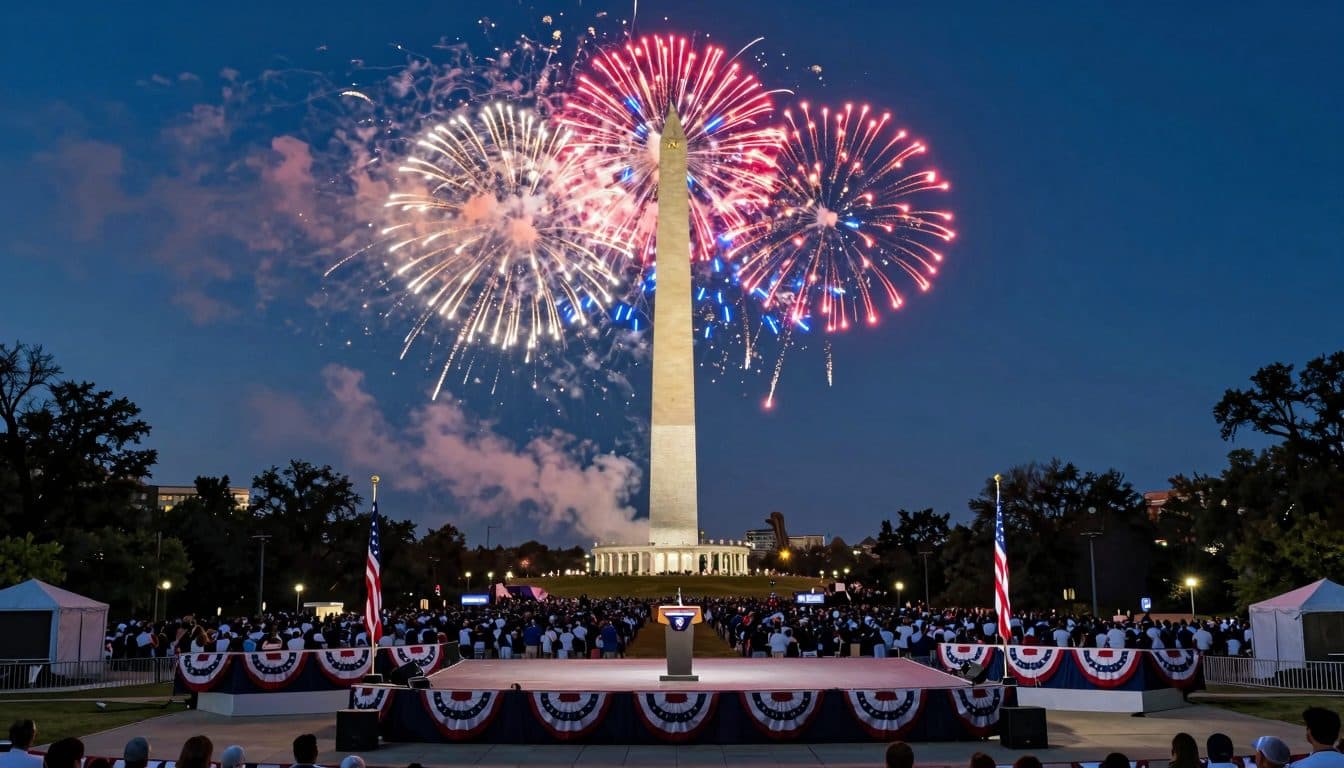
Trump celebrates the United States' 250th anniversary on the National Mall and warns of an alleged "communist threat"
Washington, July 5, 2026
AI-generated image (z-image via Kie.ai)
Summary
U.S. President Donald Trump delivered a speech of about forty minutes on Saturday evening in Washington to mark the 250th anniversary of the United States, against a backdrop of extreme heat and an evacuation linked to a thunderstorm. His address, strongly partisan in tone, was accompanied by the largest fireworks display ever fired, with 850,000 pyrotechnic effects in roughly forty minutes.
Washington, July 5, 2026
U.S. President Donald Trump delivered a speech of about forty minutes on the evening of Saturday, July 4, 2026, in Washington, before thousands of supporters gathered on the National Mall to celebrate the 250th anniversary of the independence of the United States — a speech interrupted by the evacuation of the public due to a violent thunderstorm.
In front of the Washington Monument, Donald Trump took the stage more than an hour late, after a thunderstorm and strong wind gusts forced authorities to temporarily evacuate the National Mall, the central artery of the federal capital. On his Truth Social network, the president had downplayed the incident, writing: "Gewitter bringen Glück" ("Storms bring luck"), adding that they make "events also a little more exciting."
A speech delayed by a violent thunderstorm
Once the storm had passed, the head of state delivered an address of about forty minutes, presented by him as "the most spectacular of all Trump rallies." Before a crowd chanting "USA, USA," he celebrated July 4, 1776, the day on which "emissaries of the thirteen American colonies officially adopted a declaration" by which they separated from Great Britain to found the United States of America. Trump spoke of July 4 as the "triumph of liberty over tyranny."
As he had already done the day before at the Mount Rushmore national monument, where he had warned of an alleged "communist threat" in the United States, the president made extensive use of this theme during his speech in Washington. He declared: "Amerika wird niemals ein kommunistisches Land sein. Das wird nicht passieren" ("America will never be a communist country. That will not happen"), before adding: "Wir wollen keine Kommunisten in unserem Land" ("We do not want communists in our country").
The recurring theme of the "communist threat"
Trump once again described "communists" as a "Krebsgeschwür" ("cancer") and criticized what he calls "leftism" in the country. In the preceding weeks, he had repeatedly labeled the left wing of the Democratic Party as "communist" — a party that, according to polls, could retake the majorities in both chambers of Congress in the November midterm elections.
According to verified facts, the Democratic opposition accuses the president of exploiting the 250th anniversary festivities for partisan purposes, and thus of contributing to further dividing the country. Democrats denounce the politicization of the national holiday ahead of the November elections, seeing in the arrangement a genuine electoral campaign funded by public funds.
Criticism from the Democratic opposition
U.S. Vice President J. D. Vance also spoke the day before, on Saturday, July 5, in New York, aboard the warship "USS Kearsarge." He said: "You will hear today a few small but loud voices, obsessed not with our national greatness, but with our national imperfections." He added that they "would miss the essence of America" and urged citizens to "reject the two-dimensional vision of their fellow citizens and the two-dimensional vision of their country." He spoke of a "new attack" on the country's identity.
Vice President Vance defends national unity
As at his campaign rallies, Trump launched a series of attacks against his political opponents and used the stage to promote his legislative project called the "Save America Act." He also presented himself as "the world's number one attraction" after several shows were cancelled due to extreme heat.
The speech was preceded by singer Lee Greenwood's performance of his song "God Bless the USA," while U.S. Air Force fighter jets flew over the National Mall as part of the aerial show. Meanwhile, on stage near the Washington Monument, musicians from the Marine, Air Force, and Army military bands, in uniform, sweated in the heat as they waited for the president's entrance, delayed by the weather.
For several days, the American capital had been stifling under temperatures close to 40 °C (104 °F). Several events planned in various cities on the U.S. East Coast had to be postponed or cancelled because of the heatwave. In Washington, the annual Independence Day parade was notably cancelled due to the "extreme heat." The "Great American State Fair" organized on the National Mall by the Trump administration had even had to be temporarily closed after several people collapsed.
A celebration held despite a historic heatwave
The day after the festivities, the president announced the creation by decree of a new organization called "Freedom 250," while Congress had founded ten years ago a bipartisan organization, "America 250," tasked with implementing jubilee projects throughout the country. According to verified facts, the arrangement also included the cage fight organized in June in front of the White House as well as the "Salute to America" celebration on July 4.
A few hours earlier, Donald Trump had also signed an executive order to celebrate the 250th anniversary with great pomp, with a ceremony planned around the Washington Monument and a pyrotechnic show presented as the "largest fireworks display in the world." According to verified facts, the celebration was to include 850,000 pyrotechnic effects in 35 minutes — that is, after a slight revision, 850,000 fireworks fired from ten locations in about forty minutes — twice as long as the usual show of around twenty minutes.
According to the organizers, the firing broke the previous world record for fireworks held for ten years by a Philippine megachurch. The effects were launched from ten sites into the sky over the American capital, at night, shortly before midnight local time.
In New York, large tall ships from more than twenty countries entered the harbor for the celebrations. A New York Fire Department vessel also projected jets of water as part of "Sail250." In Philadelphia, where representatives of the thirteen East Coast colonies had signed the Declaration of Independence on July 4, 1776, a time capsule containing objects from the fifty states was buried in the ground. The capsule is to be opened in 2276, on the occasion of the 500th anniversary of the United States.
Also in Philadelphia, during a ceremony at the Charlottesville, Virginia home — which belonged to Founding Father Thomas Jefferson — seventy-five people from around the world received American citizenship. Additionally, veterans over 100 years old saluted flags of historic significance.
The presence of a far-right group outrages Democrats
The festivities were nonetheless marked by a parade of dozens of masked members of the far-right group "Patriot Front," which believes in white supremacy. Some wore baseball caps bearing the insignia of this extremist group and chanted "Reclaim America!" Other participants waved Confederate flags — the flag of the slaveholding Southern states during the Civil War (1861-1865), regarded today as a racist symbol.
Democrats condemned the presence of these extremist groups, which underscores, in their view, the depth of the fracture in American society. According to verified facts, the "Patriot Front" demonstration adds to a series of events that have marred the celebrations and increased criticism of the political instrumentalization of the jubilee.
A fireworks display presented as a world record
Uncharacteristically, the president refrained during this address from attacks on critical media outlets or on certain states that have fallen from favor. He did, however, highlight the success of the war against Iran and announced that this was only the beginning of a "golden age" for the United States. He concluded: "We will always be at the top," and "we will never let our country sink. We will always be the best."
In his speech, Trump also drew a line between the Declaration of Independence and the present to praise the United States as a heroic people, thereby continuing the rhetorical tradition of national holidays. Fifty years earlier, in 1976, President Gerald Ford had delivered a speech in Philadelphia for the 200th anniversary, emphasizing what unites Americans and describing freedom as "a living flame that must constantly be fed, and not a dead ash that is worshipped."
Questions & Answers
What happened during the celebration of the United States' 250th anniversary?
President Donald Trump delivered a speech of about forty minutes before thousands of supporters on the National Mall in Washington, on Saturday, July 4, 2026, after an evacuation linked to a thunderstorm, followed by the largest fireworks display ever organized, with 850,000 pyrotechnic effects.
Why did Trump repeatedly mention the "communists"?
As he had done the day before at Mount Rushmore, Trump warned of an alleged "communist threat" in the United States, declaring that "America will never be a communist country," and described "communists" as a "cancer," thus continuing his repeated attacks against the left wing of the Democratic Party.
What criticisms did Democrats level against these festivities?
The Democratic opposition accuses the president of exploiting the 250th anniversary celebrations for partisan purposes ahead of the November midterm elections, and thus of contributing to further dividing the country, particularly after the parade by the far-right group "Patriot Front."
Trump, 250th anniversary USA: speech and controversies | allfacts360