Trump Takes Voting Rights Reforms to the Supreme Court
Washington, July 28, 2026
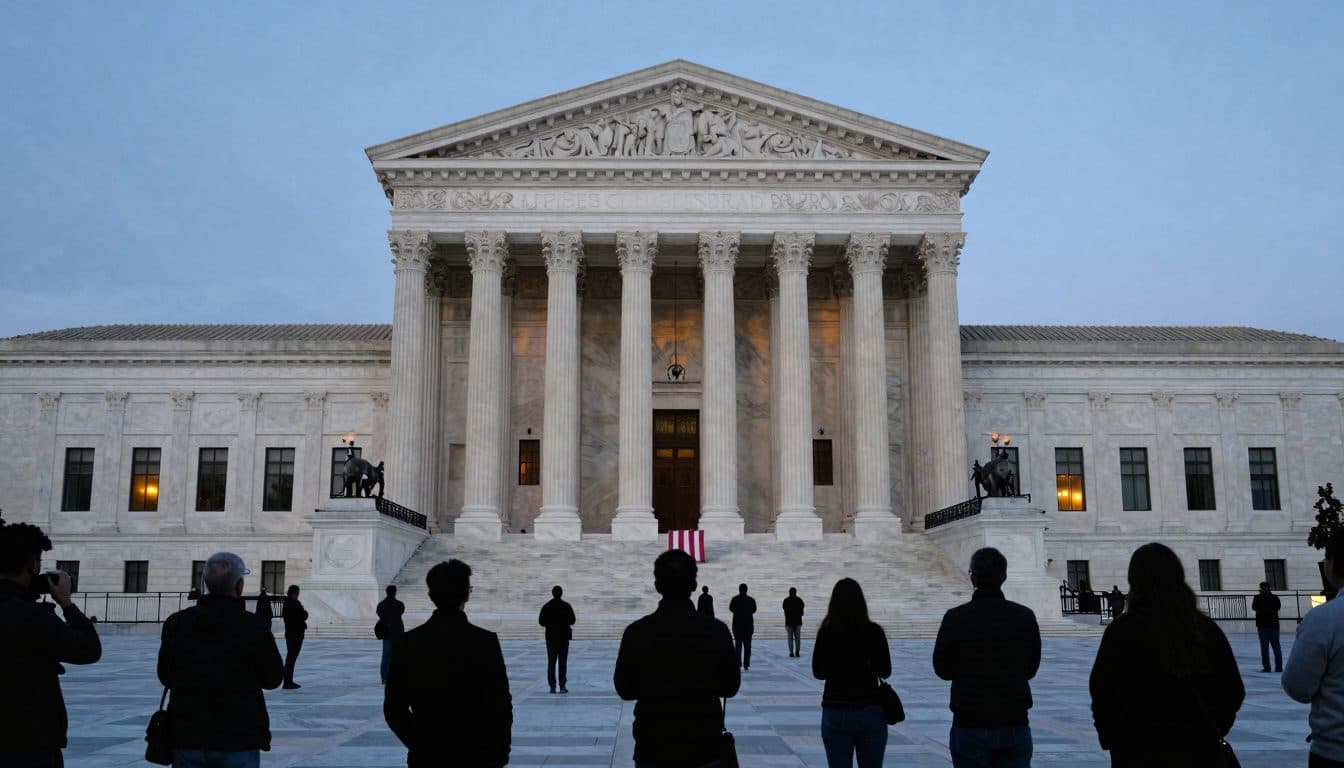
AI-generated image (z-image via Kie.ai)
Summary
Just before the U.S. congressional elections on November 3, 2026, President Donald Trump wants to enforce sweeping changes to voting rights through an emergency application at the Supreme Court. A federal appeals court in Massachusetts had previously upheld a lower court's block of his executive order; plaintiffs now have until August 3 to submit arguments.
Washington, July 28, 2026
The U.S. government has filed an emergency application with the Supreme Court seeking to lift a lower court's block on Trump's executive order tightening voting rights and to implement new rules for mail-in voting ahead of the November 3, 2026 congressional elections.
Trump's Executive Order and the Role of USCIS and SSA
The U.S. Department of Justice filed a corresponding emergency application on Monday to suspend a lower court's ruling. With the order signed in March, Trump sought to establish new voting procedures. The lower court had prevented the Trump administration from compiling voter databases and implementing new rules for mail-in voting ahead of the November 3, 2026 congressional elections.
Specifically, the order was directed at U.S. Citizenship and Immigration Services (USCIS) and the Social Security Administration (SSA). They were to compile lists of individuals whose U.S. citizenship is confirmed, who are at least 18 years old at the time of an upcoming election, and who are registered as residing in the corresponding state. Here, too, Trump demands stricter requirements, such as proof of identity and citizenship through appropriate documents.
Impact on Mail-In Voting and the Postal Service USPS
In addition, the state postal service provider USPS was only to send mail-in ballot materials to registered voters. The order also required that mail-in ballot materials be sent only with a barcode to enable tracking. As a result, the postal service was no longer to send mail-in ballot materials to individuals who were not on the new lists.
The original plaintiffs are predominantly Democratic-governed U.S. states as well as the capital district, the District of Columbia. A total of 23 states governed primarily by Democrats, along with the District of Washington, brought the suit. They now have until August 3 to submit legal arguments to the Supreme Court against the emergency application.
The Plaintiffs: 23 Democratic-Governed States
Previously, a federal appeals court in Massachusetts had already upheld a lower court's ruling, thereby preventing Trump from implementing the sweeping changes to voting rights. The panel was split in its decision: judges appointed by Presidents Joe Biden and George W. Bush voted to uphold the block, while a judge appointed by Trump dissented. The appeals court justified its decision in part by saying the order sowed confusion and led to „the disenfranchisement of many eligible voters" – that is, the exclusion of many citizens eligible to vote.
The lower court had ruled that Trump exceeded his authority with the executive order: under the Constitution and federal law, it is up to the individual U.S. states how they organize their elections – the government may not simply intervene by presidential decree without explicit statutory authorization from Congress. The plaintiffs argue similarly that, under the Constitution and federal law, the states decide how to organize their elections.
The Appeals Court's Reasoning
Trump argues that the changes will allow elections to be conducted more fairly and that people without U.S. citizenship should not be allowed to cast a ballot. When signing the executive order, he said: „Die Betrugsfälle bei der Briefwahl sind legendär. Ich glaube, das wird bei den Wahlen sehr hilfreich sein." Trump blames mail-in voting for his 2020 loss to Democrat Joe Biden and alleges manipulation without providing evidence.
Critics instead contend that such cases are rare and that people who do not have, for example, birth certificates or passports on hand would be excluded from voting. According to the U.S. State Department, only about half of all people possess a passport. The United States has no nationwide ID requirement comparable to the one in Austria.
Opposition from Critics and Missing ID Documents
Unlike Austria, the United States has no central civil registry. Citizens are therefore not automatically registered to vote. In the U.S., citizens must actively register for an election. In Germany, under the Federal Elections Act, individuals may only vote if they are entered in the voter register or hold a polling card. The voter register is compiled from the official municipal registration records.
According to the nonpartisan organization National Conference of State Legislatures (NCSL), voters in 36 of the 50 U.S. states must currently present an ID – in the remaining, mostly Democratic-governed states, no such requirement exists. Instead, a signature is often sufficient, for example in California or New York.
In early November, the „Midterms" will see roughly one-third of the Senate and the entire House of Representatives up for election. Because Republicans currently hold slim majorities in both chambers, every single seat could determine who ultimately holds power in Congress – and whether Democrats can block key items on Trump's political agenda.
Political Context: Midterms and the Save America Act
Parallel to the legal route, Trump is pressuring the Senate to pass the „Save America Act." The legislation provides that voters must prove their citizenship when registering and identify themselves at the polls with a photo ID. The measure is currently stalled in the legislative process. Critics fear that the reform, together with other planned restrictions, could effectively strip millions of Americans of their voting rights.
Trump has repeated allegations of massive election irregularities in a televised address to the nation broadcast in July. In his speech, he also claimed that China had manipulated U.S. elections for years and called for changes to the electoral system. Trump's fight against the outcome of the 2020 election culminated in the violent storming of the Capitol on January 6, 2021.
The appeal to the Supreme Court means the highest court must now decide whether the lower courts were right to block the executive order. The justices may grant the emergency application and take up the case, or deny it, in which case the block would remain in effect. APA, 7/28/2026
With his move, Trump is pursuing several goals: restricting mail-in voting, imposing stricter identification requirements, and gaining centralized federal access to voter data. How far the Supreme Court will allow presidential interference in the states' election procedures will be decided in the coming weeks.
Questions & Answers
Why has Trump gone to the Supreme Court?
Because a federal appeals court in Massachusetts upheld a lower court's block of his voting-rights executive order, the U.S. government seeks through an emergency application to have the measures take effect before the November 3, 2026 congressional elections.
What measures does the executive order contain?
The order obliges USCIS and the SSA to compile lists of eligible U.S. citizens, requires proof of identity and citizenship, and mandates that USPS send mail-in ballot materials only to registered voters and only with a barcode.
Who is suing over the executive order?
23 U.S. states governed primarily by Democrats, along with the District of Columbia, brought the suit and must submit legal arguments against the emergency application by August 3.
Trump at the Supreme Court: Voting Rights and the 2026 | allfacts360