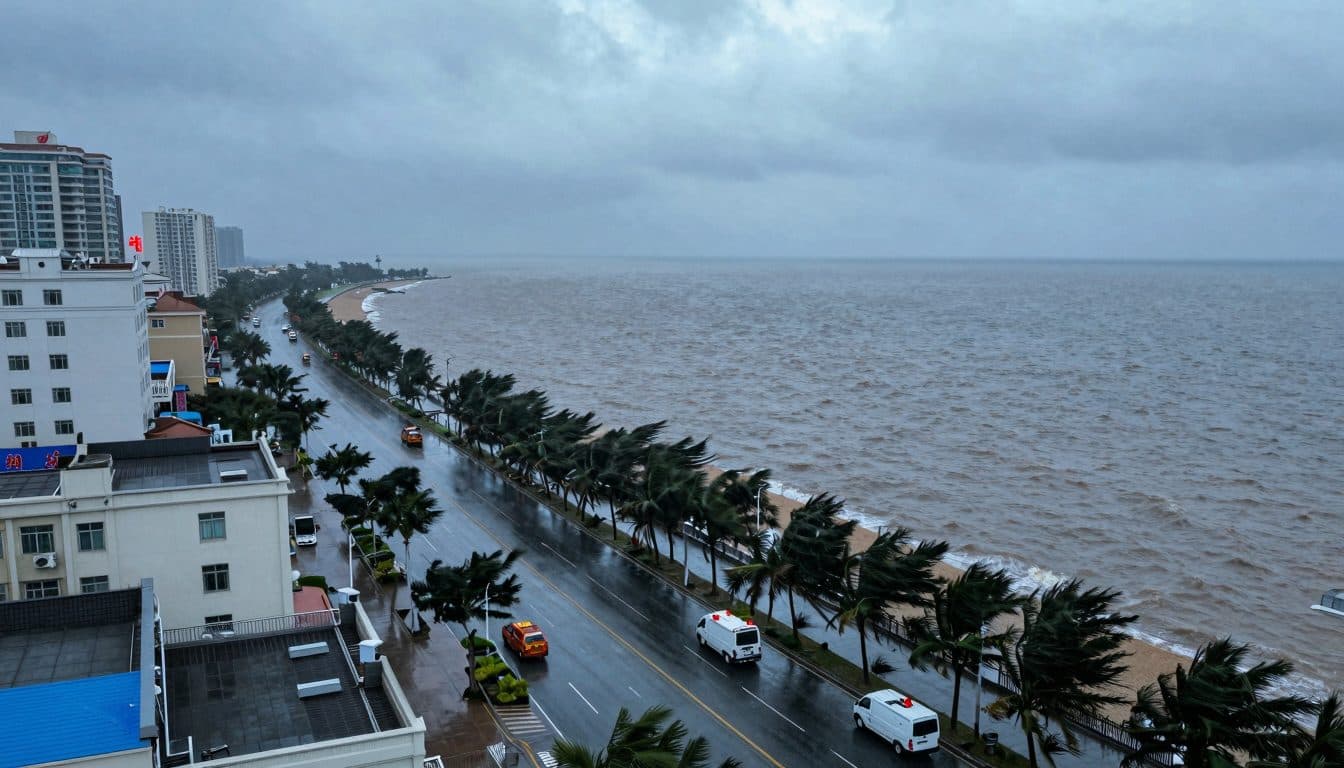
Typhoon "Bavi" hits China's east coast – authorities evacuate around 1.8 million people
Beijing, July 11, 2026
AI-generated image (z-image via Kie.ai)
Summary
Typhoon "Bavi" made landfall late on Saturday evening in the eastern Chinese port city of Taizhou. The Chinese authorities had previously brought around 1.8 million people to safety, and more than 920 international flights in Taiwan were cancelled. At least 17 people died in the Philippines.
Beijing, July 11, 2026
Typhoon "Bavi" made landfall late on Saturday evening (local time) in the eastern Chinese coastal city of Taizhou in Zhejiang Province, after which the Chinese authorities said they had brought around 1.8 million people to safety.
With wind speeds of up to 144 kilometers per hour, "Bavi" reached a considerable strength before hitting the coast, according to China's National Meteorological Center. The center had previously issued the second-highest alert level – an orange warning – in its four-tier system. However, the authority warned of extreme rainfall: "die Behörde warnte jedoch vor extremen Regenfällen".
Alert level and weather situation
Even before the storm arrived, authorities in China had brought more than 1.8 million people to safety because of the approaching typhoon, "und in Peking sowie rund 34.000 in Schanghai". According to state media, around 1.7 million people were evacuated in Zhejiang Province alone, where Taizhou is also located. In the neighboring province of Fujian, more than 100,000 people were brought to safety, according to the authorities.
The storm is heading toward the eastern Chinese metropolis of Wenzhou, home to around ten million people, "wo er voraussichtlich am frühen Sonntag auf Land treffen wird". Wenzhou's ten million residents prepared for the storm's arrival. Numerous schools in eastern China remained closed, ferry services were suspended, hundreds of flights were cancelled, and some high-speed trains stopped operating.
Preparations in China: large-scale evacuations
Taiwan had already been hit by the typhoon before it reached the Chinese mainland. Almost all cities and counties in Taiwan declared the day a day off from work because of the typhoon, with schools and authorities remaining closed. The authorities recorded 87 injuries in Taiwan, mostly from falls from two-wheelers or flying objects. The Taiwanese government had proactively brought more than 14,000 people from mountainous regions to safety.
Air traffic came to an almost complete standstill. Around 920 international flights were cancelled at Taoyuan International Airport near the capital, Taipei. In Taiwan, around 170,000 households also lost power, although other estimates spoke of about 70,000 households. No fatalities were initially reported from Japan or Taiwan.
Impact in Taiwan
Before "Bavi" set course for China, it had hit the southern Japanese Sakishima island chain with heavy rain and severe gusts. According to Japanese public broadcaster NHK, more than 200 flights were cancelled in the Okinawa region. The authorities of the Japanese prefecture of Okinawa warned of high waves, strong winds and storm surges. The island of Ishigaki, among others, was particularly affected.
In the Philippines, however, 17 people died in connection with heavy monsoon rainfall intensified by the effects of the typhoon. According to authorities, the fatalities were victims of a landslide triggered by the tropical cyclone the previous day. A further nine people were reported missing.
Philippines and Japan: traces before landfall
The scale of the storm is also impressive in terms of the spatial extent of its rain bands: they stretch across an area the size of France. Although the storm is weakening as it moves over cooler waters, the meteorological authority continued to warn of extreme rainfall. "Bavi" had temporarily been classified as a super typhoon.
In China, "Bavi" is already the second typhoon within a week. The cyclone had previously wreaked havoc in the Philippines, Taiwan, and on the southern Japanese islands, bringing strong winds and heavy rain. Landslides, flooding, and disruption to the power supply were among the immediate consequences along its path.
The Chinese authorities said they had organized the evacuations even before landfall. In addition to the 1.7 million people in Zhejiang and the around 100,000 in Fujian, more than 100,000 people were brought to safety in the capital, Beijing. In Shanghai, located further south along the coast, authorities evacuated around 34,000 people.
The storm first hit the eastern Chinese coastal city of Taizhou, which is known as an industrial and port city. Landfall occurred late on Saturday evening, and authorities expected "Bavi" to continue moving westward and reach Wenzhou. With around ten million residents, Wenzhou is one of the larger metropolitan areas on China's east coast.
Second typhoon within a week
Given the scale of the evacuations, authorities and state media spoke of one of the most extensive safety operations in recent years. In addition to the evacuations, emergency shelters were set up, rescue forces were put on alert, and ferry and high-speed train services in affected regions were suspended. Schools in several provinces remained closed.
The national weather agency in Beijing pointed out that although "Bavi" was losing strength, the danger of flash floods and landslides from the expected extreme rainfall remained. Significant precipitation was to be expected even after landfall. The warnings were directed at the population in coastal areas as well as in inland regions of eastern China.
International aid and disaster relief organizations monitored the storm's development. According to its own statements, the Chinese authorities coordinated the measures through the National Meteorological Center, local disaster relief headquarters, and the provincial governments. No information was initially available about fatalities on the Chinese mainland.
Outlook and consequences
The typhoon highlights the increase in severe cyclones in the region within a short period of time. Just a few days earlier, another typhoon had hit parts of China; the rapid succession of two such events poses particular challenges for authorities, emergency services, and the affected population. The official "Orange" alert level signaled a serious, but not the highest, danger level.
Reporting on Typhoon "Bavi" was picked up on July 11, 2026, by Deutschlandfunk, among others, and was based on reports from the news agency Reuters.
The full extent of the damage in the affected Chinese coastal regions was not yet foreseeable at the time of the reports. After the storm passed, initial tallies of injuries, building damage and power outages were expected.
Questions & Answers
Where did Typhoon "Bavi" make landfall?
According to the authorities, "Bavi" made landfall late on Saturday evening (local time) in the eastern Chinese coastal city of Taizhou in Zhejiang Province and subsequently continued toward the metropolis of Wenzhou.
How many people were evacuated in China?
According to the Chinese authorities, around 1.8 million people were brought to safety, including around 1.7 million in Zhejiang Province, more than 100,000 in Beijing, and around 34,000 in Shanghai.
What were the effects of the typhoon in Taiwan, Japan, and the Philippines?
In Taiwan, 87 people were injured, schools and authorities remained closed, and around 920 international flights were cancelled at Taoyuan Airport; in Japan, more than 200 flights were cancelled in the Okinawa region; in the Philippines, at least 17 people died from monsoon rain and a landslide.
Typhoon Bavi: Evacuation in China – damage in Taiwan and | allfacts360