Typhoon "Bavi" makes landfall in eastern China – storm weakens, heavy rains continue
Beijing, July 13, 2026
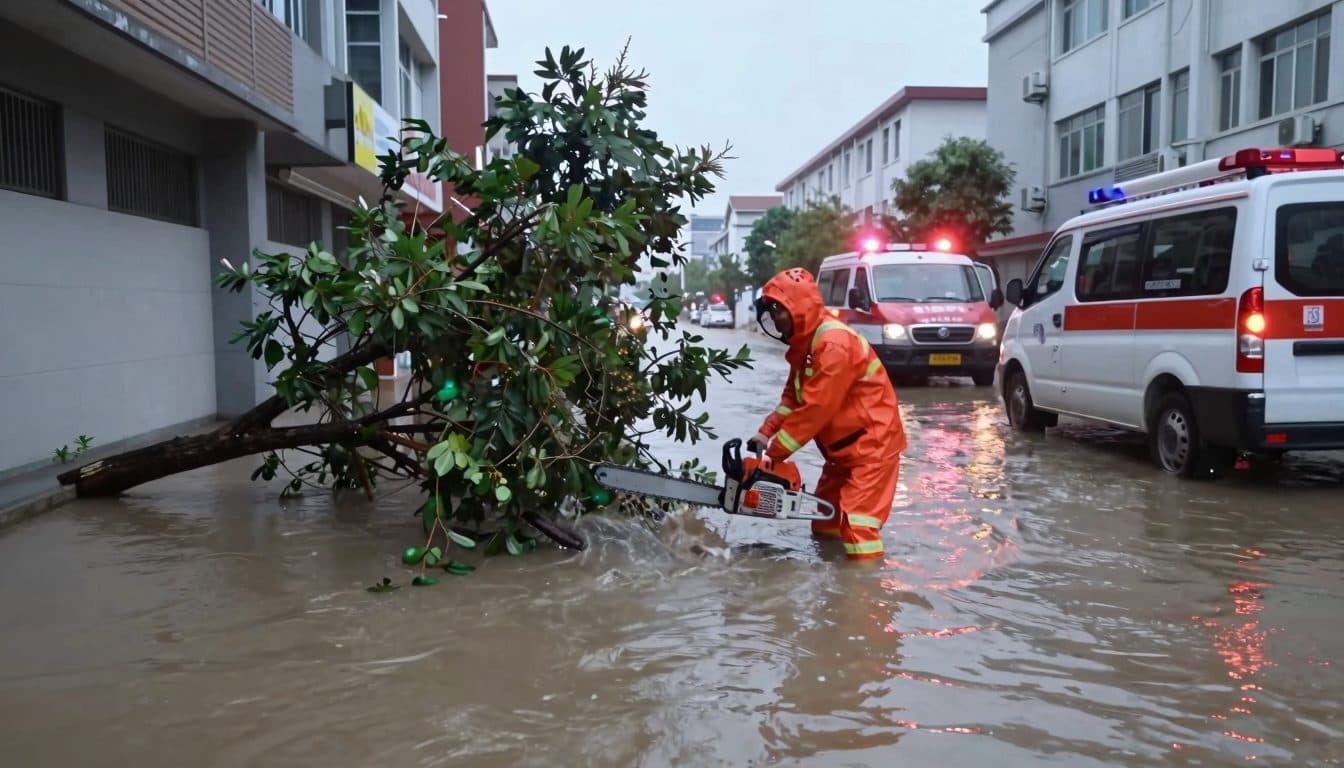
AI-generated image (z-image via Kie.ai)
Summary
Typhoon "Bavi" made landfall in the eastern Chinese province of Zhejiang late on Saturday evening and has since weakened into a severe tropical storm. Nearly two million people were evacuated as a precaution; authorities initially reported no fatalities or injuries in China.
Beijing, July 13, 2026
Typhoon "Bavi" made landfall in the eastern Chinese province of Zhejiang late on Saturday evening, has since weakened into a severe tropical storm, and continues to cause heavy rainfall and severe flooding across large parts of China.
Landfall in Zhejiang: Two landfalls within a few hours
"Bavi" struck the coastal city of Yuhuan at around 11:20 p.m. (local time) on Saturday evening, before making a second landfall around midnight in the city of Yueqing, which belongs to the metropolitan area of Wenzhou. According to state broadcaster CCTV, the cyclone reached wind speeds of up to 144 kilometers per hour at its first landfall. Within a few hours of its landfall in Zhejiang province, Chinese meteorologists downgraded it to a tropical storm. On Sunday morning, wind speeds of around 108 kilometers per hour were still measured near Hangzhou.
Typhoon "Bavi" has weakened — that is the good news so far. Within a few hours of its landfall in Zhejiang province, Chinese meteorologists downgraded it to a tropical storm. The storm system remains the size of France and, according to meteorologists, continues to move toward the Yellow Sea, where it is expected to transform into an extratropical low-pressure system by Tuesday.
Mass evacuations: Nearly two million people brought to safety
Authorities had taken massive precautions. Nearly two million people had been evacuated before the typhoon's arrival. In Zhejiang province, a major economic and technology hub in the world's second-largest economy, some 1.72 million people had been evacuated by Saturday, according to authorities. In Fujian province alone, more than 130,000 people had to leave their homes. In Shanghai, around 34,000 people in coastal areas and high-risk zones left their homes as a precaution.
Transport chaos: Thousands of flights and train services cancelled
Many schools were closed. In Zhejiang, schools and businesses remained closed, road traffic was halted, and outdoor events were suspended. Train services were suspended on several route sections. Ferry connections were cancelled and hundreds of flights were grounded: In Shanghai alone, 684 flights and 1,620 train connections were cancelled according to the news portal The Paper, along with 327 flight connections at Hangzhou airport. According to the Ministry of Transport, 137 international and 62 domestic flights were cancelled on Sunday. In total, more than 300 flights were cancelled across Zhejiang province.
Yueqing under water: Flooding, landslides, and cut-off villages
The largest evacuations took place in Zhejiang province. In Yueqing, a city of roughly ten million inhabitants in the Wenzhou metropolitan area, many streets were under more than ankle-deep water. Images from the city showed flooded alleys and undermined roadways. In the mountainous north of the city, a landslide occurred, as CCTV footage shows. Large boulders tumbled onto a mountain road. On Sunday, crews used excavators and chainsaws to clear overturned trees from the streets. According to CCTV, more than 1,300 trees were uprooted or toppled in Yueqing.
Around 1,800 villagers were cut off from the outside world in the region, according to broadcaster CCTV. Access to remote mountain villages was blocked after the landslide, and rescue teams worked with heavy equipment to clear the routes. Meteorologists warn that the tropical storm could bring prolonged and widespread rainfall across eastern and northern China. Strong winds and rain are expected to affect many cities in eastern and northeastern China on Monday. Meteorologists warned of further heavy rain and tornadoes.
Northeast on alert: Flash floods in Hebei and Liaoning
The National Weather Center said that as early as Sunday afternoon, heavy to extreme rain was recorded in provinces such as Anhui. In one area in Miaoli County, nearly 80 liters of precipitation per square meter fell. In Liaoning, authorities warned of flash floods and issued the highest alert level. In Hebei and Liaoning provinces, roads were flooded and vehicles were swept away by the waters, as seen in videos posted to online platforms on Monday. In Kuancheng district in Hebei, water on the streets rose to more than two meters high, according to local media reports.
Typhoon Bavi caused severe flooding in northeastern China. Authorities warned of flash floods, rivers bursting their banks, and inundated fields. Videos and eyewitness reports from Hebei and Liaoning showed raging currents on normally busy roads, swept-away vehicles, and collapsed bridges. Copernicus, the European Earth observation program, had previously reported that the world's oceans had recorded their highest-ever temperatures for the month of June in June — a background factor that favors the intensity of tropical cyclones.
Impact in Taiwan and Japan: Injuries and power outages
Bavi is the strongest typhoon to hit China so far this year. Before moving toward China, "Bavi" passed north of Taiwan on Saturday without making direct landfall there. However, the outer bands of the typhoon brought strong winds and heavy rain to most of the island republic. Taiwan's fire department said on Sunday that 134 people had been injured, most of them in falls — for example, from motorcycles — or by falling objects. More than 170,000 households in Taiwan were temporarily without power. No fatalities were reported.
Before reaching China, "Bavi" had already hit remote islands in southwestern Japan. On the Japanese island of Okinawa, more than 18,000 households and facilities were affected by power outages. A few days earlier, during severe storms in the region, hundreds of snakes — some of them venomous — had escaped from a breeding farm, posing an additional risk to the already-strained population.
There were initially no reports of fatalities or injuries in China. Authorities nevertheless assessed the outcome as a success of the large-scale precautionary measures. Nearly two million people had been brought to safety beforehand, which according to current knowledge prevented worse outcomes. Typhoon "Bavi" weakened into a severe tropical storm after arriving in eastern China on Sunday, but continued to cause heavy rainfall and significant transport disruptions.
Comparison with the Philippines: At least 17 dead after landslide
On the Philippines, the tropical cyclone had triggered a landslide. According to authorities, at least 17 people lost their lives. This report was broadcast on 12.07.2026 on the Deutschlandfunk program. Typhoon Bavi weakens in China — the storm's toll in China was thus milder according to initial reports than on the Philippines, where especially remote mountain regions were particularly affected.
At the time of reporting, warnings of heavy to extreme rain remained in place for several eastern Chinese provinces through at least Monday. Meteorological authorities expected that precipitation along the path of the weakened storm would continue for several more days. Even though "Bavi" has weakened, the situation in the affected provinces of Zhejiang, Fujian, Shanghai, Anhui, Hebei, and Liaoning remains tense, according to authorities.
Questions & Answers
Were there any fatalities or injuries caused by "Bavi" in China?
At the time of reporting, there were no reports of fatalities or injuries in China; on the Philippines, however, at least 17 people died in a landslide triggered by "Bavi," according to authorities.
Typhoon Bavi: Landfall in Zhejiang – Impact in China | allfacts360