UN report: AI data centers could consume as much water as 1.3 billion people by 2030
Berlin, June 03, 2026
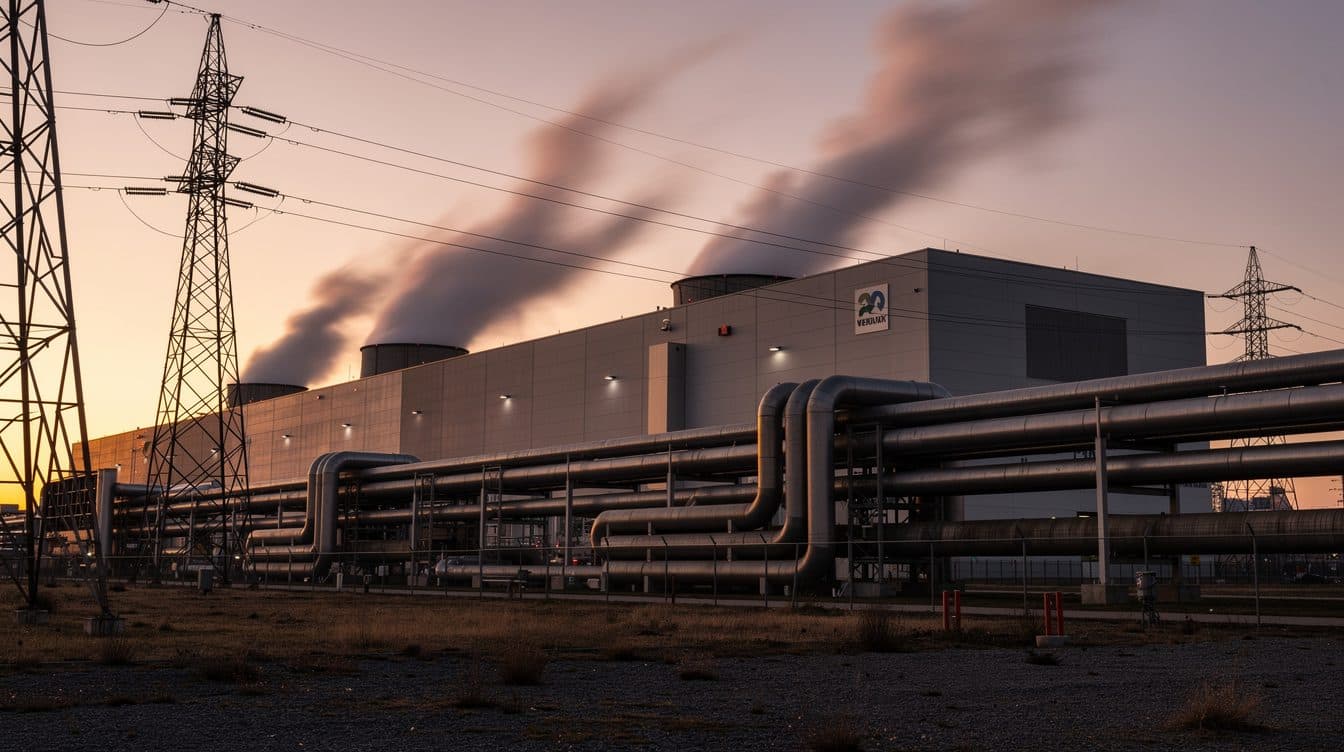
AI-generated image (flux-2/pro-text-to-image via Kie.ai)
Summary
A report from the United Nations University warns of a sharply growing ecological footprint of AI data centers. By 2030, their water demand could correspond to the annual needs of around 1.3 billion people, and electricity consumption could nearly double to approximately 945 terawatt-hours.
Berlin, June 03, 2026
A report from the United Nations University calculates that AI data centers could consume as much water by 2030 as the population of Sub-Saharan Africa, with its approximately 1.3 billion people.
The United Nations University (UNU), based in Canada, has assessed the environmental costs of Artificial Intelligence in a new report. According to the report, AI data centers could reach an annual water footprint by 2030 equivalent to the water needs of about 1.3 billion people. The report was published by the UNU Institute for Water, Environment and Health, led by Kaveh Madani.
At the same time, the electricity consumption of all data centers worldwide could more than double from an estimated 448 terawatt-hours in 2025 to around 945 terawatt-hours in 2030, based on current development trends. This would correspond to almost three percent of global electricity demand. If data centers were considered a single country, their electricity consumption would already rank eleventh worldwide today.
Electricity Consumption: From 448 to 945 Terawatt-hours
AI-related computing loads alone currently account for about 20 percent of the electricity consumption of all data centers, according to the UNU. By 2030, this share could rise to about 40 percent. The estimated AI electricity demand of 378 terawatt-hours corresponds to five to six times the current annual electricity consumption of Austria or the needs of 108 million Central European households, the report states.
The UNU Institute illustrates the scale using the chatbot ChatGPT as an example: the system reportedly processes an estimated 2.5 billion queries per day. With a conservatively estimated 0.42 watt-hours per text request, this results in an annual electricity consumption of around 383 gigawatt-hours – comparable to the needs of 109,000 Austrian households. The training of GPT-5 is estimated at about 100 gigawatt-hours in the report. An AI-powered Google search could consume up to ten times more energy than a conventional search, according to the UNU.
The background to this development is the rapid spread of generative AI. ChatGPT, launched in 2022, reached one million users within five days – faster than any other app in history. By mid-2025, according to the data, around 700 million people, about ten percent of the world's population, had used ChatGPT and together sent 18 billion messages weekly. The UNU estimates the total electricity consumption of data centers in 2025 at 448 terawatt-hours.
Warning of a Gradual Ecological Damage Balance
The report warns of a gradual ecological damage balance: "However, with a technology spreading so rapidly, ecological consequences could accumulate unnoticed alongside social, economic, and geopolitical ones. Later, they may be difficult to rectify because systems, investments, and dependencies have become entrenched." Furthermore, emissions from the energy supply for data centers could reach around 400 million tons of CO₂ equivalents by 2030 – comparable to the emissions of the United Kingdom.
Not only energy and water are in focus: by 2030, AI infrastructure could generate up to 2.5 million tons of e-waste annually, equivalent to disposing of almost 250 Eiffel Towers per year, according to the UNU. The geographical distribution of capacities is also uneven: only 16 percent of countries have AI-specialized cloud computing capacities, with 90 percent of these concentrated in the USA and China. In the USA alone, there were more than 4,100 data centers in 2025.
Experts: Figures Plausible, But Not Dominant
German and European experts consider the magnitude of the figures to be fundamentally plausible but point to methodological uncertainties. "The energy consumption of AI data centers is real and growing, but currently not the dominant climate problem," said Wolfgang Maaß from the German Research Center for Artificial Intelligence in Saarbrücken. He added: "Political attention to AI energy consumption exceeds its actual climate relevance." Furthermore, the figures are "plausible in their magnitude, but methodologically difficult to reproduce. AI providers do not publish standardized energy data per query."
David Kappel, head of the research group for Sustainable Artificial Intelligence at Bielefeld University, emphasized: "In recent years, we have observed a very steep learning curve regarding the energy efficiency of AI... At the same time, however, there has been rapid growth in AI usage that far outweighs efficiency gains." Peter Radgen from the Institute for Energy Economics and Rational Energy Application at the University of Stuttgart and Jens Gröger from the Öko-Institut in Berlin are also among the commenting experts.
Renewable Energies and Political Reactions
Major tech corporations are trying to align the locations of their facilities with renewable energy sources. Microsoft and Google use wind power in Ireland and Sweden, Meta uses hydropower and wind power in Denmark and Norway, and Amazon uses hydropower in the Pacific Northwest of the USA. In Brazil, where hydropower dominates the electricity grid, the CO₂ footprint of electricity generation is 77 percent below the global average, according to the UNU – at the same time, the water and land footprint there is almost three times higher than the global average. Martina Flörke, professor of Engineering Hydrology at Ruhr University Bochum, warns: "Droughts and periods of dryness in particular can lead to potential water use conflicts."
Gröger criticized the report's recommendations as "very non-binding": "The tech companies profiting from the boom – especially Amazon, Google, Meta, and Microsoft – are not named." In Germany, all data centers must be operated with 100 percent renewable electricity on a balance sheet basis from 2027. In April 2026, Google began construction of its first own data center in Austria in Kronstorf an der Enns, after the company had acquired the property in 2008. Switzerland is among the countries with the highest data center density worldwide. In the USA, according to a recent survey, more than 70 percent of respondents reject a data center in their neighborhood.
Kaveh Madani contextualized the study politically: "We have only a small window of time to ensure that the backbone of the technological revolution of our time develops within the planetary boundaries" – the report is "a call for responsible use of AI, not a plea against it."
Questions & Answers
What does the UN report say about the future water consumption of AI data centers?
The United Nations University predicts that the water footprint of all AI data centers could correspond to the annual needs of approximately 1.3 billion people in Sub-Saharan Africa by 2030.
How much electricity could data centers consume by 2030?
The UNU report estimates the electricity consumption of all data centers at about 448 terawatt-hours in 2025 and expects an increase to around 945 terawatt-hours by 2030 if current trends continue.
What criticism do experts voice regarding the report?
Wolfgang Maaß and Jens Gröger consider the magnitude plausible but the methodology difficult to verify due to a lack of standardized provider data; Gröger also criticizes that the recommendations remain non-binding and the major tech corporations are not named.
AI data centers: Water and electricity consumption by 2030 | allfacts360