
Michael Kratsios, the White House director of science and technology policy, accused the Chinese AI startup Moonshot AI on Wednesday of distilling leading US models to build its new Kimi K3 system and of accessing export-restricted Nvidia hardware.
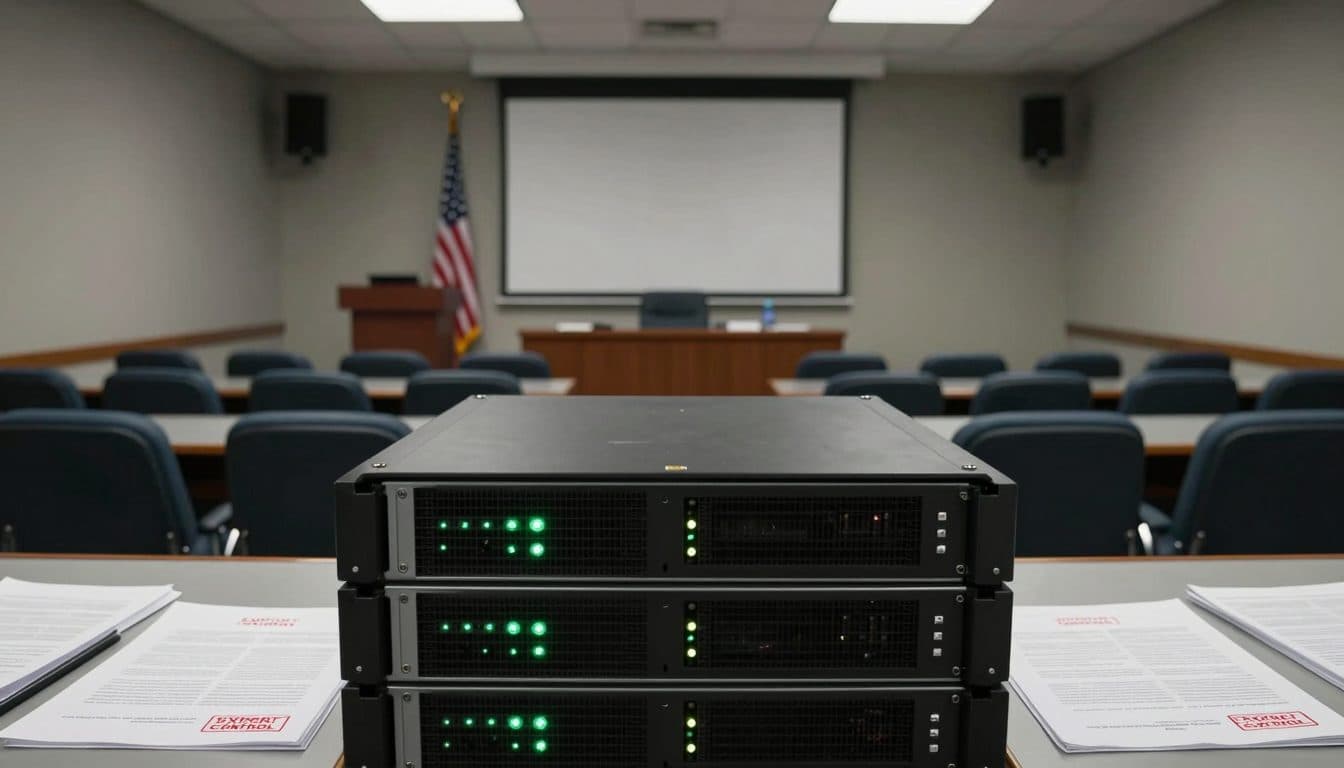
Kratsios wrote on X that the US government has information indicating Moonshot distilled Anthropic's Fable model on a large scale for Kimi K3, and that the company operated an internal platform that rapidly switched between access methods to avoid detection. He also alleged that Moonshot acquired a server with Nvidia GB300 hardware and used additional GB300 capacity in Thailand to train its own models.
The GB300 belongs to Nvidia's Blackwell generation, which remains subject to US export licensing requirements. In late May, the Bureau of Industry and Security clarified that deliveries of powerful AI chips to Chinese companies require a license even when the recipient is based outside China. Earlier restrictions covered the H20 chip from April 2025, while limited H200 deliveries were permitted from January 2026 under conditions.
Background on US export controls
Kratsios initially provided no concrete evidence to support his claims and later softened his own wording, replacing "solid evidence" with "information" in his post. A White House adviser escalated the rhetoric on Wednesday by describing the distillation practice as "stealing proprietary US technology." Moonshot AI had not commented on the new allegations at the time of reporting, and the White House, Anthropic, and Nvidia also declined to comment.
The accusations build on a campaign by US AI labs to attribute China's rapid AI progress to distillation, a common industry practice in which one model is trained on the outputs of another. In February 2026, Anthropic accused Moonshot AI, DeepSeek, and MiniMax of coordinated distillation campaigns involving more than 24,000 fake accounts and millions of conversations with Claude. Anthropic said the responses were used to improve the Chinese providers' own systems, targeting chain-of-thought data at DeepSeek, agentic reasoning and computer use at Moonshot, and agentic coding and tool orchestration at MiniMax.
Anthropic's earlier accusations
In June 2026, Anthropic accused the trading group Alibaba in a letter to the US Senate of the largest known distillation attack on Claude to date, with nearly 25,000 fake accounts and approximately 29 million conversations operated by actors with ties to Alibaba's Qwen lab. OpenAI had earlier specified similar accusations in a February 2026 memo to the House China Committee, citing "adversarial distillation" via disguised third-party routers.
Moonshot's Kimi K3 was released on July 15, 2026, roughly two weeks after Anthropic's Fable became publicly available on July 1. According to the BBC, Kimi K3 is to be released as an open-source model on July 27, which would make it the largest freely downloadable and customizable model of its class. Moonshot claims the model surpasses all competitors except Anthropic's Claude Fable 5 and OpenAI's GPT-5.6, and the company says it trained the system in 15 days. A Moonshot employee, Randy Xian, described the achievement on X as "Guinness World Record stuff."
Industry and market reaction
OpenAI President Greg Brockman acknowledged that Kimi K3 is a "ziemlich gutes Modell," though he said whether Moonshot improperly extracted results from OpenAI models cannot currently be assessed. AI researchers posting on X on Thursday described the US accusations as "political" and "reckless," noting the lack of evidence for any distillation claims against Kimi K3 and pointing out that an AI model's output is not copyrighted. Some experts highlighted Kimi K3's technical innovations.
The presentation of Kimi K3 triggered a sell-off in technology stocks reminiscent of the market reaction to DeepSeek the previous year, according to Bloomberg. Moonshot is pursuing a valuation of up to $50 billion in an upcoming funding round and is considering a subsequent listing on the Hong Kong stock exchange.
Industry pushback and diplomatic context
US Treasury Secretary Scott Bessent announced one day before Kratsios's accusations that the US would examine whether Chinese AI models had adopted capabilities from American competitors. On Monday, Bessent said on X that "the government supports open models, not the theft of intellectual property," and on Wednesday he stated that sanctions were on the table if Chinese companies crossed the line into industrial-scale distillation attacks constituting theft of intellectual property. He named sanctions and placement on the Entity List as possible measures against Moonshot.
A newly founded association of nearly 200 Silicon Valley companies is warning the Trump administration against sweeping restrictions on Chinese open-weight models, according to Politico. The association argues that such bans would hardly curb the global spread of Chinese open-weight models but would endanger numerous US startups, and its representatives are calling for targeted protective measures and leading open-weight models from the US.
The US and China are planning government talks in September to reduce tensions, and a meeting between Donald Trump and China's head of state Xi Jinping is expected. Anthropic is calling on Congress to legislate penalties for distillation attacks and clearer antitrust rules so frontier labs can share information about such attacks without risking collusion accusations.