US and Iran Agree on Roadmap for Peace Deal After 18-Hour Negotiations at Bürgenstock
Bürgenstock, June 22, 2026
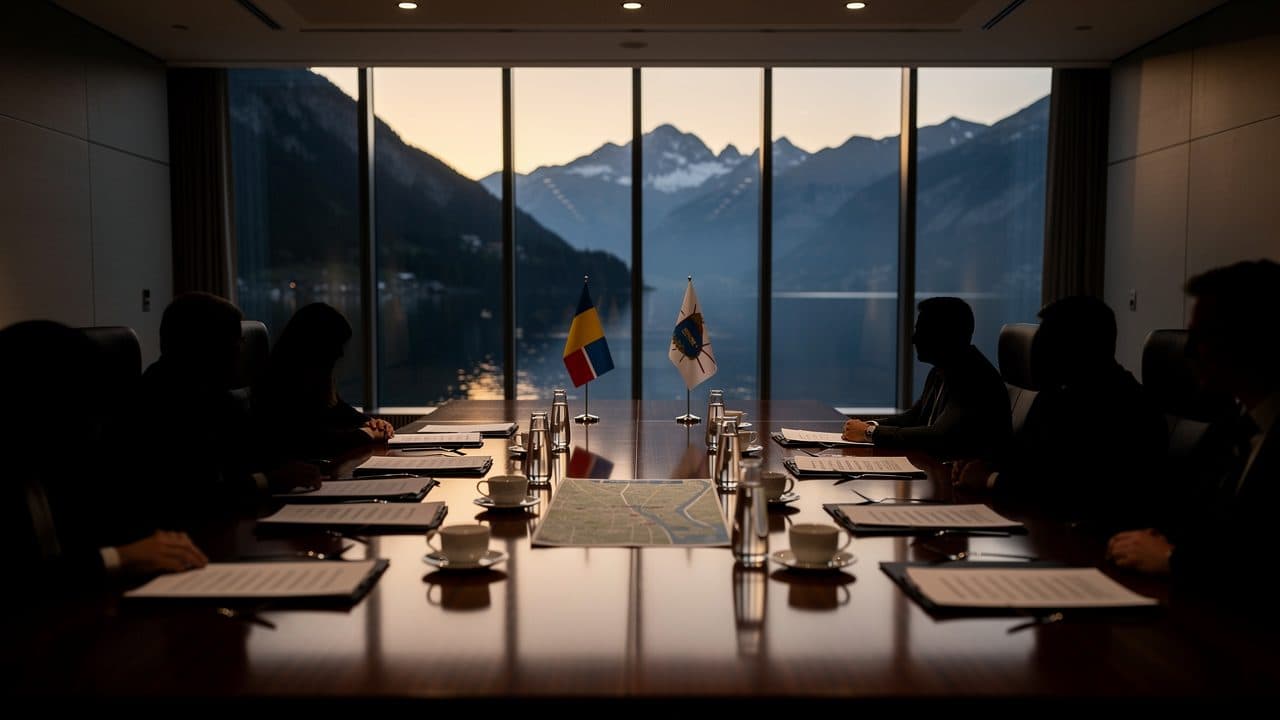
AI-generated image (flux-2/pro-text-to-image via Kie.ai)
Summary
After 18-hour negotiations at Bürgenstock, the US and Iran have agreed on a roadmap to reach a comprehensive peace deal within 60 days. At the center are a communication channel regarding the Strait of Hormuz, a conflict resolution task force for Lebanon, and working groups on Iran's nuclear program and Western sanctions.
Bürgenstock, June 22, 2026
The United States and Iran agreed over the weekend at Bürgenstock in central Switzerland, following roughly 18 hours of negotiations, on a roadmap for a comprehensive peace deal to be reached within 60 days.
Negotiation Marathon in the Alps
The talks at the highest level began on Sunday afternoon and stretched into the early morning hours. The American delegation was led by Vice President J.D. Vance, accompanied by US Special Envoy Steve Witkoff. The Iranian delegation was headed by Parliament Speaker Mohammad Bagher Ghalibaf as chief negotiator; Foreign Minister Abbas Araghchi was also part of the delegation. The talks were mediated by Qatar and Pakistan.
According to a joint statement by the two mediating states, there was a "positiven und konstruktiven Atmosphäre." "Ermutigenden Fortschritten erzielt" had been made, including the creation of a mechanism for further talks. A joint forum is to monitor compliance with the ceasefire in Lebanon going forward. The direct exchange between the delegations initially lasted just over an hour on Sunday afternoon.
Four Disputes at a Glance
At the center of the negotiations were four dossiers: the reopening of the Strait of Hormuz, the situation in Lebanon, the Iranian nuclear program, and Western sanctions. For the US it is crucial "die Strasse von Hormus möglichst schnell wieder vollständig aufzubekommen." The strait is of central importance for the transport of oil and liquefied natural gas.
A major plan for the reconstruction of Iran was also set in motion. According to the Iranian account, the US side's blockade of Iranian ports is to be lifted and initially frozen Iranian funds are to be released. In addition, according to his foreign minister's account, Tehran has pledged to use "größtmögliche Anstrengungen" to ensure the safe passage of commercial vessels through the strait.
Shadow of the Lebanon Conflict
These claims could initially not be independently verified. The joint statement by the mediators Qatar and Pakistan did not mention the release of Iranian assets. The White House also declined to comment when asked about the Iranian claims regarding eased sanctions and a reconstruction plan.
The negotiations were repeatedly overshadowed by the situation in Lebanon. "Überschattet wurde das Treffen von der Situation im Libanon, wo die Kämpfe zwischen Israel und der Hisbollah-Miliz anhalten." Israel is not directly participating in the talks but has rejected the troop withdrawal from southern Lebanon envisaged in the framework agreement. Prime Minister Benjamin Netanyahu stressed that Israeli soldiers should remain in southern Lebanon "so lange wie nötig."
Strait of Hormuz: Bone of Contention and Economic Factor
The US exerted diplomatic pressure on the Netanyahu government, which is opposed to an end to the fighting. Washington had agreed in the framework deal signed last Wednesday to an end of the fighting, including in Lebanon, without directly involving Israel. In Lebanon, Israel and the pro-Iranian Hezbollah militia are fighting each other; the ceasefire that took effect in early April has been repeatedly broken.
On Saturday, in response to Israeli attacks in Lebanon, Iran had announced another closure of the Strait of Hormuz. The US military contradicted this account. The Strait of Hormuz is a route of significance to the global economy for trade in fertilizer, oil, and liquefied natural gas from the Gulf states. During the Iran war, the extensive blockade of the strait by Tehran caused worldwide economic turbulence.
Incident Triggered by Trump Threat
During the negotiations, a dramatic moment occurred. US President Donald Trump had threatened Iran with new attacks over its support for the Hezbollah militia. "Nachdem US-Präsident Donald Trump dem Iran wegen der Unterstützung der Hisbollah-Miliz neue Angriffe angedroht hatte, verließ die iranische Delegation vorübergehend die Verhandlungen." The talks between Iran and the US were then continued.
While US Vice President Vance tried to spread good cheer on the ground, President Trump poured oil on the fire from Washington. Trump threatened Iran's leadership via the media with a new war in the event that they did not immediately open the Strait of Hormuz and did not rein in Hezbollah in Lebanon. In a Fox News interview, he warned: "Wenn ihr sie schließt, habt ihr kein Land mehr. Ihr werdet nicht einmal mehr in euer verdammtes Land zurückkehren können."
On the platform Truth Social, Trump wrote that Iran must immediately stop its "highly paid proxies" in Lebanon, "andernfalls 'we will hit Iran very hard again.'" The Iranian chief negotiator Ghalibaf responded on X: "Sie täten gut daran, mit ihren Äußerungen vorsichtig zu sein. Die Streitkräfte der Islamischen Republik seien 'bereit, auf andere Weise darauf zu reagieren'." In a further post, Ghalibaf wrote: "Unabhängig davon, wie viel sie reden, wir sind diejenigen, die handeln" – the armed forces remain "bereit, auf andere Weise darauf zu reagieren."
Iranian Foreign Minister Araghchi spoke of major progress in the early morning hours. The joint forum for monitoring compliance with the ceasefire in Lebanon is the "erste wirkliche Test" of the agreements. On X he wrote of a "großen Erfolg" for an end to the "Libanon-Krieges." Araghchi also warned: "Das werde ein Test für alles Weitere."
Assessments and Market Reactions
US Vice President Vance had described the talks at the opening as a "historisches Treffen" and spoken of a "neuen Etappe" in relations with the Iranian people. He too spoke of "großen Fortschritten" over the course of the negotiations. The US side initially issued no statement overnight on the outcome of the first day of talks.
Qatari Prime Minister Mohammed bin Abdulrahman Al Thani posted a photo on X showing him with Vance and Trump's son-in-law Jared Kushner, and wrote: "Live aus Luzern, die Arbeit geht weiter." According to ZDF correspondent Heike Slansky, it is a "vorsichtige Annäherung" by both warring parties. On some points there are said to have been "Fortschritte gegeben haben."
It was agreed to establish a communication channel between the parties to the conflict in order to prevent incidents and misunderstandings in the Strait of Hormuz and to ensure the safe passage of commercial vessels. This agreement applies for the 60-day period envisaged in the previously signed framework deal. The conflict resolution task force to end the fighting in Lebanon is also to be set up together with the Lebanese government, according to the mediators' statement.
Outlook: Working Groups and 60-Day Deadline
Within Iran itself, President Masoud Pezeshkian argued on Sunday for providing a written guarantee of forgoing nuclear weapons as part of the ongoing talks. "Falls notwendig, können wir schriftlich festhalten, dass wir nicht beabsichtigen, eine Atombombe zu bauen," he said according to the IRNA news agency. He also pointed to former Supreme Leader Ali Khamenei, who had rejected the development of weapons of mass destruction on religious grounds. The political leadership of the Islamic Republic officially maintains the position that it does not seek nuclear weapons.
For talks at the working level, working groups are to be formed in the coming days, in particular on the Iranian nuclear program and on Western sanctions. "Weitere Beratungen auf Arbeitsebene sollen folgen," it was said. The political leaders departed central Switzerland, but the technical teams are to continue negotiating at Bürgenstock until the end of the week. The goal is to reach a "letztgültiges Abkommen" within 60 days, as envisaged in the framework deal.
Markets reacted to the outcome of the first round of negotiations in Switzerland: "Der Ausgang der ersten Verhandlungsrunde in der Schweiz ließ die Ölpreise am Montag jedenfalls zurückgehen und die Aktienkurse steigen." In return, the Iranian regime can look forward to international recognition and billions to stabilize its own rule. A New York Times analysis, however, concluded that Trump is selling the reopening of the Strait of Hormuz as a success even though its closure was a consequence of the war he ordered. Trump in turn attacked the New York Times sharply over this analysis.
The talks in central Switzerland were also remarkable because they represented the first direct contacts between the two sides at a high political level since the start of the war. The US and Israel had begun the Iran war at the end of February. The meeting took place in a luxury hotel at Bürgenstock in the Swiss Alps and lasted a total of around 18 hours.
Questions & Answers
Who led the delegations at the negotiations at Bürgenstock?
The US delegation was led by Vice President J.D. Vance, accompanied by Special Envoy Steve Witkoff. The Iranian delegation was headed by Parliament Speaker Mohammad Bagher Ghalibaf as chief negotiator; Foreign Minister Abbas Araghchi was also part of it. The talks were mediated by Qatar and Pakistan.
What concrete agreements were reached in Switzerland?
Both sides agreed on a roadmap to reach a comprehensive deal within 60 days, a communication channel to prevent incidents in the Strait of Hormuz, a joint forum to monitor the ceasefire in Lebanon, and working groups on the Iranian nuclear program and Western
US Iran Negotiations Bürgenstock: Roadmap for 60-Day Peace | allfacts360