US launches third round of strikes on Iran this week – Strait of Hormuz closed again
Dubai, July 12, 2026
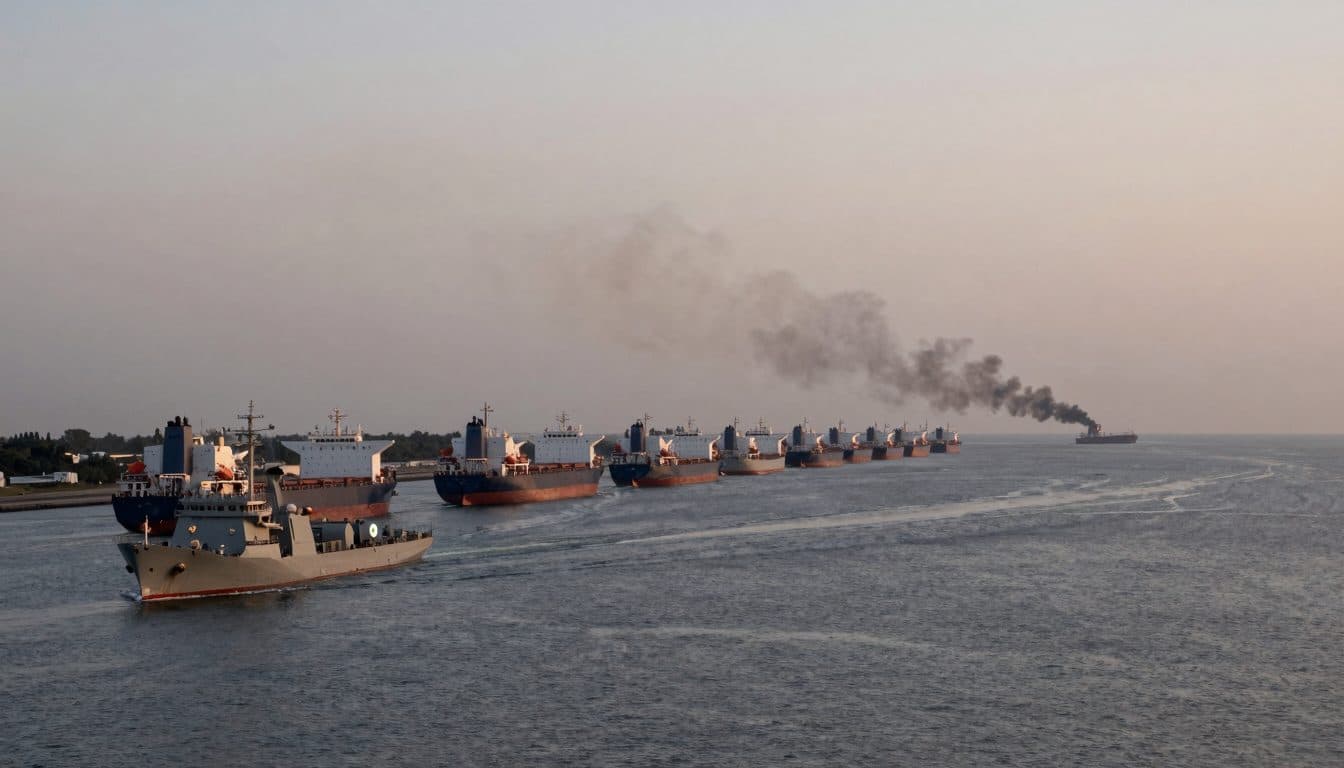
AI-generated image (z-image via Kie.ai)
Summary
The US has, according to its own statements, carried out a third round of strikes on targets in Iran within a week. The trigger was a rocket attack by the Iranian Revolutionary Guards on a Cypriot container ship in the Strait of Hormuz, in which one crew member is missing. The strait is once again closed until further notice.
Dubai, July 12, 2026
US forces carried out a new round of strikes against targets in Iran overnight into Wednesday – the third within a week, as the US network CNN and other media reported, citing US officials.
Background: Attack on Cypriot container ship
According to US regional command Centcom, the renewed bombings were triggered by an attack by the Iranian Revolutionary Guards (IRGC) on a container ship sailing under the Cypriot flag in the strategically important Strait of Hormuz. The command responsible for the region stated that the ship had been attacked, a civilian crew member was missing, and the freighter was unable to continue its voyage due to a fire and significant damage to the engine room.
A US official confirmed to journalist Barak Ravid that the Revolutionary Guards had fired a rocket at a commercial ship that had attempted to pass through the Strait of Hormuz. "The ship was hit and severely damaged," it was said. The US government initially made no official statement on the incident.
The Revolutionary Guards, for their part, stated via their Telegram channel Sepah News that the ship had "endangered maritime security in the strait." According to this, several ships had previously attempted to take an unauthorized route and had ignored the Guards' requests to correct their course. The IRGC Navy also said it had fired warning shots at a ship in the strait and stopped it.
Iran closes the strait
Following the incident, the Revolutionary Guards announced via Iranian state media: "The Strait of Hormuz is closed again until further notice following an incident, as the Iranian Revolutionary Guards announced via state media." Passage is prohibited. The closure will remain in effect until further notice and until the end of US interventions in the region, the statement continued.
The IRGC Navy also warned that it would not tolerate any "foreign interference" in determining ship routes in the strait. "Such interference would trigger decisive action on the Iranian side," it said. Addressing the US, it declared: "Should the 'aggressor' launch new attacks against Iran, we will respond with further attacks on 'enemy bases' in the region."
Third US round of strikes in a week
The US strikes, carried out on the orders of US President Donald Trump, were the third round within a week. As CNN and other networks reported, citing US officials, the US military bombed targets in Iran again. The US had previously attacked oil facilities and military installations of the Islamic Republic multiple times after Iranian forces had attacked tankers and commercial ships in the strait.
Iran responded in turn with attacks that, according to media reports, also hit Kuwait, Bahrain, and Jordan – three countries that host important US military bases. Iranian forces repeatedly attacked US bases in the region. There are indications of the reconstruction of an Iranian military research facility.
The escalation follows a period of relative calm that a framework agreement reached in June between Washington and Tehran had ushered in. Representatives from Washington and Tehran had agreed in mid-June on a framework agreement intended to pave the way for a permanent end to the war – it included an agreement to negotiate a final deal within 60 days. "It also includes the demand for the opening of the commercially important Strait of Hormuz," the agreement stated.
Framework agreement and ceasefire – failed?
A ceasefire had also been in place since the beginning of April, but it was repeatedly broken and has now been declared ended by Trump. Trump declared the ceasefire over while simultaneously agreeing to talks. US President Trump is showing willingness to talk, but is also warning of new attacks.
In the background is the death of Iran's supreme leader, Ayatollah Ali Khamenei, who was killed in an Israeli attack at the end of February. After the funeral service for his killed father, Iran's supreme leader Mojtaba Khamenei is threatening revenge. "Revenge is the demand of our people and must certainly be carried out," said a statement attributed to Khamenei's son and successor Mojtaba. After the burial of Khamenei, Iran's new leadership is swearing revenge.
Diplomatic efforts from Oman
Diplomatic efforts regarding the strait are meanwhile continuing. On Saturday, Oman's Foreign Minister Badr al-Busaidi received his Iranian counterpart Abbas Araghchi to discuss the situation in the Strait of Hormuz. Iranian state television reported that the two had exchanged views on "appropriate mechanisms to ensure the safe passage of ships." "Previously, Iranian Foreign Minister Araghchi had held talks in Oman on shipping traffic in the strait. According to the information, no agreement has yet been reached."
According to CNN, citing informed individuals, Oman proposed a deal for safe shipping routes: a southern route through Omani territory and a northern route through Iranian waters. According to this, the northern route would be controlled and cleared by Iran, but no fees would be charged for either route, according to CNN. "Axios" reporter Barak Ravid confirmed the proposal on X, but said there was no agreement yet.
From Oman, it was said that the talks would be continued at the political and technical level, the country's news agency reported. Insiders also report that the US, Iran, Qatar, and Pakistan are planning a conference call. "The US is demanding, according to media reports, that Iran publicly guarantee free and safe shipping in the Strait of Hormuz," it was further reported.
Iranian reaction and threats of retaliation
Washington has given Tehran a deadline until Saturday to publicly declare an end to the attacks in the strait and to assure that the Strait of Hormuz is open to shipping, the US news portals Axios and "Politico" reported. The US is reimposing sanctions on Iranian oil; the US Treasury Department is freezing assets of Iranian networks, and the sanctions also target exchange offices and front companies.
Iran rejected Trump's account that Tehran had asked for negotiations with the US. However, it had complied with a request from a regional mediator to discuss the current situation, Iranian Foreign Ministry spokesman Ismail Baghaei said on Saturday. While Trump threatened Iran on Saturday night on his social network Truth Social with "complete" destruction in the event of an assassination attempt against him, US media reported on Friday that Israeli intelligence had informed Washington of a new "concrete" Iranian plan to assassinate Trump. The US government had received intelligence about possible assassination plots against Trump for some time, "but the warning from Israel was new and referred to a concrete plot."
The Iranian leadership announced "revenge" for the death of its supreme leader, Ayatollah Ali Khamenei. The Tehran-based newspaper "Hamshahri," which belongs to the Tehran city administration, published a list on Saturday of those allegedly responsible for Ayatollah Khamenei's death. Shown on it, according to the newspaper, were Italian Prime Minister Giorgia Meloni, depicted in an orange prisoner jumpsuit, as well as Trump and Israeli Prime Minister Benjamin Netanyahu, each with targets on their foreheads. "The list also included British Prime Minister Keir Starmer, French President Emmanuel Macron, German Chancellor Friedrich Merz, and several high-ranking US and Israeli government officials."
This report was broadcast on 12.07.2026 on Deutschlandfunk; the news was also distributed via the dpa news channel. Financial markets also reacted: the gold price fell slightly to 4107.22 US dollars per fine ounce. The EU is meanwhile considering sanctions over Israeli settlement policy, a matter not directly related to the Hormuz incident but falling within the overall context of tensions.
Whether the already fragile talks can be continued after the new escalation was unclear at the time of reporting. Iran declared that "until the end of US interventions in the region, no ship will be allowed passage," further intensifying the already tense situation in one of the world's most important waterways.
Questions & Answers
Who attacked the container ship in the Strait of Hormuz?
According to US regional command Centcom and a US official, the Iranian Revolutionary Guards (IRGC) attacked a container ship sailing under the Cypriot flag in the strait with a rocket and severely damaged it.
Why did the US bomb targets in Iran again this week?
The US strikes, carried out on the orders of US President Donald Trump, were, according to US statements, a response to the Revolutionary Guards' rocket attack on the Cypriot container ship; it is the third round of strikes within a week.
What diplomatic efforts are currently underway regarding the Strait of Hormuz?
Iranian Foreign Minister Abbas Araghchi held talks in Oman on shipping in the strait; according to the information, no agreement has yet been reached; at the same time, the US, Iran, Qatar, and Pakistan are planning a conference call, according to insider reports.
US Iran strikes Strait of Hormuz closed July 2026 | allfacts360