US airstrikes on Iran escalate: Strait of Hormuz remains contested
Berlin, July 12, 2026
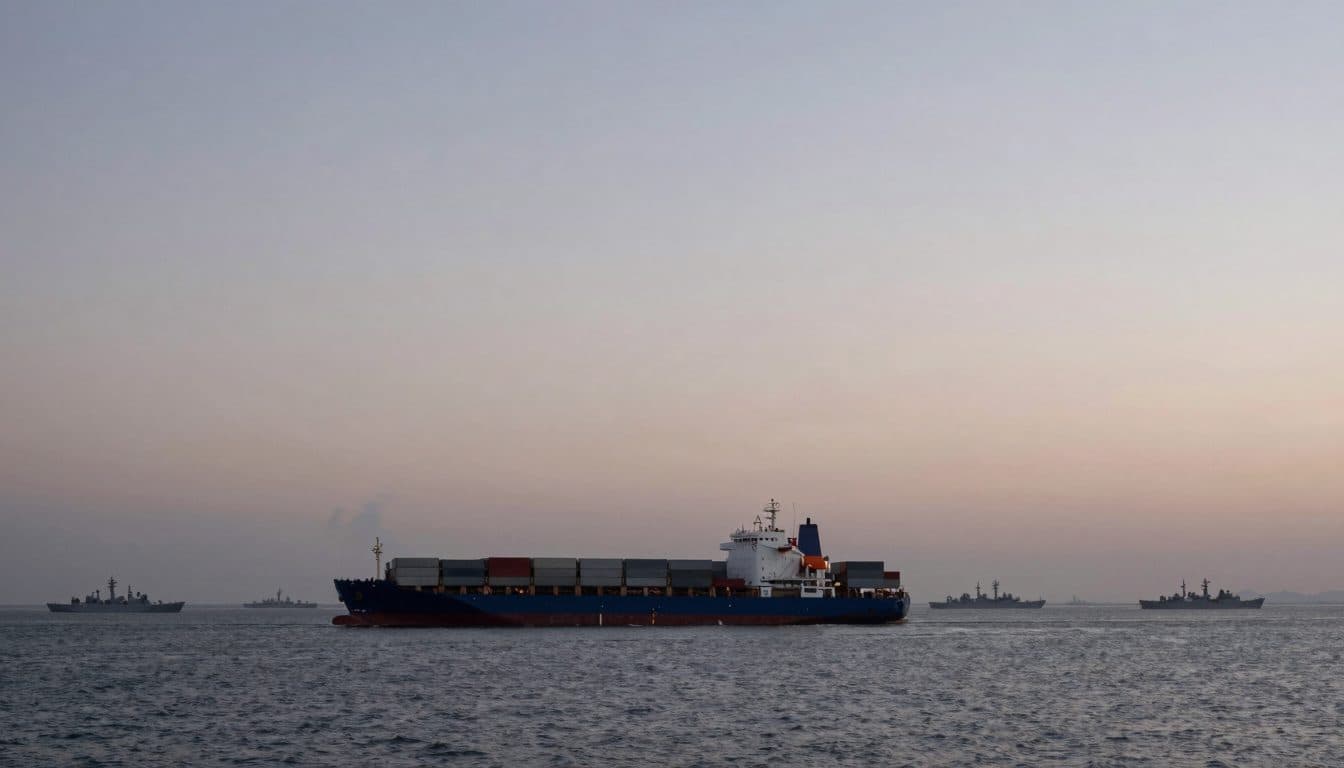
AI-generated image (z-image via Kie.ai)
Summary
The US has attacked Iranian targets for the third time within a week, after Iranian Revolutionary Guards fired on a cargo ship in the Strait of Hormuz. Iran again declared the strait — vital to world trade — closed, while the US side declared it open.
Berlin, July 12, 2026
The US attacked Iranian positions overnight into Sunday for the third time within a week, prompting Iran to again declare the Strait of Hormuz closed and to retaliate with drone and missile strikes on US bases in several Gulf states.
US forces carried out massive airstrikes on Iranian territory overnight into Sunday. According to US Central Command (Centcom), around 140 military targets were hit, including missile positions, drone launch ramps, ammunition depots, coastal surveillance infrastructure, and communications facilities. Over the three previous nights, the US military said it had struck more than 300 targets to weaken Iran's ability to attack civilian seafarers and commercial vessels. The strikes were ordered by US President Donald Trump, the US military said.
Military retaliation
The trigger for the latest strikes was the attack by Iran's Islamic Revolutionary Guard Corps (IRGC) on the Cypriot-flagged container ship "GFS Galaxy" in the strait. The hit struck the engine room and left the ship unable to maneuver. Of the eleven Indian crew members, ten were rescued according to India's foreign ministry; one Indian sailor is missing. On Sunday, the Iranian military said it had put a second ship out of action.
Iran responded to the US strikes with escalation across the region. Iranian forces fired kamikaze drones at targets in Kuwait and Bahrain and struck US military bases in the Gulf states as well as in Jordan with missiles. Three Iranian missiles hit Jordanian territory according to army reports, causing no casualties and only minor property damage. In Bahrain, warning sirens sounded at least three times in the early morning hours according to the interior ministry, and residents were urged to remain calm and seek shelter.
Contradictory assessments of the situation
The strategically vital Strait of Hormuz, through which a significant share of global oil and gas trade flows, was again declared closed by Tehran. The IRGC said on Sunday that the strait would remain "closed until further notice and until the end of US interventions in this region; no vessel will be permitted to pass." US Central Command (Centcom) pushed back: "Iran does not control the strait. Traffic is flowing," it said on the platform X. The US considers the Strait of Hormuz to be international waters and regards the southern route as open.
The military escalation is overshadowing a diplomatic process that had only recently begun between Washington and Tehran. In mid-June, both sides signed a framework agreement that provided, among other things, for a ceasefire and a commitment to negotiate a permanent deal to end the war that had been ongoing since late February within 60 days. After the signing, relative calm had temporarily prevailed in the region. On the sidelines of the NATO summit in Ankara, however, Trump declared the ceasefire over, citing alleged Iranian breaches of the agreement.
Diplomacy at a crossroads
According to Tehran, the framework agreement secured a US commitment that the only authorized shipping lane would run close to the Iranian coast. Ships using the northern corridor through Iranian territorial waters would require prior Iranian authorization, with no fees charged. The US, for its part, insists on freedom of navigation along a southern route along the coast of Oman. On Saturday, Oman — which is mediating in the conflict — put forward a proposal that would govern shipping through two separately controlled corridors, both of which would remain open.
Diplomatic talks on the future administration of the strait ended on Saturday in the Omani capital Muscat without a breakthrough. Iran and Oman did, however, agree to continue the format at the political and technical level. Iranian Foreign Minister Abbas Araghchi had previously met his Omani counterpart Sayyid Badr Albusaidi in Muscat and taken the proposal back to Tehran in principle. According to US media reports, the US had set a deadline of Saturday to force Iranian concessions for free and secure navigation.
Oman as mediator
US President Donald Trump described the strikes as retaliation in a CNN interview on Sunday. "We hit them hard last night," Trump said. Speaking to NBC News, he said the US had "wiped them out." The US had "wiped them out last night," Trump said. At the same time, he said Iran had been "close to a 'deal'" on Saturday. Then Iran "suddenly, two hours later, attacked a ship with a drone." Trump added: "There's something wrong with these people."
Pete Hegseth said Iran had "made a bad decision. Now it has to pay for it." Mohammad Baqer Ghalibaf, speaker of the Iranian parliament, wrote on the platform X: "The era of one-sided deals is OVER. We told you: keep your word or pay the price." Iran's military spokesman Amir Akraminia accused the US, according to the Iranian news agency Tasnim, of imposing an irregular route south of the Strait of Hormuz "that contradicts the agreement signed with the Islamic Republic of Iran."
Propaganda and saber-rattling
The Supreme Leader's military adviser, Mohsen Resai, called the strait "more important than dozens of atomic bombs, and the Islamic Republic of Iran will protect it." A statement read out on Iranian state television, attributed to the son and successor of the Supreme Leader, Mojtaba, declared: "Revenge is the demand of our people and must certainly be carried out." Mojtaba Khamenei, who has not appeared in public since his appointment as the new Supreme Leader more than four months ago, had on Sunday described Hormuz as one of the country's "deterrent tools."
The humanitarian consequences of the fighting are also devastating for civilian seafarers. According to UN figures, nearly 6,000 seafarers are stranded in total, including 37 ships under Indian flag with more than 1,100 crew members in the Persian Gulf. At least seven Indian seafarers have been killed since the war began on February 28. The British maritime authority UKMTO reported that the crew of a container ship had abandoned the vessel after a fire and been rescued. A fire broke out on another cargo ship, and the crew was taken aboard a rescue vessel according to UKMTO.
Attacks on civilian shipping are also hitting the civilian population in the region directly. According to Qatar's interior ministry, three people were injured by falling debris, and the defense ministry reported the interception of a missile attack. Qatar's foreign ministry condemned the attacks on the Gulf states as a "dangerous escalation" and recommended suspending shipping and all other "sea-based activities" until further notice, including fishing, recreational vessels, and jet skis. The Gulf states of Qatar and the United Arab Emirates said they had intercepted missile attacks and later issued broad all-clears.
Humanitarian and economic consequences
Iranian state media reported explosions along the country's southern coast, particularly along the coast near the Strait of Hormuz in Bushehr province, on the strategically important island of Qeshm, and in the coastal city of Bandar Abbas. According to the Mehr news agency, the head of the telecommunications authority of Hormozgan province, who had been dispatched there for repairs, was killed on Qeshm island; two other employees were injured. According to Tehran, an Iranian soldier was also killed who, according to the Mehr and Tasnim agencies, died in an attack on the port of Jask in the south of the country.
The effects of the shipping blockade are being felt worldwide. Since shipping in the Strait of Hormuz has come to a standstill, the economic consequences are also being felt in the US, where the population is suffering from high inflation and sharply rising gasoline prices. According to political observers, the Trump administration is coming under increasing pressure to resolve the conflict with Iran, particularly with an eye to the congressional elections in the fall. Since the war began on February 28, Trump has announced an upcoming peace deal 40 times, according to a count of public appearances.
International reactions
Pakistan, which is acting as a mediator, called on Tehran and Washington for restraint. The high-circulation Iranian newspaper Hamshahri published a "kill list" of senior politicians whom the leadership in Tehran allegedly intends to target. The list includes, among others, Friedrich Merz and Giorgia Meloni. Trump had already stated earlier in the week that he was at the top of Iran's "death list."
The situation in the region remains highly unstable. Both Iran and the US have ensured — through maritime blockades, attacks, and mine-laying — that the important shipping route is not passable. According to the assessment of the Joint Maritime Information Centre (JMIC), overseen by the US Navy, the security threat level in the strait remains "high." The JMIC also stated: "US forces stand ready to uphold freedom of navigation and protect lawful commerce in accordance with international law. The southern route of the strait remains open."
Questions & Answers
Why has the US attacked Iran again?
According to the US military, the attack was carried out in retaliation for the IRGC's strike on the Cypriot-flagged container ship "GFS Galaxy" in the Strait of Hormuz. The strikes were carried out on the orders of US President Donald Trump.
What role does the Strait of Hormuz play in the conflict?
The strait is of existential importance to global oil and gas trade. Iran is using it as a strategic lever and again declared it closed after the US strikes, while the US regards it as an open international shipping route.
What did the mid-June framework agreement provide for?
The framework agreement signed in mid-June provided, in addition to a ceasefire, for
US attacks on Iran: Strait of Hormuz blocked | 07/12/2026 | allfacts360