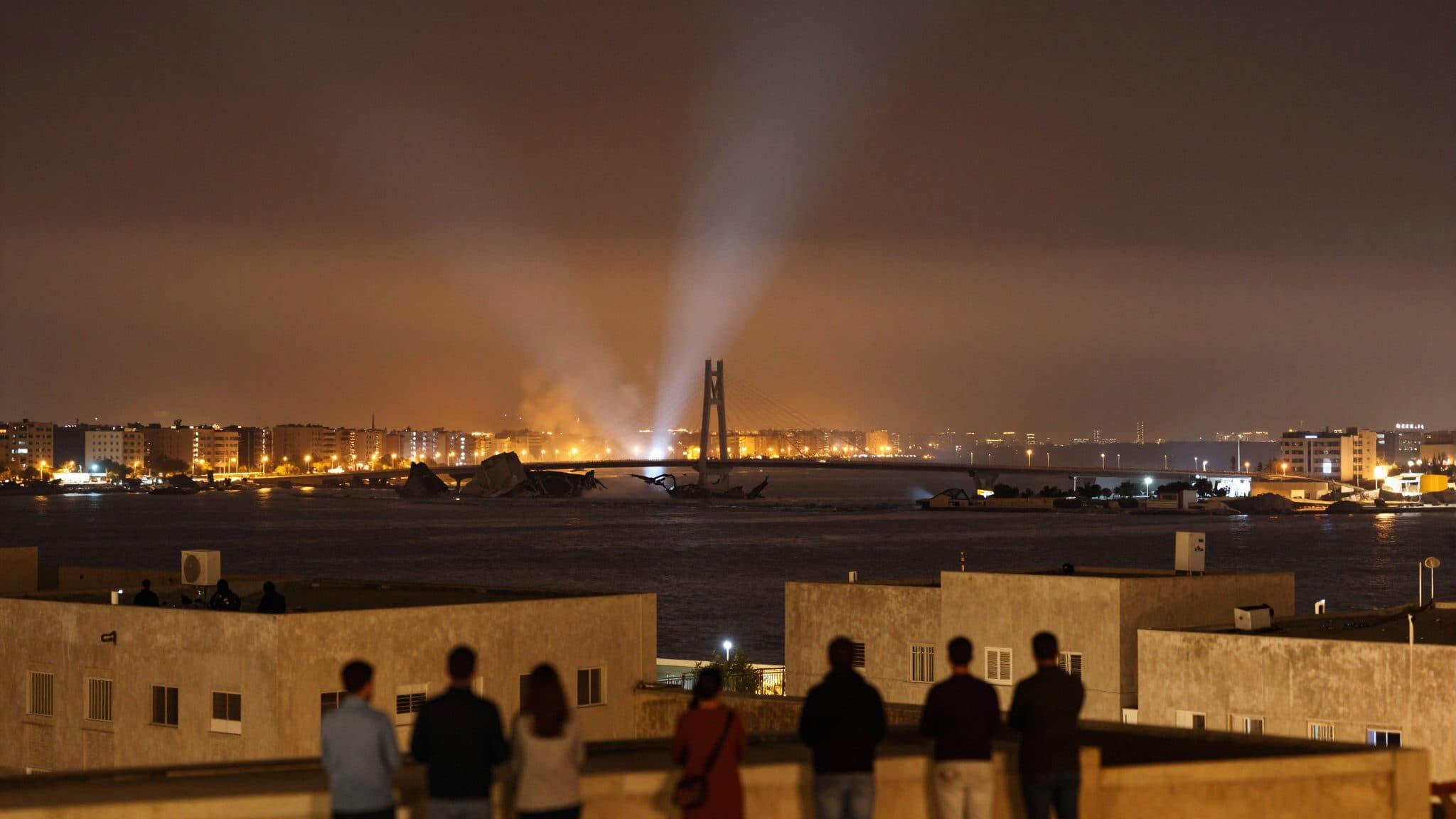
US Strikes Hit Bridges and Airport in Southern Iran as Tensions Escalate Across the Gulf
Washington, 17 July 2026
AI-generated image (z-image via Kie.ai)
Summary
The United States carried out a new wave of airstrikes against targets in southern Iran, including bridges and an airport, while Iran reported retaliatory attacks on US facilities in several neighboring countries. The escalation has raised casualty counts, disrupted shipping near the Strait of Hormuz, and renewed fears of a wider regional war.
Washington, 17 July 2026
The United States carried out a new wave of airstrikes on southern Iran on 17 July 2026, hitting bridges, an airport and military infrastructure, prompting Iran to report retaliatory strikes against US facilities in Bahrain, Kuwait, Oman, Jordan and Syria.
US Strikes and Iran's Response
The strikes, announced by US Central Command (Centcom) on X, used precision munitions against dozens of military targets. Centcom stated the goal of the operation was to "further weaken Iran's military capabilities," striking air defense systems, coastal surveillance radar installations, and other military sites. "Man habe mit Präzisionsmunition unter anderem Flugabwehrsysteme und Radaranlagen zur Küstenüberwachung getroffen," the command said in its statement.
Iranian state media reported that the new round of attacks hit an airport and two bridges in southern Iran, and later said five bridges had been struck in total. The Iranian news agency Fars reported that the Kahurestan and Gariweh bridges on transport routes in Hormozgan province were hit. The Kahurestan Bridge lies on the route connecting the port city of Bandar Abbas with the city of Shiraz further northwest, a corridor the New York Times described as a vital link between the Persian Gulf coast and the Iranian interior.
The BBC was able to verify an attack on a bridge west of Bandar Abbas. A series of explosions was reported in the port city itself, which the Wall Street Journal noted hosts a naval base of Iran's powerful Revolutionary Guard Corps and is critical to Iran's ability to project power in the Strait of Hormuz. Iranian media also reported explosions in the city of Bushehr, where the country's only active nuclear power plant is located.
Casualties and Damage in Iran
Iran's health ministry said 38 people had been killed and more than 400 injured since fighting escalated on 22 June. Iran's state-aligned Press TV reported that at least seven people were killed in the latest round of attacks. Iranian state media said the road between Bandar Abbas and the cities of Chamir and Lar was completely closed, as was a second connection in the region.
Retaliation Across the Region
Iran retaliated by striking US positions across the region. The Iranian army reported a series of retaliatory strikes against US targets in surrounding countries. A US military helicopter base and a reconnaissance aircraft in Bahrain were targeted, according to Iranian reports, along with a rail connection and a maritime surveillance tower. Two US radar installations in Oman were attacked, including a maritime surveillance radar in the Salama region and an air surveillance radar in the Ghanam region. US facilities in Jordan were also reported to have been attacked, with Jordan saying it had intercepted three Iranian missiles.
In Kuwait, the air defense was activated in response to missile and drone attacks, according to the country's army. Kuwait reported intercepting 32 hostile drones. Press TV reported that US radar installations and missile launchers in Kuwait were on fire. Iran's Revolutionary Guard said it struck the former US military base al-Tanf in southeastern Syria on Friday morning.
In Qatar, a child was injured by falling debris during air defense operations, according to the Qatari interior ministry. The incident underscored the growing risk to civilians across the Gulf as the confrontation widened.
Trump's Warnings and Diplomatic Signals
US President Donald Trump, in a televised address to the nation on Thursday evening local time, said the United States was achieving "great success" in Iran, telling Americans: "die USA erzielten im Iran 'große Erfolge, und Sie werden die Früchte dieser Arbeit schon sehr, sehr bald sehen.'" In a separate interview with Fox News, Trump escalated his rhetoric, warning that all power plants and bridges would be destroyed next week unless Iran came to the negotiating table.
White House spokeswoman Karoline Leavitt offered a more conciliatory note, saying Tehran remained interested in a deal with Washington and that the two sides were "in close contact." "Der Iran steht nach wie vor in engem Austausch mit den Vereinigten Staaten von Amerika," she told reporters at the White House on Thursday. The dual messaging from the administration raised questions about the direction of US policy.
US Defense Secretary Pete Hegseth pushed back against Iranian assertions of control over the strategic waterway, writing on X that "der Iran kontrolliere die Straße von Hormus nicht." Iranian parliament speaker and chief negotiator Mohammad-Bagher Ghalibaf reiterated Iran's position that it claims control over the strait, a vital artery for global trade in oil, gas and fertilizer.
Strait of Hormuz and Naval Blockade
Iran's ambassador to the United Nations said US attacks on civilian infrastructure constituted war crimes. The exchange of accusations came as the economic impact of the conflict rippled through energy markets. A barrel of North Sea Brent crude for September delivery was last quoted at $84.01, down 0.26 percent on the day, but analysts warned that refined products were under much greater pressure than crude.
"Raffinierte Produkte stehen viel stärker unter Druck als Rohöl," said Simon Lack, a portfolio manager at the Catalyst Energy Infrastructure Fund, in comments to Bloomberg. Another market expert noted: "Wir hatten nur diese kurze Phase der Entspannung, als Energie-Manager gewarnt haben, dass wir unsere Lagerbestände abbauen und es im System wirklich nicht mehr viel Puffer gibt." Fuel markets in the United States and Europe were signaling record-high scarcity, raising the risk of higher costs for already-strained consumers.
Economic Fallout and Energy Markets
The United States has re-imposed a naval blockade against Iranian ports. Since the blockade was reinstated earlier in the week, the US has redirected three ships and disabled another that did not follow instructions. The move threatened to further constrict Iranian exports and intensify the standoff at sea.
The Wall Street Journal reported that the bridge strikes were intended to cut supply routes to an Iranian naval base on the Strait of Hormuz. By targeting transportation infrastructure, the United States appeared to be seeking to limit Tehran's ability to resupply its forward naval positions, even as diplomatic channels, at least publicly, remained open.
With both sides signaling further escalation, the situation in the Gulf remained highly volatile. Trump's warning of additional strikes on power plants and bridges, combined with Iran's threats to maintain its grip on the Strait of Hormuz, set the stage for what diplomats and analysts warned could become a wider regional war with global economic consequences.
Questions & Answers
What did the United States strike in Iran on 17 July 2026?
US Central Command (Centcom) said precision munitions were used against dozens of military targets, including air defense systems, coastal surveillance radar installations, an airport, and bridges in southern Iran, including the Kahurestan and Gariweh bridges in Hormozgan province.
How did Iran respond to the US strikes?
Iran's army reported retaliatory strikes against US targets in neighboring countries. According to Iranian reports, a US helicopter base and reconnaissance aircraft in Bahrain, radar installations in Oman, US facilities in Jordan, and the former US base al-Tanf in Syria were targeted.
What did President Trump say about the conflict?
President Donald Trump told Fox News that all power plants and bridges would be destroyed next week unless Iran came to the negotiating table. In a separate address to the nation, he said the US was achieving "great success" in Iran.
US Strikes Bridges in Iran, Iran Retaliates Across Gulf | allfacts360