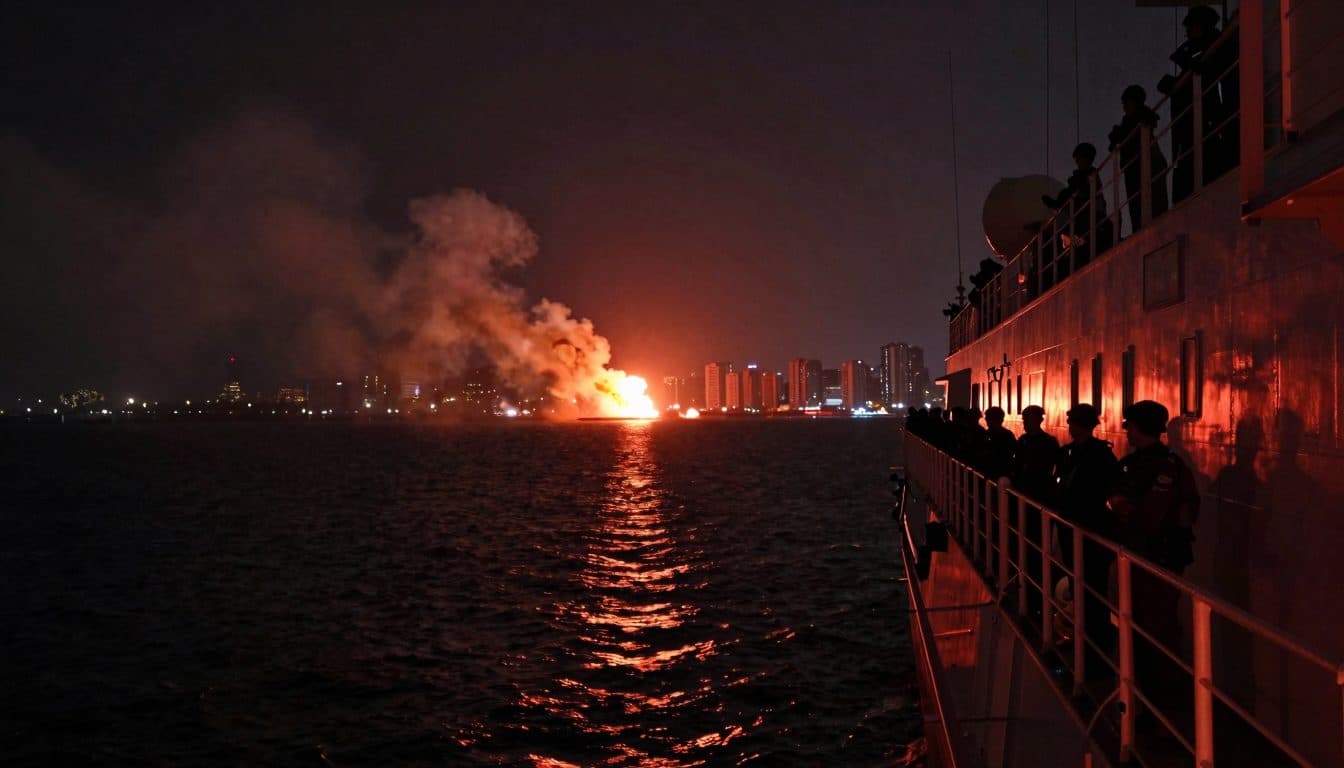
USA Iran War: Fourth wave of strikes on Hormuz (July 2026) | allfacts360
USA and Iran escalate war with mutual strikes – fourth US wave of attacks in one week
Dubai, July 13, 2026
AI-generated image (z-image via Kie.ai)
Summary
The USA attacked dozens of targets in Iran again on Sunday and Monday, while Tehran retaliated with strikes on US bases in Kuwait, Bahrain, and Jordan. UN Secretary-General António Guterres warned of a full resurgence of the war and called for the immediate resumption of negotiations.
Dubai, July 13, 2026
The USA and Iran exchanged attacks on Sunday and Monday, with the USA, according to its own statements, bombing dozens of targets in Iran for the fourth time within less than a week, while Tehran responded with retaliatory strikes on US bases in Kuwait, Bahrain, and Jordan.
US wave of strikes on Iranian infrastructure
The US military attacked Iranian air defense systems, coastal radar stations, missile and drone positions, as well as small boats on Sunday, according to the responsible regional command CENTCOM. "The US military attacked dozens of targets in multiple locations in Iran with its latest wave of strikes, according to its own information," the armed forces stated. In addition to fighter jets and aerial drones, floating combat drones were reportedly deployed for the first time.
It was already the fourth American wave of strikes since the war escalated again on the night of Wednesday. The US attacks had reportedly taken place around midday, after the US military had originally declared its wave of strikes complete in the morning. On Saturday, CENTCOM had already reported having attacked more than 300 Iranian targets within three nights in order to weaken Iran's military striking power.
Casualties in Iranian cities
According to the Iranian news agency ISNA, two people were killed and three others injured in the attacks in the industrial city of Abadan on the border with Iraq. "In the industrial city of Abadan on the border with Iraq, there were several dead and injured according to local authorities." In addition, the Iranian online portal "Hammihan" reported that a guard stationed in front of an agricultural water pumping station had been killed in the city of Mahshahr. The industrial province of Khuzestan in southwestern Iran was also hit. There had previously been two deaths in Iran caused by US attacks.
Iran's retaliatory strikes against US bases
The Iranian Revolutionary Guards (IRGC) responded with retaliatory attacks on US bases in the neighboring Gulf states. According to Iranian state media, the IRGC fired on a mobile rocket artillery system of the US Army in Kuwait, fuel and ammunition depots at Prince Hassan Air Base in Jordan, as well as a control center at US base Sheikh Isa in Bahrain. The powerful Revolutionary Guards announced on Monday that they had targeted American military facilities on the Persian Gulf in response to recent US attacks.
In addition, the Revolutionary Guards stated that they had damaged a fighter jet maintenance center in Qatar as well as American logistics bases in Oman over the weekend. They also claimed to have destroyed radar systems in Oman and to have fired on fuel and ammunition depots at Prince Hassan base in Jordan. According to the online journalist "Vahid," strikes on Bandar Abbas were continuous: "In Bandar Abbas they are striking continuously, and the eleventh-grade students must be at school in an hour because they have an exam."
In Tehran, the Foreign Ministry condemned the latest overnight attacks and accused the USA of having "caused a return of insecurity in the Strait of Hormuz as well as disruptions to international commercial shipping." The attacks had nullified all diplomatic efforts of the past months. Iranian chief negotiator Mohammad-Bagher Ghalibaf wrote on X on Sunday: "Die Ära einseitiger Abkommen ist vorbei. Wir haben euch gesagt: Haltet euer Wort oder zahlt den Preis! Die Realität holt euch ein." Foreign Ministry spokesman Ismail Baghaei stated on Monday that Iran no longer felt bound by the framework agreement.
Strait of Hormuz between closure and counter-claims
The government in Tehran declared the strategically important Strait of Hormuz closed once again. Control over the waterway, through which officially 120 to 150 ships per day sailed before the war and through which one-fifth of global oil and liquid gas was transported, remains unresolved. The ship tracking tool Keplr counted only six official ship passages on Sunday; at the end of June/beginning of July, there had already been around 50 again on peak days. CENTCOM, however, declared that shipping through the Strait of Hormuz was continuing and wrote on X that the passage was open for "legal" shipping and that Iran was not exercising control.
Israeli Iran expert Danny Citrinowicz wrote in a guest article for the newspaper "Israel Hayom" that the new Iranian leadership was aware "dass gegenüber den USA ein gewisses Maß an Pragmatismus erforderlich ist." Tehran is now more willing to consistently use military force. It is a leadership that "bei der Bewältigung der Krise pragmatischer vorgeht, ideologisch jedoch nicht gemäßigter ist." According to the Critical Threats Project of the Institute for the Study of War (ISW) and the American Enterprise Institute, Iran regards control over the Strait of Hormuz as an important strategic objective; from Tehran's perspective, an end to the war without this control would be a severe strategic defeat.
Power of the Revolutionary Guards and Iranian strategy
Washington must decide: to escalate the confrontation in the Strait of Hormuz or to accept an agreement and focus on preventing Tehran from building an atomic weapon, Citrinowicz wrote. With the killing of influential generals and high-ranking politicians, the Revolutionary Guards have, according to common expert assessment, further expanded their power in the Islamic Republic. Iranian state television also reported that Iran had fired "Warnschüsse" at two ships attempting to traverse the waterway on Monday.
The framework agreement from mid-June had originally provided for a ceasefire and obligated Iran to make best efforts to ensure safe and 60-day duty-free passage of commercial ships through the Strait of Hormuz. Under this agreement, Iran and Oman were to consult with other Gulf states on the future administration of the waterway. US President Donald Trump declared the agreement void a few days ago. In a phone interview with Fox News, he announced: "Wir werden die Meerenge behalten und sie wahrscheinlich kontrollieren," and demanded compensation for the US operation: "Wir werden eine Entschädigung erhalten, denn die anderen Nationen sind sehr wohlhabend. Sie stehen auf unserer Seite, und man kann erwarten nicht, dass wir das umsonst tun."
Failed framework agreement and Trump's demands
The USA accuses Iran of having attacked ships in the waterway multiple times. Talks on Saturday in the Omani capital Muscat ended without a breakthrough. According to CNN, Oman had proposed a plan under which ship traffic on the southern route through the waterway should be free as before the war, while for the northern route along the Iranian coast, permits from Tehran would be required. According to Baghaei, Iran remains in contact with the mediating states Qatar, Pakistan, and Oman in order to prevent further escalation.
UN Secretary-General António Guterres expressed on X being "zutiefst besorgt" about the "signifikante Eskalation" and called for the immediate resumption of negotiations. A full resurgence of the war could have catastrophic consequences. Austrian Foreign Minister Beate Meinl-Reisinger (NEOS) expressed concern on Monday at the EU Foreign Affairs Council in Brussels about the renewed escalation and stated that Europe was ready to take responsibility. The Brent crude oil price rose by up to five percent at times in the course of the escalation and was still up 3.5 percent on Monday, after having fallen significantly in June following the signing of the framework agreement.
Diplomatic efforts and energy prices
The reports from both warring parties cannot be independently verified. The islands of Qeshm and Sirik had also been bombed in recent days, as Iranian media reported overnight before Monday, citing explosions on the southern coast. The war between the USA and Israel against Iran began on February 28. The current situation remains unclear as diplomatic efforts are to be continued under the pressure of violence.
Questions & Answers
Who is Mohammad-Bagher Ghalibaf and what did he say?
Mohammad-Bagher Ghalibaf is, according to the facts, Iran's chief negotiator. On Sunday he wrote on X that the era of one-sided agreements is over: "Wir haben euch gesagt: Haltet euer Wort oder zahlt den Preis! Die Realität holt euch ein."
Why is the Strait of Hormuz so important?
Before the war, officially 120 to 150 ships per day sailed through the waterway, through which one-fifth of global oil and liquid gas was transported. Both the USA and Iran regard control over this route as a central strategic objective.
How did UN Secretary-General Guterres react to the escalation?
UN Secretary-General António Guterres expressed on X being "zutiefst besorgt" about the "signifikante Eskalation," called on Iran and the USA to immediately resume negotiations, and warned that a full resurgence of the war could have catastrophic consequences.