US Strikes on Iranian Coastal Infrastructure: Revolutionary Guards Threaten Further Retaliatory Strikes
Washington/Tehran, July 17, 2026
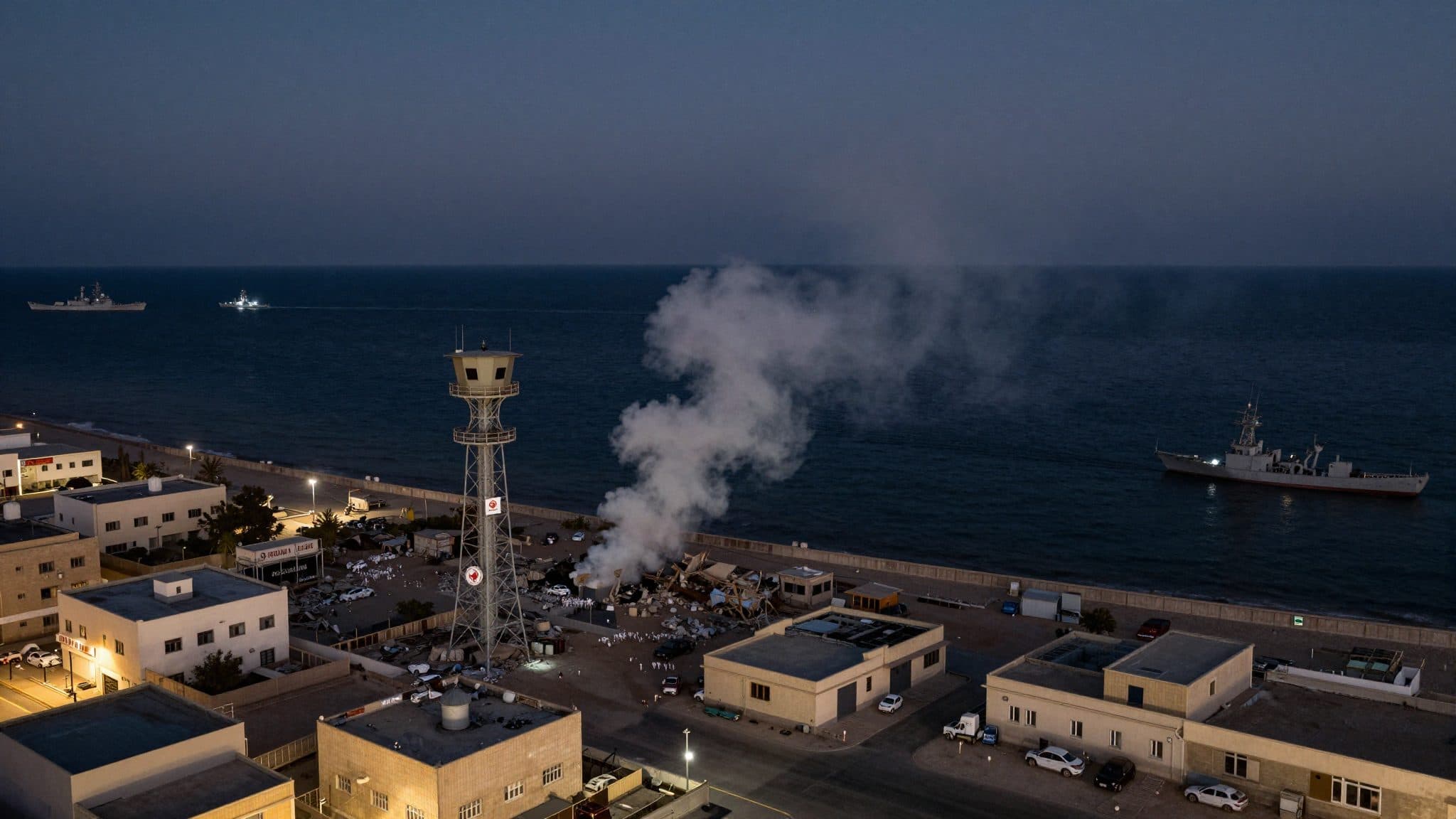
AI-generated image (z-image via Kie.ai)
Summary
The US military has bombed targets in Iran for the sixth consecutive night, including bridges, an airport, and a Revolutionary Guards surveillance tower on the…
Washington/Tehran, July 17, 2026
The US military has bombed targets in Iran for the sixth consecutive night, including bridges, an airport, and a Revolutionary Guards surveillance tower on the Strait of Hormuz, while the commander of the Iranian Air Force announced retaliation until calm is restored on the Iranian coast.
Strikes on Bridges, Airport, and Surveillance Tower
The US Air Force carried out a new wave of strikes on targets in Iran overnight into Friday (CEST). According to a post on platform X by the responsible regional command CENTCOM, it was the sixth consecutive night of strikes. US President Donald Trump had previously announced on Fox News that all power plants and bridges would be destroyed in the coming week if Iran did not come to the negotiating table.
According to Iranian reports, the strikes hit bridges, an airport, and maritime infrastructure. The Iranian news agency Fars cited official sources and reported that the Kahurestan and Gariveh bridges on transport arteries in Hormozgan Province had been hit. According to the New York Times, the Kahurestan Bridge connects the port city of Bandar Abbas with the city of Shiraz, located further northwest, and is considered an important route between the coast on the Persian Gulf and the southern Iranian hinterland. The road between Bandar Abbas and the cities of Khamir and Lar was completely closed, as was a second connection in the region.
The attacked airport is located further inland in the city of Iranshahr in Sistan-Baluchestan Province. According to a Wall Street Journal report, Bandar Abbas hosts a naval base of the Iranian Revolutionary Guards (IRGC) and is crucial to Iran's ability to exert power in the Strait of Hormuz. The Wall Street Journal reported, citing a US official, that the strikes on bridges were intended to interrupt supply routes to this naval base.
The Tasnim news agency also reported that one person was killed in a strike on a telecommunications tower in the coastal city of Bandar Abbas. According to Iranian figures, a total of 38 people have been killed in July so far in connection with US strikes. The Iranian Health Ministry reported more than 400 injured since June 22. Press TV spoke of seven killed in strikes.
Threat from Tehran: Strikes Until Calm on the Coast
The US military said it had destroyed a tower on Thursday that was part of a maritime surveillance network along the Iranian coast on the Gulf of Oman. The Iranian Revolutionary Guards (IRGC) had used the tower for decades to track and target commercial ships in the Strait of Hormuz. The US military further stated that the destruction of the tower directly weakens the IRGC's ability to coordinate attacks on innocent civilian crew members. The strike carried out on Thursday also protects the freedom of navigation for all ships, except those attempting to breach the US naval blockade against Iranian ports.
The commander of the Air Force of the Iranian Revolutionary Guards stated in a declaration disseminated by the Tasnim news agency that attacks would continue from all over Iran until calm was restored on the country's own coast. Iranian Parliament Speaker and chief negotiator Mohammad Baqer Qalibaf reaffirmed in a partially televised statement that Iran claims control over the Strait of Hormuz, which is important for global trade in oil, gas, and fertilizers.
The US had also reimposed a naval blockade against Iranian ports this week. Since the resumption of the blockade at the beginning of the week, the US side had redirected three ships and disabled another ship that did not follow instructions, it was said. The US military released photos showing US Marines boarding and searching a commercial vessel. US Secretary of Defense Pete Hegseth wrote on X that Iran does not control the Strait of Hormuz.
Retaliatory Strikes Against Gulf States
Iran responded with strikes on targets in the Gulf states allied with Washington: Kuwait, Bahrain, and Qatar. In Kuwait, air defense units were deployed in response to missile and drone attacks, according to the Kuwaiti army. Press TV reported that US radar installations and missile launchers in Kuwait had caught fire. Bahrain's Interior Ministry had previously reported a siren warning on X. The Iranian army announced via Press TV that it had struck a helicopter landing pad and a US military reconnaissance aircraft in Bahrain in retaliatory strikes. Qatar's Interior Ministry reported that a child was injured by falling debris during air defense operations.
Iran also spoke of strikes on targets in Syria, Iraq, and Jordan. The Gulf state of Kuwait reported damage to a power plant. According to Kurdish rebels, Iranian strikes killed nine people in northern Iraq. Iran called on its population to save electricity. Iran attacked Syrian territory for the first time.
In the week of the article, shipping in the Strait of Hormuz had nearly come to a standstill following Iranian attacks on tankers as well as drone and missile attacks on military bases in Bahrain, Kuwait, and Jordan. Ships had recently had to take a northern route through Iranian waters, while the US Navy escorted ships on a southern route along the coast of Oman. At the beginning of the conflict, Iran had reportedly demanded 1.7 million euros per ship for the use of the waterway.
Strait of Hormuz: Lifeline of Global Energy Trade
Greek maritime risk management firm MARISKS stated that the limited progress achieved after the ceasefire in June has now effectively been undone. The probability of further escalation remains very high. Iran's message is equally clear: either all regional producers export energy, or none do. The direct threat from Iran against the Gulf region's alternative oil export infrastructure may be the most significant development in the current situation.
Before the attacks by Israel and the US on Iran on February 28, the Strait of Hormuz was a toll-free international waterway. A preliminary ceasefire agreement between the US and Iran had been signed on June 17, which initially brought some relief for shipping, but is no longer in effect. Almost a month before the attacks, the two sides had signed a declaration of intent to end the Middle East war that began in February.
The Strait of Hormuz is one of the most important energy trade routes in the world. According to the International Energy Agency (IEA), about 20 percent of globally traded liquefied natural gas (LNG) was transported through the strait before the conflict. According to the US Energy Information Administration (EIA), this corresponded to an average of about 20 million barrels per day in recent years. About 20 percent of global crude oil was transported through the strait from the Persian Gulf to the Arabian Sea and beyond, with the majority going to Asia. In the first quarter, throughput through the Strait of Hormuz fell to about 14.6 million barrels per day and has declined sharply since the conflict escalated.
Iran, Iraq, Kuwait, Qatar, and Bahrain remain predominantly dependent on the Strait of Hormuz for their oil exports. Additional pipelines in Iraq, Jordan, Kuwait, and Turkey are either operational or under construction, but their capacities are limited and cannot compensate for a major disruption in the Strait of Hormuz. According to the IEA, these alternative pipelines can redirect a maximum of 8.8 million barrels of oil per day. Saudi Arabia has the East-West Pipeline (Petroline) and the United Arab Emirates has the Abu Dhabi Crude Oil Pipeline, both of which bypass the strait. Saudi Arabia was most recently able to circumvent blockades in the Strait of Hormuz by routing oil through pipelines and ports on the Red Sea. The UAE plans to expand its existing infrastructure and build a new port with a container terminal on its east coast.
Houthi Threats and the Yemen Conflict
Analysts warn that further attacks on Iran could trigger retaliatory measures against oil and gas infrastructure in the Gulf, including refineries, ports, and pipelines. Guntram Wolff, Senior Fellow at the think tank Bruegel and Professor of Economics at the Free University of Brussels, stated that months of airstrikes have not eliminated Iran's ability to control the Strait of Hormuz.
The Houthi militia in Yemen is considered one of Iran's most important non-state allies. On Thursday, Houthi leader Abdel Malik al-Houthi had threatened neighboring Saudi Arabia with attacks on oil facilities, airports, and other sensitive targets. All Saudi Arabia's oil facilities and critical installations in the country are targets for our missiles and drones, al-Houthi said in a televised speech. On Monday, one of the heaviest confrontations in years had occurred between the Houthis and the internationally recognized government in Yemen, which is supported by Saudi Arabia. An informal ceasefire has been in place between the two sides since 2022. The Yemen war has been ongoing since 2014.
Attacks on Sanaa airport in northern Yemen and on targets in Saudi Arabia fueled new concerns. UN Secretary-General António Guterres expressed concern, through a spokesperson, about attacks on civilian infrastructure in Iran and across the region. Such attacks are unacceptable. The Iranian UN ambassador stated that US attacks on civilian infrastructure constitute war crimes.
Pakistan Between Mediation and Alliance Obligations
Pakistan, which has been playing a mediating role in the conflict, is showing hesitation. The nuclear power Pakistan has maintained a military alliance with Saudi Arabia since last year that requires both countries to support each other in the event of an attack on one of them. Pakistani soldiers are stationed in Saudi Arabia. A Pakistani diplomat told the German Press Agency that it would not be easy to continue mediating if the conflict spread to Saudi Arabia. In that case, Pakistan could be forced to enter the conflict. At a press conference on Thursday, a spokesperson for the Pakistani Foreign Ministry had called on all parties to the conflict to exercise restraint. Leading politicians are increasingly frustrated with the process, the German Press Agency learned from diplomatic circles in the country. Active mediation efforts by Pakistan in the conflict are currently suspended, it was added further.
According to reports from the British maritime security authority (UKMTO), an attack on a commercial vessel off the coast of Yemen was said to have occurred on Friday. Unauthorized persons were said to have boarded while the ship was traversing the
US Strikes on Iranian Coastal Infrastructure:… | allfacts360