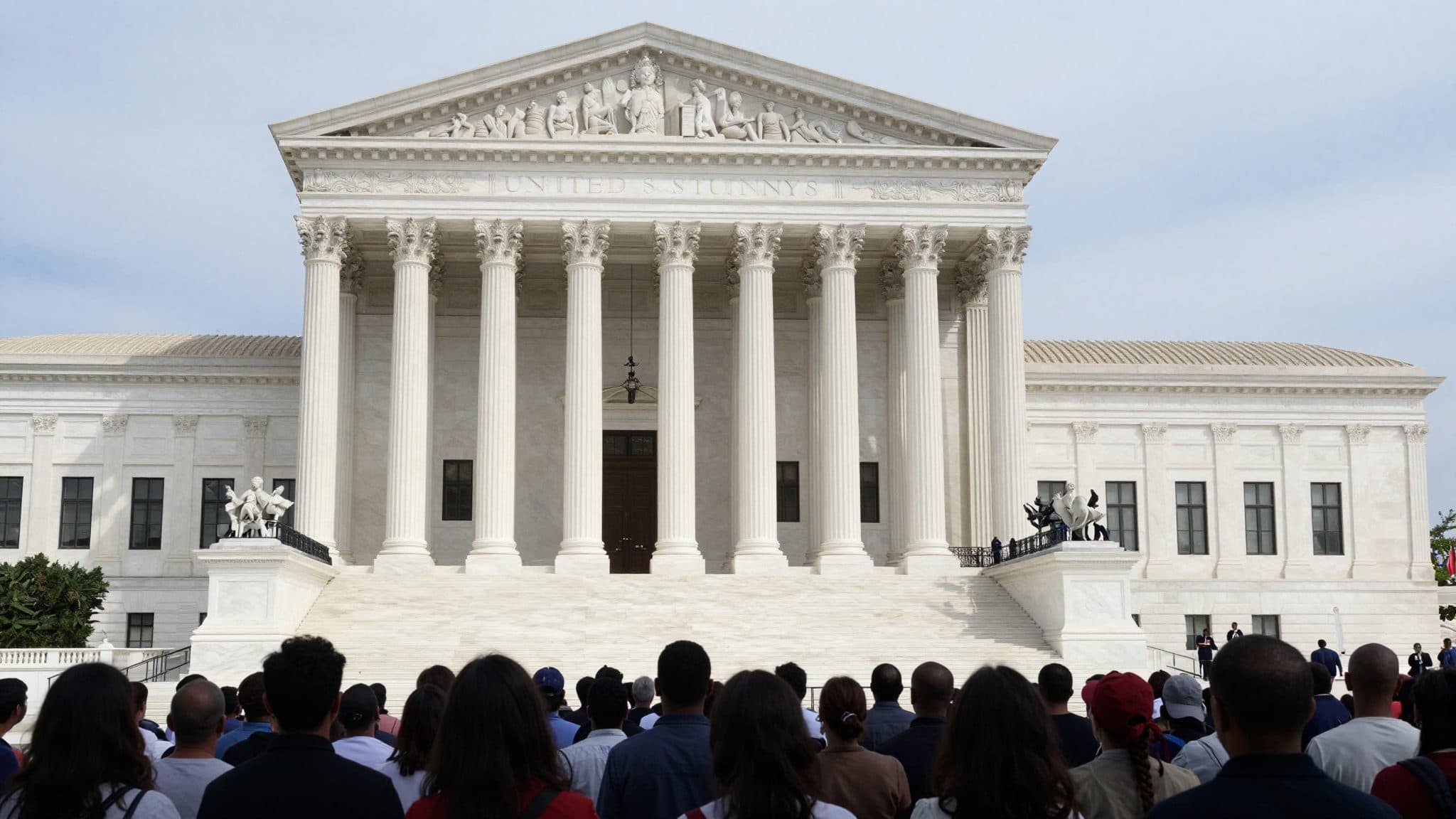
US Supreme Court allows government mass deportations from Haiti and Syria
Washington, 25 June 2026
AI-generated image (z-image via Kie.ai)
Summary
The US Supreme Court has ruled 6-3 in favor of allowing the government of Donald Trump to revoke TPS protected status for people from Haiti and Syria. This makes the deportation of around 350,000 Haitians and 6,000 Syrians possible; in a second ruling, the court also upheld so-called metering at the border with Mexico.
Washington, 25 June 2026
The Supreme Court of the United States ruled on Thursday in a 6-3 decision along ideological lines that the government of Donald Trump may revoke Temporary Protected Status (TPS) for nationals of Haiti and Syria without judicial review.
Background: What is TPS status?
This allows US authorities to order the deportation of around 350,000 people from the Caribbean nation of Haiti and around 6,000 Syrians who have been living and working legally in the United States. The court thus fully followed the Trump administration's argument of treating the TPS program as a flexible instrument of the executive branch.
Justice Samuel Alito, appointed to the Supreme Court by George W. Bush, authored the majority opinion. The court justified its decision by stating that the law expressly excludes judicial review of non-constitutional claims by affected persons. In the exact wording: "The statute expressly bars judicial review of non-constitutional claims by beneficiaries."
The plaintiffs from Haiti and Syria had sued against the revocation of protected status and had already failed in lower courts. They accused the government of racial discrimination; this allegation of unconstitutional unequal treatment was rejected by the high court. The dissenting votes came from the three liberal justices.
The historical parallel to the MS St. Louis
The dissenting opinion was written by Justice Sonia Sotomayor and — an unusual step — read aloud publicly from the bench. In her reasoning, Sotomayor drew a historical parallel to the MS St. Louis, a ship carrying around 1,000 Jewish refugees that was turned away at the US coast in 1939 and sent back to Europe. Many of these passengers later became victims of the National Socialist genocide.
The Temporary Protected Status program was created by Congress in the 1990s to allow people from countries experiencing acute crises to have temporary legal residence in the United States. Holders of active TPS status, currently from El Salvador, Lebanon, Sudan and Ukraine, however have no automatic path to a Green Card or US citizenship.
At the time Trump took office, around 1.3 million people from 17 countries with such protected status were living in the United States. The Trump administration has already revoked TPS for people from Afghanistan, Ethiopia, Myanmar, Haiti, Honduras, Yemen, Cameroon, Nepal, Nicaragua, Somalia, South Sudan, Syria and Venezuela. As court documents show, the government plans to end protection in eleven more countries.
Reactions from the White House
In a press release, the White House called the decision a "great victory" — literally: „grossartigen Sieg". The government sees the ruling as confirmation of its line of consistently tightening immigration policy and strengthening executive power in this area.
Second ruling: Metering at the border
On the same day, the court issued a second decision, also by a 6-3 majority, declaring so-called metering at the border with Mexico lawful. Under this procedure, asylum seekers are stopped a few meters before the US border on the Mexican side and are not physically allowed to enter the country — in the court's view, they have therefore not formally "arrived in the United States."
The government had argued in the proceedings that the previous judicial blockade of the policy "der Exekutive ein entscheidendes Werkzeug zur Bewältigung von Grenzschüben und zur Verhinderung von Überfüllung an den Einreiseorten entziehe." Literally, it said that a metering stop robs "the Executive Branch of a critical tool for addressing border surges and preventing overcrowding at ports of entry."
Justice Sotomayor countered in her dissenting opinion that border officers at legal points of entry already speak with all immigrants and that such a conversation practically constitutes the first step of "arriving in" the United States. She pointed to the exact wording of the law, which applies to asylum seekers who "in the U.S. arrive" — a formulation which, in the dissenters' view, also includes those affected by metering.
Migration figures at the southern border
The background figures on migration at the southern border are remarkable: between autumn 2022 and autumn 2023, US authorities had still apprehended 2.2 million migrants and asylum seekers at the border with Mexico. According to official figures, fewer than 10,000 irregular migrants per month are now being apprehended at the border — the lowest figure in decades.
The metering procedure was originally tested under President Barack Obama, abandoned under President Joe Biden, and reactivated by the Trump administration. With the current decision, the high court has retroactively approved this practice and at the same time significantly expanded the executive's room for maneuver.
Outlook: Birthright citizenship before the Supreme Court
Human rights organizations and bar associations responded with sharp criticism of the ruling. They warned that the revocation of protected status for several hundred thousand people who had lived and worked in the US for years could trigger a humanitarian crisis. Affected families worried immediately after the decision about their whereabouts, their jobs and their children's school attendance.
The Trump administration announced it would implement the decision swiftly and quickly deport the affected persons from Haiti and Syria. A spokesperson said they would now "use all available legal means" to end the stay of those affected. At the same time, proceedings were ongoing before further instances in which affected individuals are suing against imminent deportations.
The Supreme Court is expected, according to observers, to rule before the summer recess on another key migration-policy issue: the Trump administration's attempt to restrict birthright citizenship — anchored in the US Constitution and granting automatic citizenship to children of undocumented immigrants. This case is also likely to further inflame political debate in the US.
Internationally, the ruling drew criticism, particularly from Latin American and Caribbean states. Haiti's transitional government expressed concern about the humanitarian consequences for the already fragile situation in the Caribbean nation. International refugee organizations also pointed to the historical example of the MS St. Louis and warned against a repetition of such turnbacks.
Overall, the two decisions show a clear shift in migration policy in the United States: away from an individualized asylum process and toward a broad empowerment of the executive branch to revoke protected status and effectively prevent asylum applications at the border. What practical consequences the rulings will have for those affected now depends on the concrete implementation by the immigration authorities.
Questions & Answers
What is the Supreme Court's TPS decision about?
The US Supreme Court has ruled 6-3 that the government may revoke Temporary Protected Status (TPS) for people from Haiti and Syria without judicial review. This makes the deportation of around 350,000 Haitians and 6,000 Syrians possible.
What role did Justice Sonia Sotomayor play?
Sotomayor wrote the dissenting opinion of the three liberal justices and read it aloud publicly from the bench — an unusual step. She drew a parallel to the MS St. Louis, a ship carrying Jewish refugees that was turned away in 1939.
What did the court decide in the second ruling on metering?
The Supreme Court declared so-called metering lawful by a 6-3 vote. Asylum seekers who are stopped a few meters before the border on the Mexican side are therefore not considered to have "arrived in the US" and cannot apply for asylum.
Supreme Court: Green light for deportation of 350,000 | allfacts360