Supreme Court Upholds Birthright Citizenship: Trump Suffers Defeat at US Highest Court
Washington, June 30, 2026
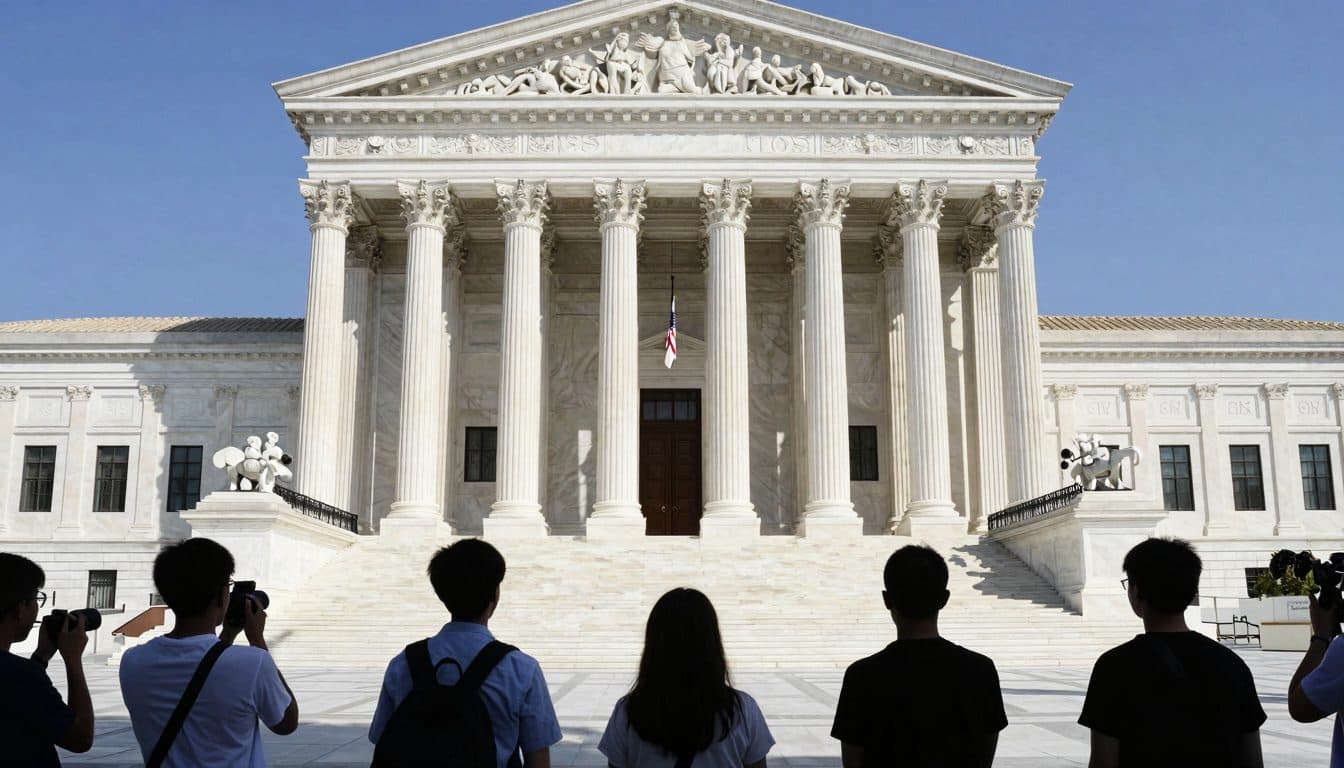
AI-generated image (z-image via Kie.ai)
Summary
The Supreme Court of the USA has ruled by a vote of six to three that birthright citizenship for nearly all children born on American soil remains in effect. President Donald Trump suffered a severe defeat in one of his central political initiatives and called on Congress to abolish birthright citizenship.
Washington, June 30, 2026
The Supreme Court of the USA has upheld, by a six-to-three majority, birthright citizenship for nearly all children born on American soil, rejecting an attempt by President Donald Trump to override the principle, in effect since 1868, by executive order.
In its decision of June 30, 2026, the court in Washington struck down a Trump decree that sought to restrict the automatic granting of US citizenship to newborns. The ruling came on the final day of the Supreme Court's term and was considered one of the most politically anticipated judicial decisions of the year. Chief Justice John Roberts wrote in the opinion: "Then as now, citizenship means having rights—the right to participate freely in our political community."
Background: Birthright Citizenship in the US Constitution
Specifically, the ruling addresses the 14th Amendment to the US Constitution, which since 1868 has provided: "All persons born or naturalized in the United States, and subject to the jurisdiction thereof, are citizens of the United States." This principle, also known as jus soli or the birthplace principle, has since guaranteed automatic citizenship to virtually every child born on US territory. The amendment was added to the Constitution shortly after the end of the American Civil War to grant citizenship to freed slaves and their children.
Trump had signed an executive order on the first day of his second term seeking a reinterpretation of the 14th Amendment. However, the order never took effect, as it had already been blocked in lower courts. The US president justified his move by arguing that the 14th Amendment "was never interpreted to extend citizenship universally to everyone born within the United States." Instead, newborns must also be subject to US jurisdiction through their parents.
The highest court did not follow this argument. The justices emphasized that terms such as "lawfully" or "temporarily," on which Trump relied in his order, do not appear in the constitutional text—"for a simple reason: they did not matter." The drafters of the 14th Amendment had extended the promise to "every free-born person in this country." It was clearly established that all "persons born or naturalized in the USA and subject to US jurisdiction" are citizens.
The Wong Kim Ark Case: Precedent Since 1898
The reasoning also drew on a landmark Supreme Court ruling from 1898 in the case of Wong Kim Ark. At that time, the court decided that a man of Chinese descent born in San Francisco possessed US citizenship despite the then-existing "Chinese Exclusion Act"—a racist law aimed at excluding Chinese migrants. For opponents of Trump's push, the legal situation had already been conclusively settled by that ruling.
In the current case, an asylum seeker from Honduras sued under the pseudonym "Barbara," who had fled with her family from the violence of the Mara 18 gang and has been living in the USA since 2024. In October 2025, she gave birth to her fourth child. The plaintiffs argued that the children affected were "citizens from birth under the Constitution." The Supreme Court agreed with this argument.
The Justices and Their Majority
Joining the majority opinion alongside the three justices considered liberal was Amy Coney Barrett, regarded as conservative. Justice Samuel Alito, considered conservative, characterized the previously established and now confirmed interpretation of birthright citizenship in a dissenting opinion as a "serious error." Liberal Justice Sonia Sotomayor spoke of "unleashed chaos" and warned that the ruling could pave the way for future restrictions on other constitutionally guaranteed rights.
Trump reacted to the decision with sharp criticism. He called the ruling on his platform Truth Social "very unfortunate for our country" and urged Congress to "work to abolish the costly and unjust birthright citizenship that burdens our country." Even before the decision, he had described a possible "negative" ruling as an additional burden on the country. The court was thus maintaining a "strong incentive to enter or remain illegally in this country," he criticized.
Trump's Reaction and Political Consequences
Following his defeat with regard to large parts of his tariffs before the Supreme Court, this was another burden that would be "economically unsustainable" for America and would cost a fortune, he wrote on Truth Social. Trump also wanted to take action against so-called "birth tourism"—that is, people who enter the USA solely to give birth to their baby there. He claimed that "taxpayers are being fleeced" as a result. Hundreds of thousands of children of migrants without legal status would be affected—a nightmare would loom for those children permitted to remain in the USA while their parents were deported without ifs or buts. "This story is not over yet," he added.
The "New York Times" headlined its coverage "Supreme Court Halts Trump's Bid to End Birthright Citizenship." Observers identify two major currents in the so-called "Roberts Court": on the one hand, the majority belongs to the camp of so-called originalists, who base their interpretation on the original intent of the Constitution and its exact wording. Their jurisprudence is thus an attempt to return to the meaning of the Constitution as it stood 150 or nearly 250 years ago.
Mathias Moschel, a jurist and expert on the US Constitution at the Central European University in Vienna (CEU), warned: "If the birthplace principle is curtailed, fears grow that other rights not anchored in the Constitution could also fall—such as the right to same-sex marriage." Critics saw the initiative as a violation not only of the 14th Amendment but also of a 1940 precedent that guaranteed citizenship, with few exceptions, to everyone born on American soil.
The statistical dimension is considerable: around 3.5 million children are born in American hospitals each year and thus immediately receive the right to US citizenship. According to forecasts by the Migration Policy Institute and Penn State University, the number of people without legal residency could rise by 2.7 million by 2045 and by 5.4 million by 2075 if immigration policy does not fundamentally change.
Impact on Millions of Families
On the same day, Trump also lost another legal dispute before the Supreme Court: the court confirmed by a vote of five to four that he must pay a journalist five million dollars in damages for sexual abuse and subsequent defamation. The justices also permitted Trump to dismiss a person designated by the independent regulatory agency FTC—thereby overturning a 1935 precedent. The "NYT" pointed out that the president could now dismiss senior officials at dozens of other federal agencies at will. Peter Conti-Brown, a Fed expert at the University of Pennsylvania, told the "NYT" that the ruling was "an invitation to even more interference" by the president.
By a narrow five-to-four majority, the justices also ruled that Trump may not remove Fed officials "for any reason or no reason," thereby underscoring the special status of the Fed institution. The "New York Times" sees this as a "huge shift in the balance of power from Congress to the president." The three liberal justices voted against the decision and warned that dozens of independent commissions could now be turned into pure executive agencies.
Further Rulings at the End of the Term
With the birthright citizenship ruling, the Supreme Court sent a clear signal to the executive: even a president cannot simply override a constitutional principle in effect for nearly 160 years through an executive order. The ruling strengthens the rights of millions of children and their families who rely on the protection of jus soli. At the same time, the political debate over birthright citizenship in the USA remains volatile, as Trump has now explicitly called on Congress to act.
What concrete legislative steps Congress will now take, and whether Trump could succeed in achieving a change to birthright citizenship through the legislature, remains to be seen. Observers assume that Congress remains deeply divided on this issue and that no change to constitutional law is to be expected in the short term. Birthright citizenship thus remains for now a fixed component of the US Constitution—but the debate over it is not concluded by this ruling.
The ruling fits into a series of landmark decisions by the Supreme Court at the end of this year's term. It underscores the role of the highest court as the final authority in interpreting the US Constitution—especially in a politically charged environment in which the dividing lines between the parties and between the various factions within the judiciary are emerging more clearly than ever. For millions of families in the United States, the decision initially means clarity: their children born in the USA remain US citizens.
Questions & Answers
What did the Supreme Court decide regarding US birthright citizenship?
The Supreme Court of the USA has ruled by a vote of six to three that birthright citizenship for nearly all children born on American soil remains in effect. It thereby rejected an executive order issued by President Trump.
Who sued against Trump's decree?
The plaintiff was an asylum seeker from Honduras, who appeared under the pseudonym "Barbara." She had fled with her family from the violence of the Honduran gang Mara 18 and has been living in the USA since 2024.
How did Trump react to the defeat before the Supreme Court?
Trump called the decision on Truth Social "very unfortunate for our country" and urged Congress to "work to abolish the costly and unjust birthright citizenship that burdens our country."
Supreme Court Upholds US Birthright Citizenship: Trump Loses | allfacts360