USA launches fourth wave of attacks on Iran – Revolutionary Guards declare Strait of Hormuz closed
Berlin, July 13, 2026
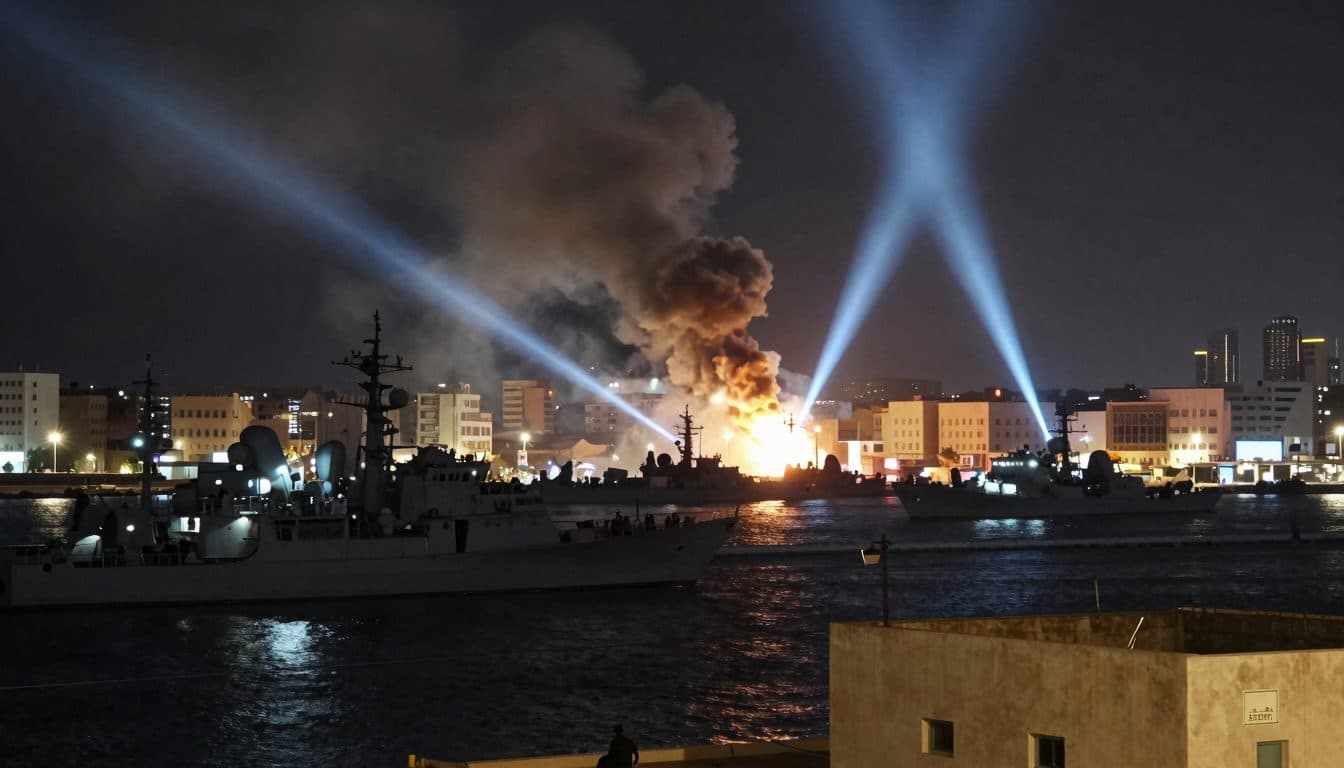
AI-generated image (z-image via Kie.ai)
Summary
According to US regional command Centcom, the USA has launched a fourth wave of attacks on targets in Iran, including missile positions, air defense facilities, and boats of the Revolutionary Guards. In response, the Iranian Revolutionary Guards declared the Strait of Hormuz, which is central to world trade, closed until further notice.
Berlin, July 13, 2026
The USA flew another wave of attacks on targets in Iran on Sunday, while the Iranian Revolutionary Guards declared the Strait of Hormuz closed to international shipping in response.
According to their own statements, US forces attacked around 140 military targets in Iran on Sunday. According to the responsible US regional command Centcom, the attacks began at 5:00 PM ET (11:00 PM German time) with further strikes on targets in Iran. This marks the fourth wave of attacks by the USA since hostilities flared up again overnight into Wednesday.
Iranian state television, meanwhile, reported several explosions near the city of Sirik as well as west of Bandar Abbas. The state news agency Irna spoke of "hostile attacks" in Bandar Abbas, where successive explosions were heard in some city districts in the evening. The affected areas were military facilities, Irna wrote. The incident is being investigated.
Explosions in Bandar Abbas and Sirik
The Iranian news agency Tasnim reported detonations in the port city of Bandar Abbas and not far from the island of Qeshm in the Persian Gulf. The US media "Wall Street Journal" and "New York Times" had previously reported, citing US government officials, that the attacks had targeted missile positions and air defense facilities. Boats of the Iranian Revolutionary Guards were also attacked.
In response to the attacks, the Iranian Revolutionary Guards declared the strait closed. The Strait of Hormuz, which is important for world trade, would remain closed "until further notice and until the end of American interventions in this region." The Revolutionary Guards also announced that the waterway had been closed again until further notice following an incident.
Revolutionary Guards declare strait closed
The US Army promptly rejected this declaration. "Iran does not control the strait. Traffic is flowing," Centcom stated. US President Donald Trump also declared that the Strait of Hormuz was open. Among other things, the USA demands that the Strait of Hormuz remain open.
According to the US military, the attacks on Sunday followed an attack by the Iranian Revolutionary Guards on a ship in the Strait of Hormuz. Tehran responded in turn with attacks on targets in several Gulf states. The spiral of violence between the two countries has thus escalated further.
Iran condemns attacks and speaks of failed diplomacy
The Iranian Foreign Ministry sharply condemned the latest attacks overnight. It declared that they had "destroyed all diplomatic efforts of the past months." In addition, the USA had caused a return of insecurity in the Strait of Hormuz as well as disruptions to international merchant shipping, it was said from Tehran.
After the funeral ceremony for his killed father, Iran's supreme leader Mojtaba Khamenei threatens revenge. The situation in the region thus remains extremely tense. US President Trump is meanwhile showing willingness to talk, but is also warning of new attacks.
UN Secretary-General António Guterres posted on the platform X that he was deeply concerned about the "significant escalation." A return to full-scale fighting would have catastrophic consequences for the security of the region and the world economy, Guterres warned. A full resurgence of the war could have catastrophic consequences, the UN Secretary-General added.
UN Secretary-General warns of catastrophic consequences
Guterres urgently called on Iran and the USA to immediately resume negotiations and resolve outstanding issues through diplomatic means. This demand for a diplomatic solution stands in contrast to the continued military violence on both sides.
The Strait of Hormuz is one of the world's most important shipping lanes. A large share of international oil trade is conducted through this strait. A prolonged closure or even significant disruptions to shipping traffic would have far-reaching consequences for global energy prices and the world economy.
Strait of Hormuz as a strategic flashpoint
According to Palestinian reports, at least five people were killed in Israeli attacks in the Gaza Strip. This shows that tensions are continuing to escalate throughout the region. The situation in the Middle East remains highly unstable.
Centcom stated that the goal of the attacks was to limit Iran's ability to attack merchant ships in the Strait of Hormuz. US forces had already attacked around 140 military targets in Iran overnight into Sunday, according to their own statements.
Most recently, the USA had flown attacks on targets along the Iranian southern coast and on the island of Qeshm in the Persian Gulf. US media had previously already reported on US attacks on targets in Iran. The fourth wave of attacks marks a further significant escalation of the conflict.
Escalation in the Persian Gulf
The international community is observing the developments with great concern. The combination of military attacks, the closure of one of the world's most important trade routes, and the rhythm of mutual retaliation raises fears that the crisis will continue to escalate. Following the US attacks overnight, Iran has once again reported explosions along the southern coast.
Diplomatic channels meanwhile appear to be largely blocked. The USA and Iran have blamed each other for the escalation in recent days. The question of whether there is still a chance for negotiations remains open for now. Guterres' appeal to resume dialogue has so far echoed without concrete response.
The developments in the region have the potential to significantly impact the world economy. Rising energy prices, uncertainties in international trade, and the risk of further spread of the conflict to other countries in the region are just some of the possible consequences.
This news was broadcast on 13.07.2026 on the Deutschlandfunk program. The situation remains dynamic, and further developments are to be expected in the short term.
Questions & Answers
Who is Mojtaba Khamenei and what role does he play in the current crisis?
Mojtaba Khamenei is referred to in the available reports as Iran's supreme leader, who threatened revenge after the funeral ceremony for his killed father. His exact position and his relationship to the previous supreme leader are not elaborated further in the available facts.
Why did the Iranian Revolutionary Guard declare the Strait of Hormuz closed?
The Iranian Revolutionary Guards declared the Strait of Hormuz closed following the US attacks until further notice and until the end of American interventions in the region. This occurred in response to the US airstrikes on Iranian targets.
What targets did the USA attack in the fourth wave of attacks?
According to reports by the Wall Street Journal and the New York Times citing US government officials, the attacks targeted missile positions and air defense facilities in Iran. Boats of the Iranian Revolutionary Guards were also attacked.
USA fourth wave of attacks Iran Strait of Hormuz | allfacts360