Oil prices rise after US strikes on Iran – Strait of Hormuz remains contested
Frankfurt, July 13, 2026
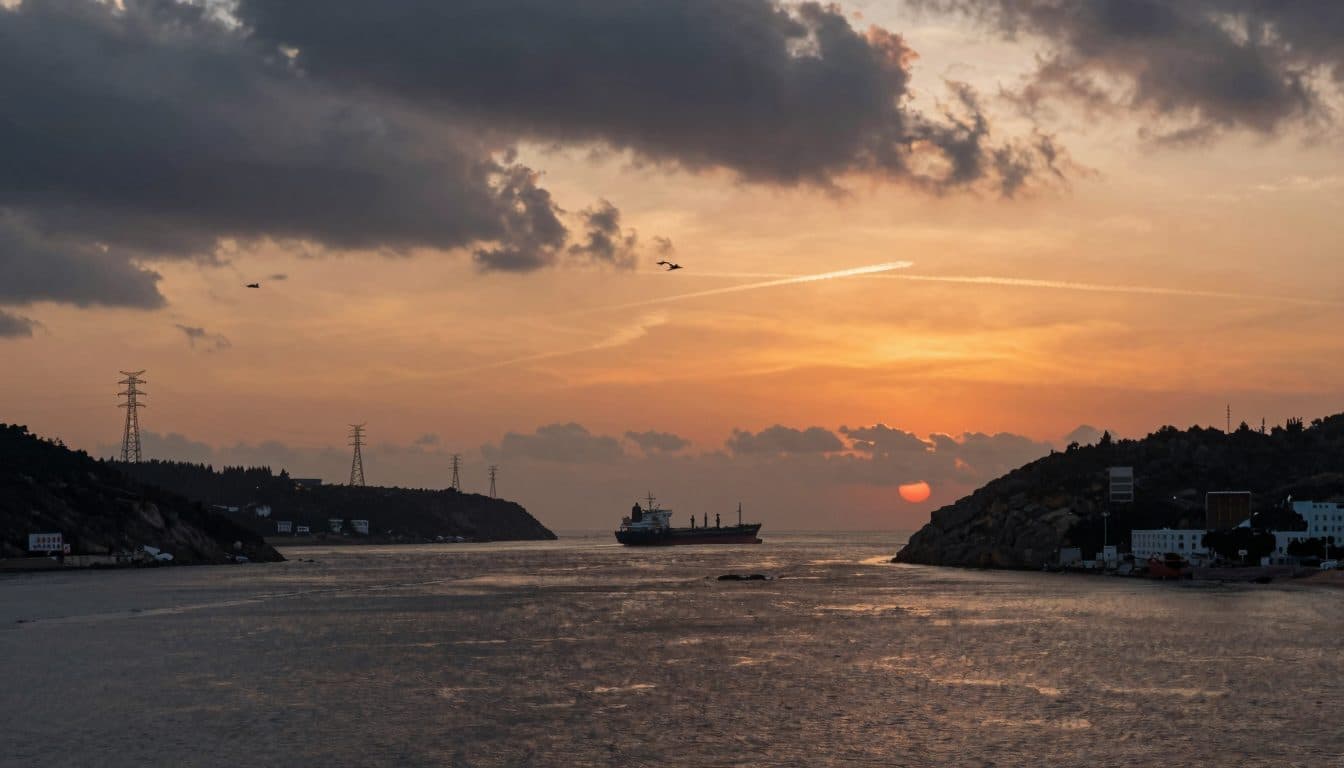
AI-generated image (z-image via Kie.ai)
Summary
Following new US airstrikes on Iran and Iran's declaration that the Strait of Hormuz is closed, oil prices rose sharply on Monday. Concerns about a disruption to global energy supplies are also weighing on Asian stock markets and the German equity market.
Frankfurt, July 13, 2026
Oil prices rose noticeably on Monday after a fresh wave of US military strikes on Iran and Tehran's declaration that the Strait of Hormuz is closed indefinitely, as international mediators press for a return to the negotiating table.
US forces launched another wave of strikes on targets inside Iran during the night leading into Monday. As the responsible regional command Centcom announced on the platform X, the strikes began at 23:00 CEST. According to the "Wall Street Journal" and the "New York Times," citing US government officials, the attacks targeted missile positions and air defense facilities. Centcom stated that the strikes hit air defense systems, radar installations, missile positions, drone sites, and small boats. Radar systems in Oman were also destroyed. According to the Iranian state agency IRNA, at least one person was killed in a US attack on the city of Mahshahr in the southwestern Iranian province of Khuzestan.
Centcom published video footage showing fighter jets launching from an aircraft carrier, warships firing cruise missiles, and projectiles hitting their targets. According to the command's account, this is the fourth wave of strikes since the previous Wednesday. In addition to combat aircraft and aerial drones, the operation also used surface drones for the first time. US forces are ready to defend the freedom of civilian shipping – including against "the unjustified aggression of Iran, its harassment, threats, and arbitrary statements." US President Donald Trump had ordered the strikes to limit Iran's ability to attack commercial ships in the strategically important strait, according to the US military.
Military situation: strikes, retaliation, and footage
The Iranian Revolutionary Guards said they had retaliated and struck US military targets in Jordan, Kuwait, and Bahrain. According to IRNA, citing statements by the Revolutionary Guards, targets included an air force base in Jordan, a US drone control center in Bahrain, and bases in Kuwait. Arab states in the region confirmed that attacks had come from Iran and said they had intercepted hostile projectiles. Meanwhile, Iranian state television reported several explosions near the city of Sirik as well as west of Bandar Abbas.
Tehran simultaneously stepped up its rhetoric. On Sunday, the Iranian leadership declared the Strait of Hormuz closed indefinitely. Iranian military spokesman Amir Akraminia said, according to the Tasnim news agency: "The Americans are trying to impose an unlawful route south of the Strait of Hormuz that contradicts the agreement signed with the Islamic Republic of Iran". Iran's Foreign Ministry said the US had nullified all diplomatic efforts of recent months with its latest strikes. At the same time, Iran is attempting to agree a joint transit arrangement for the strait with the Gulf state Oman; US pressure on Oman is hampering these efforts.
Strait of Hormuz: declaration and counter-voices
Concerns about a disruption to energy supplies via the strait were clearly felt on commodity markets on Monday. A barrel of North Sea Brent crude rose, after interim spikes, to $78.35, at one point costing slightly more than $126 a barrel. Brent and US light sweet crude quotations gained around four percent overall. Rising energy prices are also weighing on Asian equity markets: Japan's leading Nikkei index fell 1.6 percent in the morning, while the MSCI index for Asia-Pacific stocks outside Japan dropped 0.9 percent. The South Korean market, which had recently been strong, lost 5.4 percent; shares of chipmaker SK Hynix fell as much as 8.2 percent at their low.
Impact on energy and equity markets
On US stock exchanges, there had still been a record mood on Friday. The Dow Jones index rose 0.3 percent to 52,637 points, buoyed by strong technology stocks. The Nasdaq gained 0.3 percent to 26,281 points, the broader S&P 500 added 0.4 percent to 7,575 points, closing just short of its record high. The US listing of South Korean chipmaker SK Hynix also went well: the shares closed at $170, around 13 percent above their issue price. This friendly mood stands in contrast to the current escalation in the Persian Gulf.
In Germany, the signs on Monday point to losses. Broker IG currently values the Dax 0.9 percent lower. On Friday there had still been hopes that the Dax could head back toward its record high of 25,900 points in the new week. It had only reached that level on the Monday of the previous week, before the new escalation in the Middle East dragged the index down to 24,830 points by midweek. By midweek, the IG indication on Monday morning stood at 24,850 points, down 0.9 percent.
Reactions on the German market
Roland Schmack, managing director of asset manager Meine Werte, vividly described the situation on the market: "The taller the tower, the more sensitive it is to wind, and the Dax is a tall tower right now". Investors who remained on the buy side after the rally so far should tighten their stop-loss levels more than usual. Schmack also pointed to a familiar pattern: with the erratic leadership style of the US president, a "calming" of the situation is possible at any time.
Analysts at the Australian-New Zealand banking group ANZ wrote in a note: "Hopes for a relatively swift resolution of the latest fighting could be thrown into doubt after the weekend escalation". Rising oil prices are seen as a direct indicator that market participants are pricing in a longer period of uncertainty in maritime trade.
US President Donald Trump had declared an end to the ceasefire a few days earlier, citing Iran's failure to honor its commitments. On NBC's "Meet the Press" on Sunday, Trump contradicted this with regard to the Strait of Hormuz: "It is open". At the same time, he reaffirmed the US's readiness to act militarily against threats to shipping. Iranian parliament speaker and chief negotiator Mohammad Baqer Qalibaf wrote on X: "We told you: keep your word or pay the price". The choice of words underlines that both sides are escalating the conflict on different levels.
Diplomatic efforts and UN appeal
The interim assessment from a diplomatic perspective is cautious. UN Secretary-General António Guterres expressed concern after the start of the latest wave of strikes about the "significant escalation". He urgently called on Iran and the US to immediately resume negotiations and to resolve outstanding issues through diplomatic means. The escalating strikes call into question the future of a preliminary agreement between the US and Iran signed last month.
Another point of contention is the status of the trade route. Iran's Foreign Ministry did not comment on Iranian attacks on international commercial ships in the Strait of Hormuz in recent days. The US Army, by contrast, reported that commercial ships continued to transit the strait despite Iran's closure declaration. This leaves an obvious gap between Iran's official account and the US forces' observation of the situation. Which side prevails in the coming days will likely also depend on whether diplomatic efforts with Oman can be resumed.
Meanwhile, Iranian diplomacy is sticking to the line that a negotiated solution is possible provided the US halts its attacks. The Iranian leadership said it is working together with Oman to "establish a common understanding and common arrangements in the region". The spokeswoman of the Iranian Foreign Ministry also rejected allegations that Iran is arbitrarily obstructing shipping. The US side, for its part, insists that the Strait of Hormuz is "not controlled by Iran" and that freedom of navigation should, if necessary, be enforced militarily as well.
Outlook: what investors should watch
For the coming trading sessions, observers expect heightened volatility in energy and equity markets. As long as it remains unclear whether Iran's closure declaration is being enforced in practice or whether the US naval presence is continuing to allow commercial ships to transit, prices remain vulnerable to news from the Gulf. In the foreign exchange market, a firmer US dollar as a safe haven is also to be expected should the situation escalate further.
The further course depends crucially on whether the negotiations urged by Guterres are actually resumed. Observers point out that the US government has previously and surprisingly pivoted toward de-escalation on several occasions, each time providing noticeable relief to markets. Until then, many investors take the view that risks in the current environment clearly dominate – and that an escalation spiral around the strait, the oil price, and the global economy could be set in motion simultaneously.
Questions & Answers
Why did oil prices rise sharply on July 13, 2026?
Prices rose because the US launched another wave of strikes against Iran and Tehran declared the Strait of Hormuz closed indefinitely. Concerns about global energy supply pushed Brent and US light sweet crude quotations up by around four percent.
What did US President Donald Trump say about the strikes?
Trump said he had ordered the strikes to limit Iran's ability to attack commercial ships in the strait. On NBC's "Meet the Press" on Sunday he said the Strait of Hormuz was "open".
What role is the UN Secretary-General playing in the conflict?
UN Secretary-General António Guterres expressed concern over the "significant escalation" and called on Iran and the US to immediately resume negotiations. He pointed out that the strikes called into question the future of the preliminary agreement signed the previous month.
Oil prices rise: Strait of Hormuz under pressure after US | allfacts360