Vienna Torture Trial: Eight Years in Prison for Two Former Representatives of the Assad Regime
Vienna, 06 July 2026
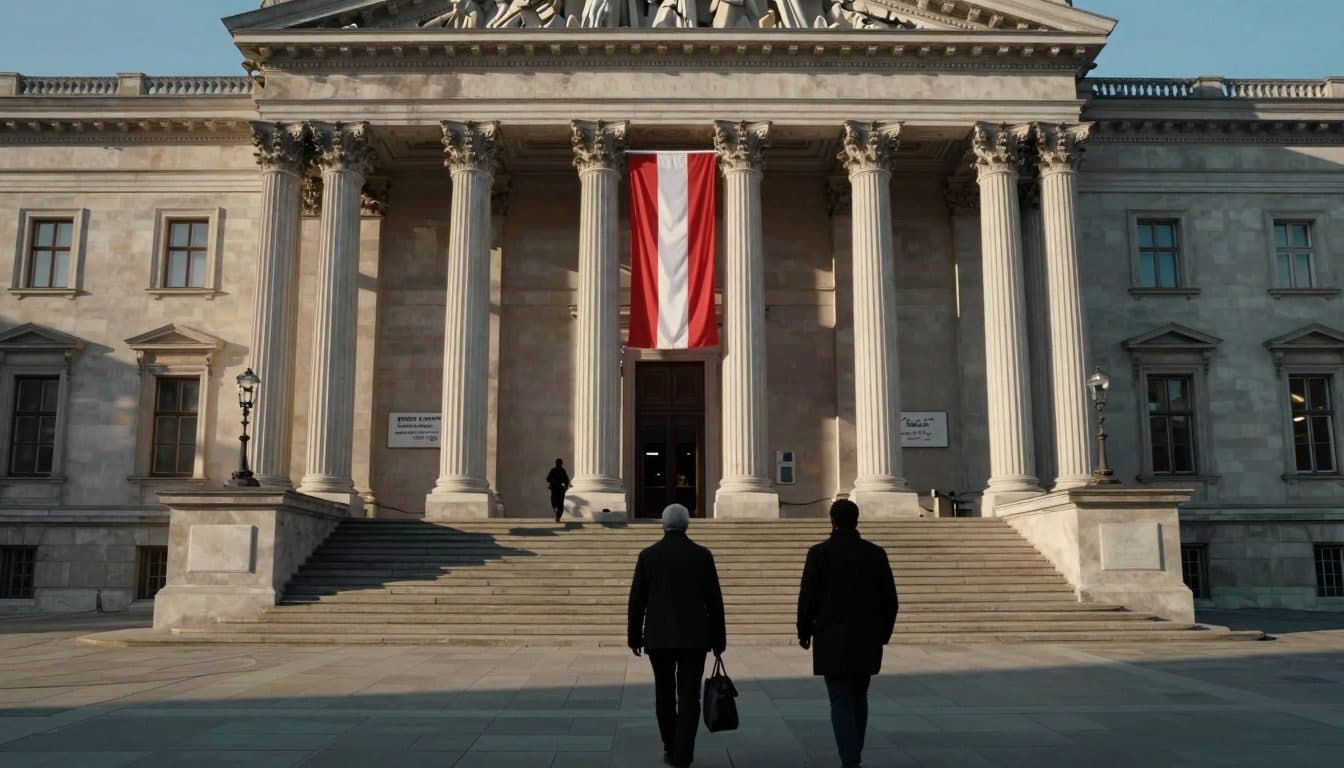
AI-generated image (z-image via Kie.ai)
Summary
The Vienna Regional Criminal Court has sentenced two former Syrian officials to eight years in prison each for torture and aggravated bodily harm against 21…
Vienna, 06 July 2026
The Vienna Regional Criminal Court has sentenced two former Syrian officials to eight years in prison each for torture and aggravated bodily harm against 21 civilians. The verdict against the former brigadier general Khaled al-Halabi and his co-defendant is not yet final.
The Vienna Regional Criminal Court on Monday sentenced two former high-ranking Syrian officials to eight years in prison each for systematic torture and serious crimes against 21 civilians, though the verdict is not yet final.
The trial at the Vienna Regional Criminal Court is considered one of the most significant criminal proceedings in Austria dealing with crimes from the Syrian civil war tried under the universal jurisdiction principle. After 13 hearing days, the lay judges' panel found the two defendants—former brigadier general Khaled al-Halabi and the former head of criminal police in Raqqa, Moussab Abou Rokbh—guilty on the majority of the charges.
Background: Crimes at Branch 335
The central figure in the proceedings was the 63-year-old al-Halabi, who during the protests against the regime of President Bashar al-Assad had led the notorious Branch 335 of the Syrian intelligence service in Raqqa. This detention facility reported directly to the Interior Ministry in Damascus. According to the indictment, opposition members there were "indiscriminately and brutally mistreated." The indictment spanned 165 pages and accused both men of bearing co-responsibility for the mistreatment of regime opponents between April 2011 and March 2013.
The presiding judge characterized the acts as "state-organized systematic torture" and referred to a particular investigation commission—which played a central role in the trial—as a "torture commission." Al-Halabi was not only responsible for numerous acts of mistreatment but had also personally carried out some of them. In Abou Rokbh's case, the court found that he had personally applied violence on multiple occasions. Both had been "part of the system."
The presiding judge considered it an aggravating factor that the torture had served the "objective" of deterring people from demonstrating against the Assad regime. The first defendant had "never taken a single step to ensure that what we heard here today did not happen. And he was at the top of the chain of command." Nadja Lorenz, representing an additional plaintiff and two other victims, stated that the screams of the tortured could be heard throughout the entire building.
Verdict and Sentence
Al-Halabi was convicted of numerous counts of aggravated bodily harm, aggravated coercion, torture, and sexual coercion. Against Abou Rokbh, the court likewise imposed a sentence of eight years for aggravated bodily harm, aggravated coercion, and sexual coercion. On one charge, the court acquitted the defendants, as no connection to political persecution could be proven in that case.
The sentence of eight years was oriented toward the upper limit of what was possible under Austrian law for the offenses imposed; the sentencing range could have been up to ten years. The court justified the sentence on the basis of a "particularly reprehensible motive"—namely, the suppression of a freedom movement. The convicted men must pay the victims a total of 130,000 euros in compensation for pain and suffering, with further claims referred to civil proceedings. Individual victims received between 5,000 and 15,000 euros, depending on the case.
Victim and Plaintiff Testimony
During the trial, 25 witnesses testified, including 19 direct victims who traveled from across Europe and Syria. Former victims heavily implicated the two defendants. Additionally, two expert witnesses were heard, including an expert on torture injuries. Representatives of the European Center for Constitutional and Human Rights (ECCHR) and of the NGO Center for the Enforcement of Human Rights International (CEHRI), which represented 18 victims, supported the prosecution. CEHRI stated: "Die Intention war, größtmögliches Leid und Trauma zu verursachen."
The defense largely rejected the accusations. Al-Halabi himself argued that he had "neither personally tortured anyone nor known about it." He was "just a small cog who could not have resisted without endangering himself." His defense attorney, Timo Gerersdorfer, stated that the proceedings concerned "one of the darkest chapters of Syrian history," but that the entire Syrian civil war could not be judged in a Vienna courtroom. Gerersdorfer pointed out that his client had not joined the army out of conviction, but because for non-Alawites it had been the only path for advancement.
Defendants' Defense Strategy
The defense attorney further elaborated: "We are all blessed by the accident of being born late. None of us has to ask ourselves how one would really behave in a dictatorship." He emphasized that his client had "truly broken with the regime," had fled, and had not seen his family in years. The acts dated back 13 years, and his client had behaved well since then, which should be considered a mitigating factor. However, the court deemed al-Halabi's defense an "incredible protective claim."
The prosecution described the convicted men's behavior as showing no remorse and no consideration for the victims. It drew a legal comparison to the accountant of Auschwitz and the example of Pablo Escobar to discuss the question of the responsibility of subordinates in dictatorial systems. Immediately after the verdict, it announced both an appeal on points of law and an appeal on the merits, as did the defense. The verdict is therefore not final.
Universal Jurisdiction and International Context
The trial was only possible because Austria had passed universal jurisdiction legislation in 2014. This principle allows states to prosecute the most serious crimes regardless of the location of the crime and the nationality of the perpetrators. Similar proceedings had previously taken place only in Germany and Sweden. War crimes and crimes against humanity have only been part of Austrian criminal law since 2015. The torture provision of the Austrian Criminal Code entered into force on 1 January 2013, so that only one charge could be directly subsumed under it.
The background of the proceedings is remarkable. Al-Halabi had defected to the rebels in 2013, shortly before Raqqa fell. He is said to have worked as a double agent for Israel. As part of Operation "White Milk," the Israeli foreign intelligence service Mossad brought him from France to Austria in 2015, where the now-dissolved Federal Office for the Protection of the Constitution and Counterterrorism (BVT) hid and supported him. Mossad had assured Austria that al-Halabi was not a war criminal, and France had been unwilling to take him in due to his past. He received asylum in Austria.
Operation "White Milk" and Background
The Vienna public prosecutor's office opened investigations against the former general in 2016, after NGOs had begun gathering evidence against him from that point on. Al-Halabi had been in pre-trial detention at the Vienna-Josefstadt correctional facility since his arrest, initially since December 2024. His co-defendant Abou Rokbh, who is sometimes referred to as the "Angel of Death of Raqqa," was at large at the time of the verdict.
The international background of the proceedings raises questions. The crimes of the Assad regime should actually have been tried before the International Criminal Court in The Hague, but Syria is not a state party to the Court, and a mandate from the UN Security Council failed due to Russia's veto of a special UN tribunal. Initial trials have also begun in Syria itself, but whether the justice system there can conduct fair proceedings "remains to be seen."
German lawyer Wolfgang Kaleck, founder of the ECCHR, sees these proceedings as approximations of justice: "Die internationale Strafjustiz ist ein Flickenteppich. Es ist leider nicht so, dass jedes Verbrechen gegen die Menschlichkeit strafrechtlich verfolgt werden kann." The decisive question is, "whether one does nothing and accepts impunity, or whether one tries to work through this task." Kaleck criticized that instead of crimes against humanity, prosecutors sometimes had to fall back on offenses such as bodily harm or coercion.
The Vienna verdict marks another milestone in the judicial reckoning with Syrian crimes. In 2021, the Koblenz Higher Regional Court had conducted the world's first court proceeding against representatives of the Syrian regime for state torture and crimes against humanity. After the verdict was delivered, additional plaintiffs' representative Tatiana Urdaneta Wittek stated that her clients had hoped for this outcome "for many, many years." A CEHRI representative put it this way: "Sie werden ihr Leben lang unter den Folgen leiden. Gerechtigkeit dafür wird es nie geben, aber es gibt als Opfer die Möglichkeit auf ein wenig Gerechtigkeit, indem man zumindest die Täter zur Rechenschaft zieht."
Questions & Answers
Who are the two convicted individuals in the Vienna torture trial?
The convicted individuals were the 63-year-old former Syrian brigadier general Khaled al-Halabi, who had led Branch 335 of the intelligence service in Raqqa, and the 55-year-old Moussab Abou Rokbh, former head of criminal police in Raqqa. Both received eight years in prison each.
What were the two men convicted of?
The court convicted them, among other things, of aggravated bodily harm, aggravated coercion, torture, and sexual coercion against a total of 21 civilians from the years 2011 to 2013. They were acquitted on one charge.
Why could the proceedings take place in Austria?
The trial was only possible because Austria incorporated the universal jurisdiction principle into its legislation in 2014, which allows the prosecution of the most serious crimes regardless of the location of the offense. Syria is not a state party to the International Criminal Court, and a special UN tribunal failed due to Russia.
Vienna Torture Trial: Eight Years in Prison for Two… | allfacts360