Volkswagen supervisory board meets as reports of 100,000 job cuts and four plant closures set off nationwide protests
Wolfsburg, 09 July 2026
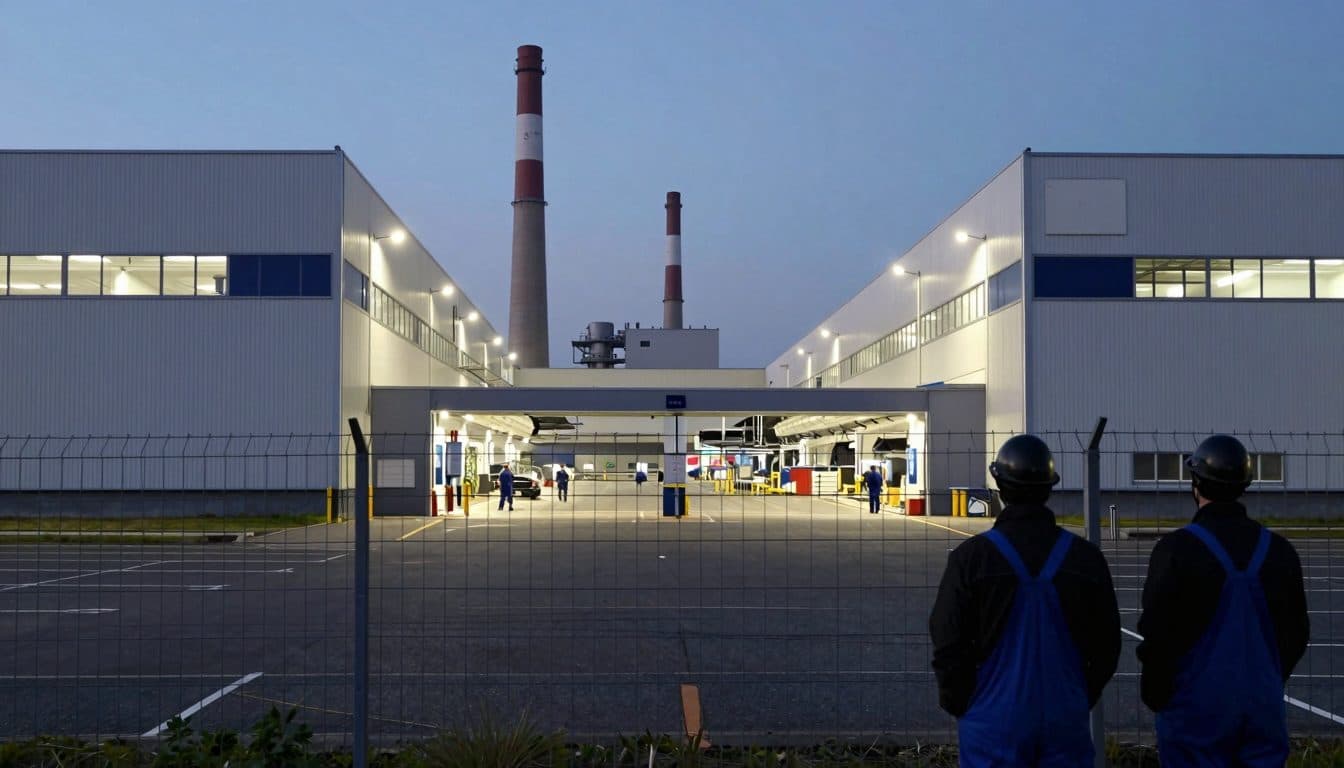
AI-generated image (z-image via Kie.ai)
Summary
Volkswagen's supervisory board convened on Thursday in Wolfsburg amid reports that up to 100,000 jobs worldwide and four German plants could be cut by 2034. IG Metall organised protests at roughly 18 sites, with workers warning of mass resistance if the management proceeds with the plans.
Wolfsburg, 09 July 2026
Volkswagen's supervisory board met in Wolfsburg on Thursday to discuss a far-reaching restructuring plan that, according to German media reports, could eliminate up to 100,000 jobs worldwide and lead to the closure of four German plants by 2034.
The meeting, originally scheduled for 14:30, was delayed as workers gathered outside company sites to protest the proposals. A company spokesperson confirmed beforehand that the board and management would discuss "the precise content of the future plan" and that the talks would also cover how to reduce excess capacity. "Die genauen Inhalte des Zukunftsplans und die damit verbundenen notwendigen Maßnahmen werden heute zwischen Aufsichtsrat und Vorstand der Volkswagen AG erörtert", the spokesperson said, adding: "Und ja, wir werden auch Überkapazitäten abbauen müssen."
What the media reports describe
According to Der Spiegel, the closures would affect the Zwickau and Emden plants as early as 2031, followed by the VW Commercial Vehicles site in Hannover in 2032 and the Audi plant in Neckarsulm in 2034. Together, the four facilities employ around 40,000 people. Manager Magazin has reported that up to 100,000 of VW's roughly 657,000 positions worldwide could ultimately be cut — double the figure previously announced for Germany by 2030.
Volkswagen has been under severe financial pressure. Operating profit nearly halved in 2025, with the Porsche subsidiary hit particularly hard: its profit fell more than 90 percent as China deliveries dropped by 32 percent. In the first quarter of 2026, VW's operating margin stood at just 3.3 percent, and sales in the first half of the year slipped a further 16 percent. The company also faces an estimated five billion euros in annual costs from tariffs imposed by US President Donald Trump, according to Der Spiegel.
Financial pressures behind the cuts
Chief Executive Officer Oliver Blume had earlier pledged to "turn over every stone" to bring costs under control and, in spring, announced a new "target picture 2030" for the group. Reports indicate the plan would also slash investments by 45 billion euros over the next five years, from a previously planned level down to 135 billion euros. Plants covered by a December 2024 deal — including Emden and Hannover — currently have site guarantees only until 2030, and any extension would depend on meeting efficiency targets.
Reaction from the workforce was immediate. IG Metall called for simultaneous protests at 18 German locations. Demonstrations began at 09:30 in Osnabrück, where about 70 union representatives and works council members gathered at the plant gate. The largest turnout was in Emden, where the union counted roughly 1,500 participants and where Mayor Tim Kruithoff estimated around 600 people were present. Wolfsburg saw around 500 workers rally, with about 400 in Salzgitter and 300 in Kassel-Baunatal. Around 800 people protested at Audi's Neckarsulm site.
Workers take to the streets
Overall chairwoman of the works council Daniela Cavallo joined the Wolfsburg rally. She acknowledged to NDR Niedersachsen: "Wir wissen, dass wir in der Krise stecken." But the workers' side demanded a holistic concept rather than one centred on cutbacks. Cavallo called on management to end the climate of fear: "Schluss mit diesen Verunsicherungen." Union leader Christiane Benner was equally blunt: "Dass vier Werke in Deutschland geschlossen werden, das dürfen wir als IG Metall nicht mitmachen", she said, adding that workers had already made painful concessions in the 2024 wage round.
The political backdrop adds a further layer of complexity. Lower Saxony, which holds a 20 percent stake in Volkswagen, holds seats on the supervisory council through its state representatives and rejects closures. Green state legislator Andreas Hoffmann criticised management's approach: "Wer keine Ideen mehr hat, dem bleibt nur das Sparen." He warned against breaking off the components division in Braunschweig, where components for 5.6 million vehicles were supplied last year.
Industry experts and political reactions
Industry experts argue Volkswagen must act decisively. Stefan Bratzel, director of the Center of Automotive Management in Bergisch Gladbach, said: "Da hat Volkswagen eben Überkapazitäten und muss leider wirklich radikale Schritte gehen und Kapazitäten reduzieren - und zum Teil wahrscheinlich auch Werke schließen." He went further: "Wenn VW jetzt nicht eine grundlegend neue Struktur schafft, die langfristig tragbar ist, dann reden wir in zwei, drei Jahren tatsächlich über die Abwicklung von VW."
VDA president Hildegard Müller framed Volkswagen's troubles as a symptom of wider German industrial weakness: "Es ist nicht die Industrie, die ins Schleudern gekommen ist, sondern der Produktionsstandort Deutschland." She estimated that between 2019 and 2025 roughly 190,000 jobs could disappear across the auto industry due to the technological transition, and called for an "innovation offensive" to keep future technologies in Europe. Müller also criticised politicians for failing to deliver on bureaucracy, taxes and energy costs.
Anger and uncertainty on the shop floor
Workers at the Wolfsburg rally held a banner reading "Vereint für unsere Zukunft kämpfen" and blew whistles, a dpa photographer reported. In a joint appeal to Volkswagen and Lower Saxony's Minister President Olaf Lies (SPD), employees urged: "Stehen Sie zu Ihrem Wort, erhalten Sie das VW-Werk in Emden!" Benner summed up the union's position at the rally: "Die Wut und Verunsicherung, die dadurch entsteht, ist verständlicherweise groß."
Volkswagen's situation mirrors pressures at rival Mercedes-Benz, whose 2025 profit also slumped by roughly half, prompting a controversial package requiring workers to move from 35 to 40 hours per week without additional pay. In Stuttgart about 200 vehicles took part in a car parade, while at the Porsche plant in Zuffenhausen some 250 employees staged a spontaneous protest and roughly 250 to 300 people gathered at Audi's Ingolstadt headquarters.
Analysts remain divided on the path forward. UBS rates Volkswagen "Neutral," while Jefferies maintains a "Buy" and RBC Capital Markets an "Outperform." Bernstein Research holds a "Market-Perform." Helena Wisbert, an automotive expert at Ostfalia University, expects only a directional decision on Thursday, with concrete measures likely to be finalised at a subsequent supervisory board meeting. Wisbert notes that the European market is saturated and that the pre-crisis peak of 2019 will likely never be reached again.
Outlook: direction today, details later
The December 2024 agreement, sometimes called the "Christmas miracle," explicitly ruled out redundancies for economic reasons until the end of 2030 and tied investment commitments to specific efficiency targets. Volkswagen says costs at major sites have already fallen by about 20 percent under the deal. Whether management can square further deep cuts with that framework — and with works council opposition — is the central question now facing the supervisory board as it prepares to deliberate behind closed doors in Wolfsburg.
After the meeting, the company said it would inform staff promptly about any decisions. For now, the protests have sent a clear signal. "Im ganzen Land haben die Kolleginnen und Kollegen heute die klare Ansage gemacht: So nicht!", union leader Christiane Benner said, framing the day as the opening of a longer campaign in which IG Metall is prepared to escalate pressure if the board endorses the cuts.
Questions & Answers
Why is the Volkswagen supervisory board meeting on 9 July 2026?
The supervisory board convened to discuss a far-reaching restructuring plan under CEO Oliver Blume's "target picture 2030," which according to Der Spiegel could involve closing four German plants and cutting up to 100,000 jobs worldwide.
Which Volkswagen plants are reportedly slated for closure?
According to media reports, vehicle production at Zwickau and Emden would wind down from 2031, followed by VW Commercial Vehicles in Hannover in 2032 and the Audi plant in Neckarsulm in 2034, affecting around 40,000 workers in total.
How are workers and the IG Metal union responding?
IG Metall called protests at 18 German sites, drawing roughly 1,500 people in Emden, around 500 in Wolfsburg, and about 800 in Neckarsulm, with works council chairwoman Daniela Cavallo and union leader Christiane Benner warning of mass resistance and further escalation if the cuts go ahead.