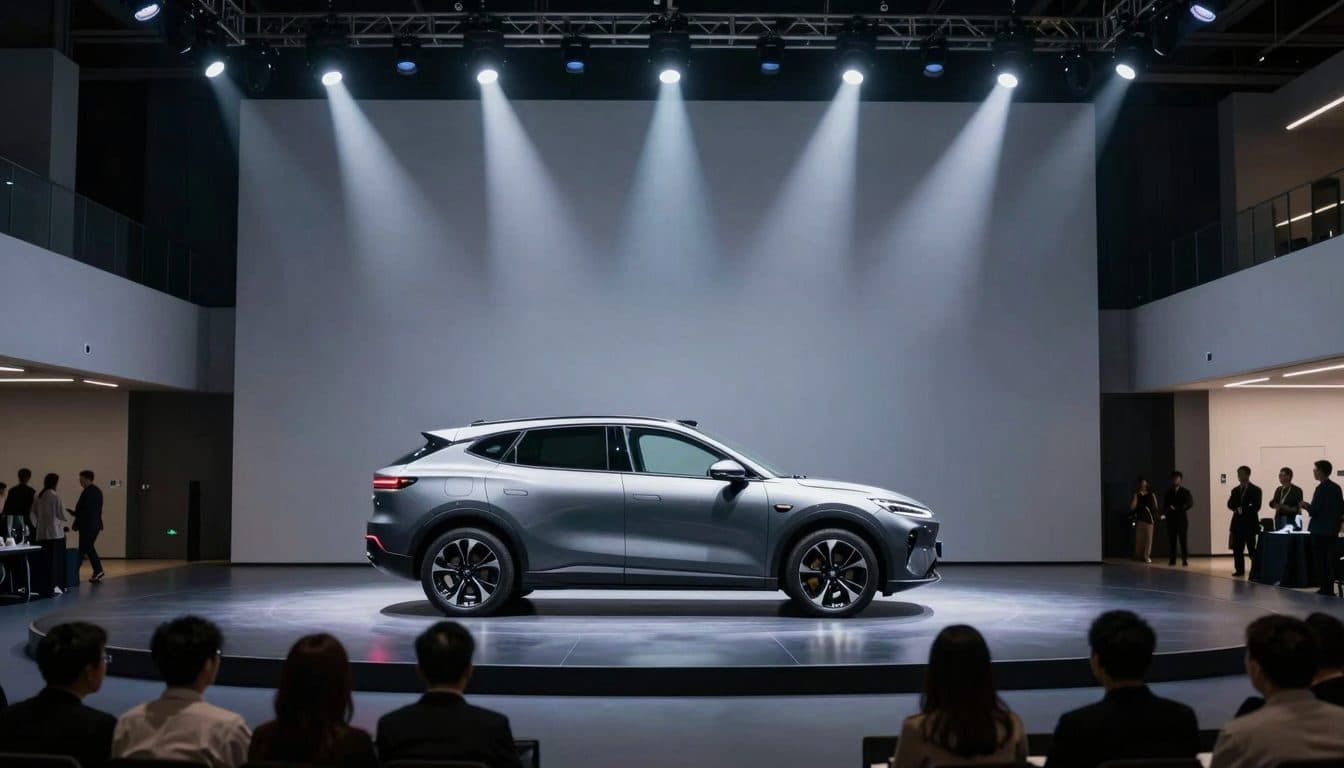
Volkswagen unveils the ID.Cross: compact electric SUV with tow hitch starting at 28,000 euros
Wolfsburg, July 15, 2026
AI-generated image (z-image via Kie.ai)
Summary
Volkswagen has announced the ID.Cross as an electric compact SUV that carries the nickname "Baby Touareg" among employees. The 4.15-meter-long vehicle is to be available from 28,000 euros and is scheduled to hit the market in autumn 2026.
Wolfsburg, July 15, 2026
Volkswagen unveiled the fully electric compact SUV ID.Cross on July 15, 2026, which according to the manufacturer will be available from 28,000 euros and is to roll into dealerships in autumn 2026.
Dimensions and Design: A "Baby Touareg" in subcompact format
The ID.Cross measures, according to the company, 4.15 meters long, 1.79 meters wide (excluding exterior mirrors) and 1.58 meters tall. This positions the model below the larger Touareg and is already affectionately referred to internally as the "Baby Touareg," as the press release reveals. With these exterior dimensions, Volkswagen says the car should fit easily into small parking spaces while still offering the sense of space of a larger SUV.
For the powertrain, Volkswagen relies on the APP290 electric drivetrain, which is already used in the upcoming ID.Polo. Unlike the rear-wheel-drive ID.3, the new subcompact models have front-wheel drive. This creates additional interior space: cargo capacity is 475 liters — 90 liters more than in the ID.3 — and a frunk with 22 liters is added under the front hood.
Drivetrain and Batteries: Two batteries, three motors
Customers can choose between two battery sizes. The smaller 37-kWh battery is based on LFP cells and can be combined with an 85-kW motor (116 hp) or a 99-kW motor (135 hp). The larger 52-kWh battery uses NMC chemistry and is initially available exclusively with 155 kW, according to Volkswagen. The company puts the range at 316 kilometers for the smaller and 436 kilometers for the larger battery, subject to final type approval; an earlier communication mentioned up to 439 kilometers.
When it comes to charging, there are differences between alternating and direct current. At a home wallbox, 11 kW AC is standard; a 22-kW AC charger, such as the Hyundai Group is increasingly offering, is not part of the lineup. With DC fast charging, the small battery reaches a maximum of 90 kW, the large one up to 105 kW. A standard charging stop from 10 to 80 percent takes, according to the manufacturer, 27 minutes (37 kWh) or 24 minutes (52 kWh).
Charging Times and Everyday Usability
Top speed is limited to 150 km/h for the two smaller motorizations, while the most powerful variant is capped at 160 km/h. Curb weight is around 1,550 kilograms according to VW, which including the driver amounts to roughly 1.5 tons. Ground clearance of 14 centimeters should, the manufacturer says, also allow for light unpaved tracks.
A standout feature in the electric compact SUV segment is towing capacity: the ID.Cross is permitted to tow up to 1,200 kilograms braked. Tongue weight is 75 kilograms, which VW says is enough for two e-bikes including a bicycle rack. The roof rails are also rated for 75 kilograms — enough, according to the press release, to "locker eines der immer beliebteren Dachzelte mit in den Urlaub [zu] nehmen und so zu einem kompakten Reisemobil" zu werden.
Towing Capacity and Camper Van Potential
Inside, Volkswagen is using the new "Pure Positive" design philosophy. Controls and displays are meant to be friendly and logical, as stated in the release. Available optionally and at extra cost are, among other things, a Harman Kardon sound system, expanded driver assistance systems and 12-zone massage seats. As a "certain something," VW is also promoting the "Retro-Modus" already familiar from other models, in which displays appear in the style of the 1970s.
Standard equipment varies by trim line. The entry-level "Trend" variant is only available with the small battery and the 85-kW motor. The mid-level "Life" trim includes, among other features, adaptive cruise control, 2-zone automatic climate control, a reversing camera and 18-inch alloy wheels. The top "Style" variant shares its drivetrain lineup with "Life": small battery with 99 kW as standard, large battery with 155 kW as an option. A GTI version with a 166-kW motor is planned, according to Volkswagen.
Trim Lines and Prices
In Germany, VW quotes an entry-level price of 28,000 euros. With the larger 52-kWh battery, the ID.Cross should sit "somewhere between 35,000 and 40,000 euros" in German dealerships, as reports put it. Market launch is announced for autumn 2026.
When it comes to the trunk, the strengths of the electric drivetrain are evident: with 475 liters, the ID.Cross surpasses the equally long but flatter Hyundai Ioniq 3, which according to reports offers 441 liters. Beneath the load floor there is an additional compartment that holds two crates of beer — or alternatively one crate and a subwoofer when the optional Harman Kardon system is on board.
In the competitive environment, the ID.Cross must hold its own, according to VW, against the Hyundai Ioniq 3, the Kia EV2 and EV3, the Renault 4 and the Mini Aceman. While the Ioniq 3 offers a wheelbase of 2.68 meters, the ID.Cross's wheelbase is, according to the available data, somewhat shorter — which should improve the turning circle. The final classification under the planned subcategory M1E, which is relevant for certain vehicle types, is still pending.
At an initial static presentation in Hamburg in April, the overall sense of space was good, based on seating trials. The interior is dominated by a tidy dashboard layout; physical buttons for the most important functions are retained. The bidirectional charging cable, with which an e-bike could be recharged on the go, is expected to be available as an option.
Competitive Environment and Market Opportunities
Volkswagen emphasizes that the ID.Cross is part of a new electric subcompact family based on the MEB platform, which also includes the ID.Polo. The shared use of APP290 motors, battery technology and modular toolkit is intended to deliver economies of scale and reduce production costs. This is the group's response to increasing price pressure from Chinese manufacturers and to the growing model diversity at Hyundai and Kia.
Overall, Volkswagen is positioning the ID.Cross as an affordable entry into the electric SUV world with above-average towing capacity and flexible storage. Whether the announced ranges and the starting price will actually hold in autumn 2026 will only become clear once deliveries begin. Until then, the type approval remains provisional.
Questions & Answers
How much does the VW ID.Cross cost in Germany?
Volkswagen quotes an entry-level price of 28,000 euros for the base Trend variant with the small battery. With the 52-kWh battery, the car is expected to cost between 35,000 and 40,000 euros in Germany.
When will the ID.Cross come to market?
Market launch is scheduled for autumn 2026. Final type approval — and therefore the final range figures — is still pending according to the manufacturer.
Which competitors does the ID.Cross face?
According to Volkswagen, the ID.Cross must hold its own against the Hyundai Ioniq 3, the Kia EV2 and EV3, the Renault 4 and the Mini Aceman, among others.