VW ID. Polo Production Start Spain: Electric Car from | allfacts360
VW begins series production of the ID. Polo and Cupra Raval in Spain
Madrid, June 03, 2026
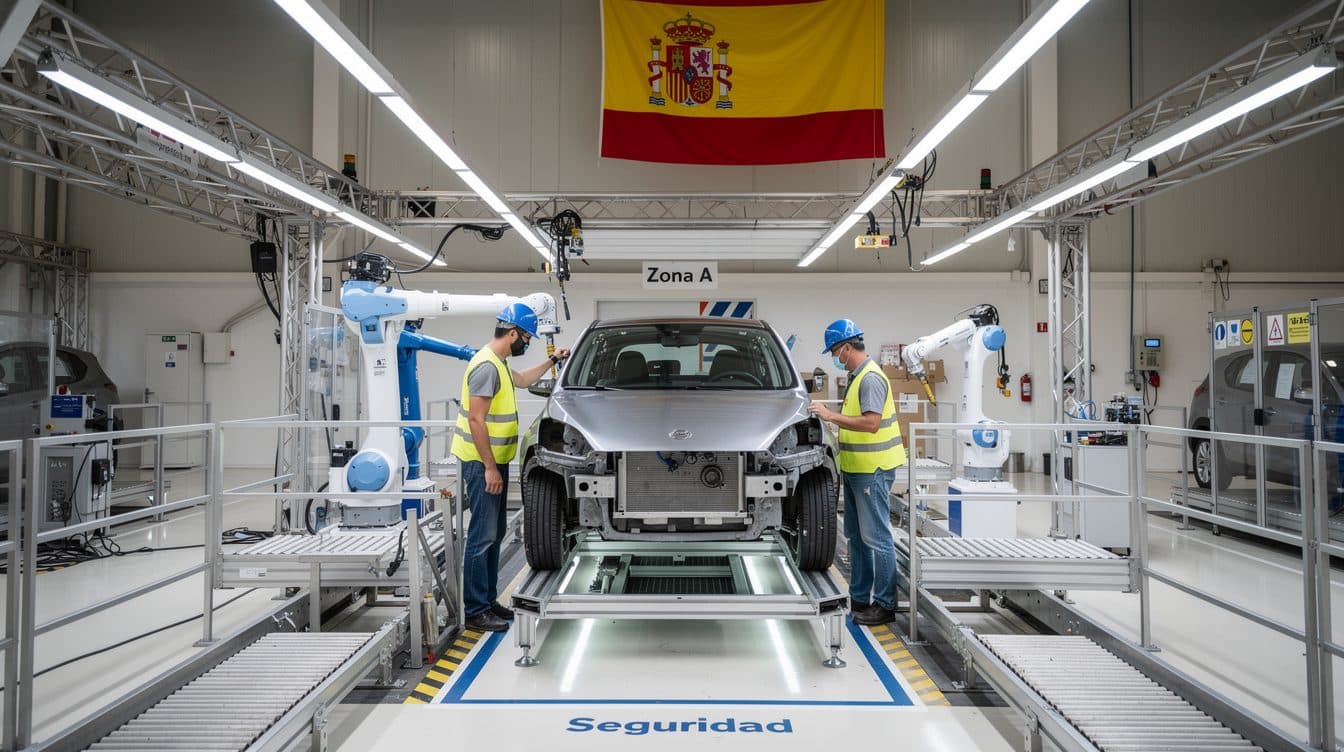
AI-generated image (flux-2/pro-text-to-image via Kie.ai)
Summary
Volkswagen on Wednesday launched series production of its first two electric compact cars, the ID. Polo and Cupra Raval, at the Seat plant in Martorell near Barcelona. Group CEO Oliver Blume and Spanish Prime Minister Pedro Sánchez were expected at the official production start.
Madrid, June 03, 2026
Volkswagen on Wednesday launched series production of its first two electric compact cars, the ID. Polo and Cupra Raval, at the Seat plant in Martorell near Barcelona, marking the beginning of a new electric car family from the Spanish plant.
Production Start in Martorell
With the start of production, the Wolfsburg-based group aims to position itself in the growing segment of battery-electric compact cars. According to the group, the Martorell plant has been reconfigured to produce up to 300,000 electric cars per year in the future. VW states that three billion euros alone have been invested in the factory's conversion since 2023, with the Spanish state adding almost 400 million euros in subsidies. In total, Volkswagen and its suppliers have invested around ten billion euros in the conversion of production sites in Spain.
To free up the site for electric models, VW moved the production of the combustion engine Polo from Martorell to South Africa in 2024. The model family now launching comprises a total of four vehicles based on a common platform. The company emphasizes that approximately 80 percent of the parts are identical across the four models, which is said to have significantly reduced development costs. According to VW, the savings from bundling development at Cupra amount to about 600 million euros.
Strategy: 80 Percent Common Parts
Group CEO Oliver Blume sees the new electric car program as an attack on one of the highest-volume segments of electromobility. At the presentation of the study in September at the IAA in Munich, he said: "With this new vehicle family, we are attacking one of the highest-volume vehicle classes in electric mobility, with great growth potential." According to him, the European market for fully electric compact cars is expected to be around four times larger after 2030 than it is today. "We want to sell several hundred thousand cars of this model series every year," Blume announced.
At the world premiere of the Cupra Raval in Madrid in April, Blume had already spoken of a "milestone for Cupra." The model shows "what affordable, emotional electric mobility developed in Europe can look like" – "without compromises in technology, safety, or design." VW brand board member Thomas Schäfer stated on the occasion of the Polo launch: "With this car, we are emphasizing that electric entry-level mobility does not require compromises." Electromobility should not be a luxury; it must work, be affordable, and convince in everyday use.
Dignitaries at the Launch
For the official production start, the company mobilized political and media presence: In addition to Blume, Seat-Cupra CEO Markus Haupt, and Thomas Schäfer, Spanish Prime Minister Pedro Sánchez was also expected in Martorell. The caliber of attendees is reminiscent of the launch of the first ID model in Zwickau in 2019, which was attended by then-Chancellor Angela Merkel. With the presence of the Spanish government, VW underscores the strategic importance the country is set to have for the group's electric strategy in the coming years.
Technically, the two models share a uniform platform, but there are differences in powertrains and batteries. The high-performance cells with nickel-manganese-cobalt chemistry for the higher-equipped variants come from the VW battery plant in Salzgitter. The cheaper lithium iron phosphate cells for the base versions are to come from a new cell factory in Sagunto near Valencia, which is currently under construction. With this, VW aims to bundle the entire value chain more strongly in Europe.
Prices and Competitors
The entry price for the new model family is above what is generally considered the entry price for electric cars. According to the company, the VW ID. Polo starts at just under 25,000 euros, with the Cupra Raval being around 1,000 euros more expensive. However, at the start of sales, only better-equipped versions with a large battery will be available, costing significantly over 30,000 euros. The cheaper base variants with smaller batteries and lower motor power will be available for order from July, with deliveries of the Polo in both variants beginning in September, according to VW.
Industry expert Frank Schwope from the University of Applied Sciences for Management and Communication in Berlin emphasizes that 25,000 euros can hardly be considered an entry price anymore: "This is no longer an entry-level model these days." Other manufacturers have been faster and are sometimes significantly cheaper with entry-level prices for electric cars in Europe: The electric Renault Twingo is already available for around 20,000 euros, and the Citroën Electric C3 is just over 17,000 euros thanks to a current promotional bonus. The Dacia Spring and the T03 from Stellantis partner Leapmotor are even cheaper. With the ID. Every1, which is expected to come from Portugal next year for around 20,000 euros, VW itself aims to move further downmarket.
Why Spain, Not Germany?
The fact that VW is building the affordable compact cars in Spain and not in Germany has a business logic. Works council chairwoman Daniela Cavallo made this clear in a dpa interview in early March: "It is clear: In Germany, we tend to produce more complex models with higher margins than small vehicles." However, it is important for the brand that customers can switch from compact cars to larger models – and those would then come from German production. Industry expert Stefan Bratzel from the Center of Automotive Management in Bergisch Gladbach draws a clear line: "Such a model can no longer be built in Germany" – "But it's not too late" for the market entry. "And 25,000 euros as a starting price isn't so bad now. I believe that will hit a broad market," he added.
In view of high fuel prices and the new e-car subsidies in Germany, Bratzel even sees a favorable market entry timing for the Wolfsburg-based company. The base variants are to be available for order from July, with deliveries starting in September. With this, VW also intends to prepare for the market launch of the even cheaper ID. Every1 from Portugal, which is scheduled to start next year for around 20,000 euros. In total, the group plans to sell several hundred thousand vehicles of the new model series annually in the coming years – in a market segment that management estimates will grow significantly by 2030.
Outlook: Every1 and Pamplona
Parallel to the production start in Martorell, preparations are underway at the Pamplona site in northern Spain for two further models in the family. The SUV siblings Skoda Epiq and VW ID. Cross are scheduled to roll off the assembly line there later this year. This brings VW's electric car family in Spain to a total of four model lines, which will share different components and powertrains. Industry observers see the high proportion of common parts across all models as a crucial lever for keeping unit costs low in a market segment where high-margin sales are more difficult than in the upper vehicle classes.
With the start of production, the role of the Spanish plant network for the entire group also changes. While Seat and Cupra were long primarily responsible for sportier models and niche vehicles, Spain is taking on a key role in the European e-car business with the ramp-up of electric models. Volkswagen aims to underscore its goal of offering competitive electric cars in the compact car segment even in an economically challenging environment – while simultaneously reducing dependence on Chinese manufacturers in this segment.
Questions & Answers
Which models are starting production in Martorell?
Volkswagen on Wednesday launched series production of the electric car ID. Polo and the Cupra Raval at the Seat plant in Martorell. Two further models from VW and Skoda are to follow later at the Pamplona site.
What do the new electric cars cost?
The entry price for the VW ID. Polo is just under 25,000 euros, according to the company, with the Cupra Raval about 1,000 euros more. At the start of sales, only better-equipped versions with a large battery will be available for significantly over 30,000 euros.
Why is VW producing the compact cars in Spain and not in Germany?
According to industry experts, small electric cars are no longer economically viable to manufacture in Germany. Works council chairwoman Cavallo explained that more complex models with higher margins are built in Germany, while smaller vehicles come from abroad.