Western Automakers Shift E-Car Production Back to Europe
Brussels, July 13, 2026
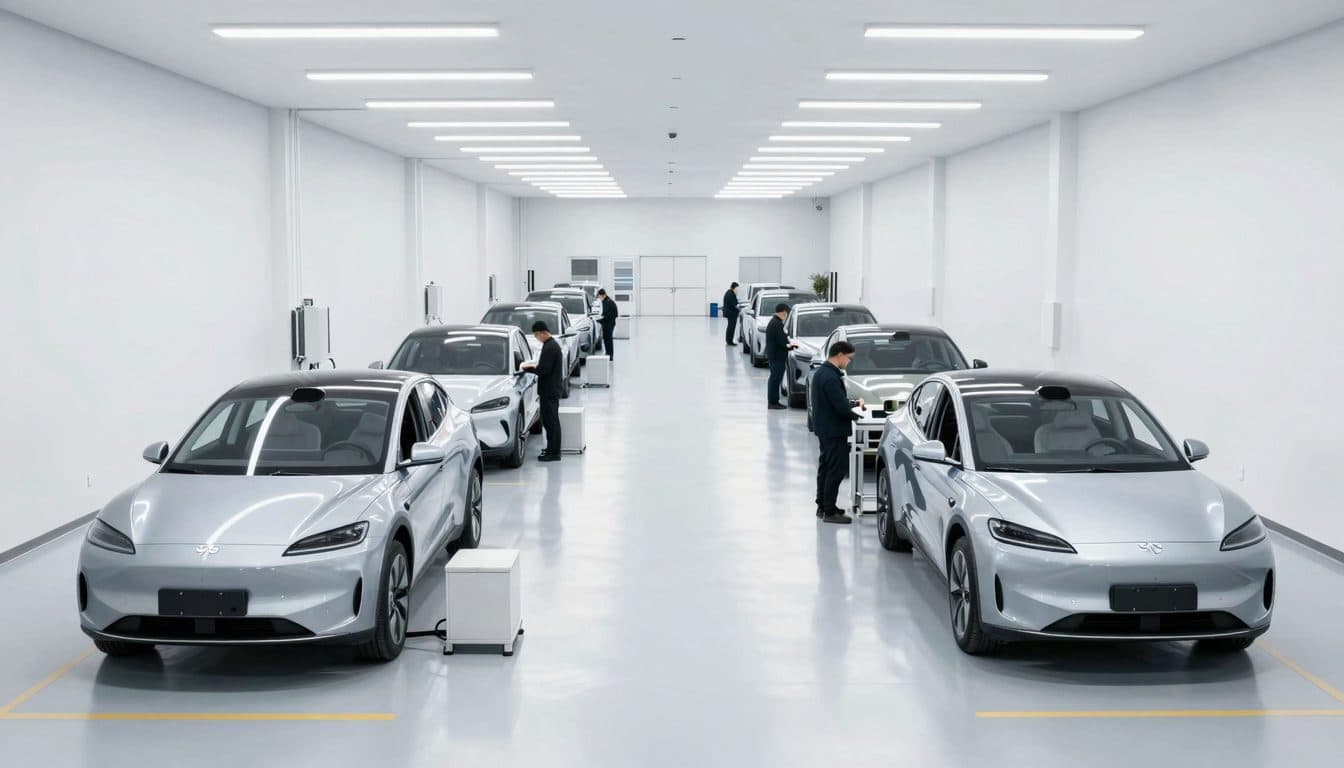
AI-generated image (z-image via Kie.ai)
Summary
A study by transport association T&E shows that since the EU tariffs on Chinese electric cars, western automakers have increasingly relocated their production back to Europe. The share of China-made e-cars from western brands in European sales fell from 38 to 23 percent between 2024 and the first quarter of 2025.
Brussels, July 13, 2026
Since the European Union imposed tariffs on electric cars from China in the fall of 2024, western manufacturers such as BMW, Volvo, Dacia, Smart, and Tesla have once again been producing more in Europe, according to a new report.
Decline in Chinese Imports of Western Brands
According to a study by the European environmental organization Transport & Environment (T&E), the share of China-produced electric cars from western brands in the European sales market fell significantly between 2024 and the first quarter of 2025. The share reportedly dropped from 38 percent to 23 percent of total battery-electric sales in Europe. According to T&E, the study is based on production and sales data from the provider GlobalData.
The change is particularly visible in the case of the US manufacturer Tesla. The share of China-produced Tesla vehicles in Europe's overall electric vehicle market fell from 23 to 19 percent over the comparison period. According to T&E, the analysis included the brands BMW, Dacia, Volvo, Smart, and Tesla.
German Production Rises, Sales Collapse
The trend is broadly consistent with data from the German Association of the Automotive Industry (VDA). According to the VDA, production of electric cars in Germany rose by 15 percent last year to 1.22 million units. However, the VDA explicitly stated that its figures do not show whether the increase is connected to a relocation of capacity from China.
At the same time, the German sales market for electric cars came under pressure. According to VDA data, sales collapsed last year, without the growing domestic production being able to offset this. The industry is therefore facing the contradiction of expanding manufacturing alongside declining sales. Battery production in Germany also recorded an 11 percent increase to 8.1 billion euros in 2025, according to ZVEI, reaching a record level.
EU Tariffs as the Trigger for the Shift
At the heart of the shift is the EU's tariff policy. The Union imposed punitive tariffs on electric cars from China in the fall of 2024, after an investigation had found that the value chain of Chinese manufacturer SAIC benefits from government subsidies to a greater extent than that of its competitors. The measure was intended to protect the European market and create a counterbalance to the subsidized prices.
According to T&E, the effect of these tariffs on Chinese manufacturers themselves has been limited. As the association notes, the tariffs have done little to curb imports of e-cars from Chinese manufacturers. The main reason for this is the high overcapacity of these companies in China, which maintains pressure to push vehicles onto the European market as well.
Chinese Manufacturers Respond with New Plants
However, according to the association, some Chinese manufacturers have also relocated a larger share of their e-car production to Europe. Since the EU investigation into subsidies in 2023, ten planned production facilities on the continent have become known. The Chinese corporations are responding to the tariff barriers by building up manufacturing within the EU single market.
The tariffs affect the individual Chinese brands differently. BYD more than doubled its market share in the EU year-on-year, according to the study. Geely also significantly increased its imports to Europe. SAIC, by contrast, is an exception, with its sales figures in Europe having declined sharply since 2024. According to T&E, the reason is that SAIC's e-cars are subject to almost double the tariff rates compared to vehicles from BYD or Geely.
BYD and Geely Gain, SAIC Loses
At the same time, the product mix of Chinese exporters is shifting. As T&E notes, Chinese manufacturers have increasingly focused on plug-in hybrids (PHEV) in their exports from China. Chinese brands now hold a 13 percent share of the EU PHEV market, compared to 3 percent in 2024. Plug-in hybrids are vehicles that have both a combustion engine and a rechargeable battery.
The shift among western manufacturers has immediate consequences for Europe's industrial structure. With increasing manufacturing in Europe, dependence on imports from China is falling, and new value creation is emerging in domestic plants. For the supplier industry, battery manufacturers, and component suppliers, this brings new orders, while at the same time supply chains are becoming shorter.
Outlook for the European Market
At the same time, competition is intensifying. Chinese manufacturers producing in Europe circumvent part of the tariff burden and compete directly on the single market. They are thus competing with European manufacturers not only in the Chinese market but increasingly also in their home market. The EU Commission is monitoring this development, but so far there is no new tariff package specifically targeting Chinese models manufactured in Europe.
Observers regard the trend as an adjustment to changed conditions. The tariffs have, in their view, reordered the competition between locations: western manufacturers are responding by relocating back to Europe, Chinese manufacturers by making direct investments on the continent. Both sides are trying to position themselves within the European market.
The demand side is also changing. Current registration data show that electric cars overtook all other types of powertrain in new registrations in Europe for the first time in June 2026. This rise could further increase the pressure on European production and boost the need for domestic manufacturing.
The VDA data suggest that the German industry is prepared for this development. With production of 1.22 million electric cars in 2025, the industry is reaching a level that exceeds earlier expectations. However, it remains to be seen whether manufacturing capacity can be utilized sustainably in the face of a fluctuating sales market.
Overall, the T&E study paints a picture of a European automotive industry in transition. Tariff policy has changed trade flows in the short term, and production structures are shifting in the medium term. The coming years will show whether the relocation of western manufacturers back to Europe and the direct investments of Chinese corporations will make the continent a permanently competitive location for electric mobility.
Questions & Answers
What does the T&E study say about the production of western e-car manufacturers?
According to T&E, the share of China-produced electric cars from western brands in European sales fell from 38 to 23 percent between 2024 and the first quarter of 2025. The brands BMW, Dacia, Volvo, Smart, and Tesla were included in the analysis.
Why did the EU impose tariffs on Chinese electric cars?
The EU imposed punitive tariffs in the fall of 2024, after an investigation found that the value chain of Chinese manufacturer SAIC benefits from government subsidies to a greater extent than that of its competitors.
How have BYD, Geely, and SAIC responded to the tariffs?
BYD more than doubled its EU market share year-on-year, Geely also increased its imports, while SAIC recorded sharp sales losses in Europe, according to T&E. According to T&E, SAIC's e-cars are subject to almost double the tariff rates compared to vehicles from BYD or Geely.
E-Car Production: Western Manufacturers Return to Europe | allfacts360