ADAC criticizes rise in fuel prices after end of tank discount as unjustified
Munich, 02 July 2026
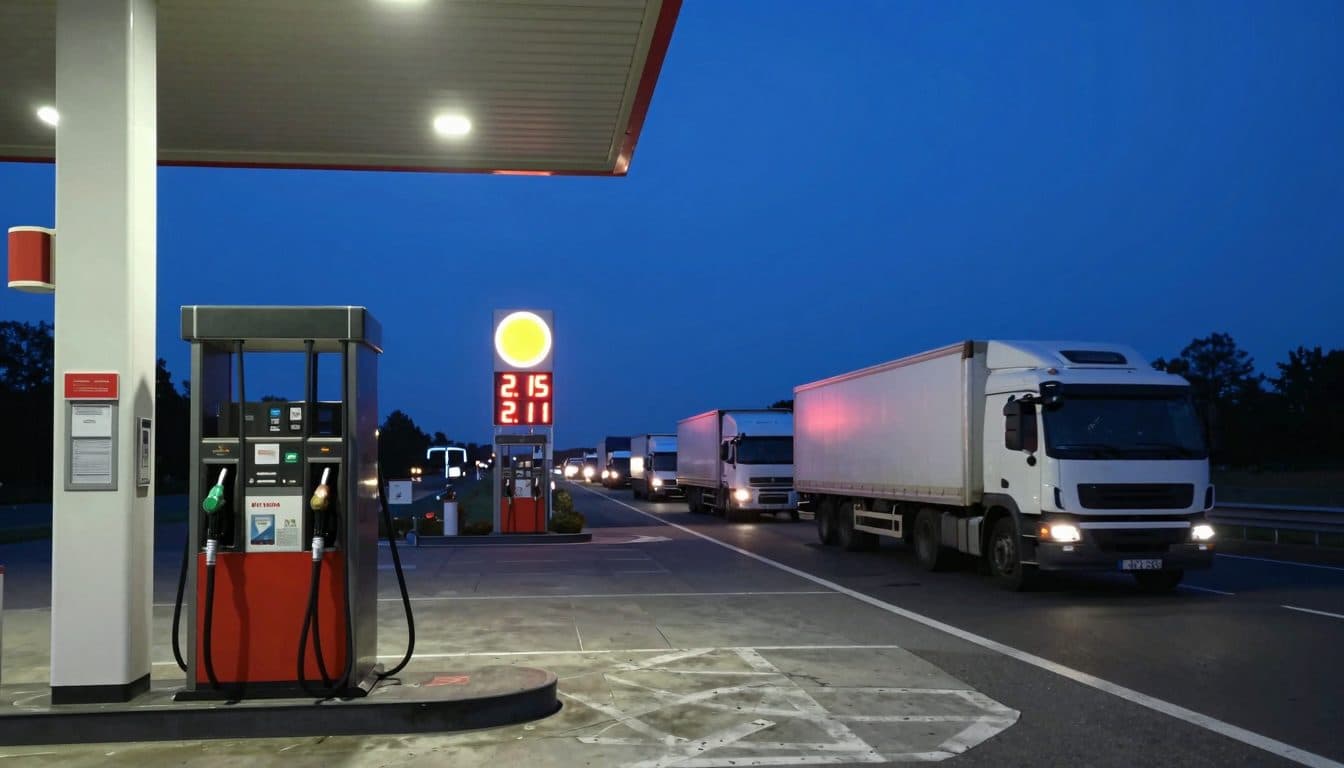
AI-generated image (z-image via Kie.ai)
Summary
With the expiration of the tank discount, fuel prices in Germany have risen significantly. The ADAC sees no justification for this and criticizes that oil companies apparently priced in the tax increase prematurely.
Munich, 02 July 2026
With the expiration of the so-called tank discount in the night of 1 July 2026, prices for Super E10 and Diesel at German filling stations jumped sharply, while the ADAC denies any factual justification for this rise.
ADAC criticism
The automobile club ADAC sharply criticized the sudden price increases at filling stations after the end of the temporary tax relief. "From our perspective, there is absolutely no justification for these price increases," said Julian Häußler, spokesperson for ADAC Württemberg, to SWR. The club points out that the crude oil price is currently not rising and that the political situation has stabilized. "Tankers are once again sailing through the Strait of Hormuz," Häußler added.
Already by Tuesday midday – and thus before the tank discount expired at midnight – motorists had experienced price jumps of up to 24 cents per liter, according to the ADAC. The markups on Tuesday were even higher than on Wednesday itself, at 20.3 cents for Super E10 and 24.0 cents for Diesel. On Wednesday, between 11:45 a.m. and 12:15 p.m., one liter of Super E10 became more expensive by 18.2 cents to 2.15 euros nationwide on average; for Diesel, the markup was 20.4 cents to 2.11 euros per liter.
Height of the price markups
The temporary tax relief under the tank discount had amounted to 16.7 cents per liter when filling stations were supplied. It expired on 1 July 2026. In earlier estimates, the state had assumed tax revenue losses of around 1.6 billion euros. With the end of the measure, according to the ADAC: "Damit ist die Steuersenkung um knapp 17 Cent pro Liter Sprit Geschichte."
The ADAC sees the premature increases as confirming the suspicion that oil companies had already priced in the foreseeable tax increase before the formal end of the discount. "Der Tankrabatt ist seit heute Nacht Geschichte – doch an den Zapfsäulen war das Ende längst eingepreist," the club summarizes the situation. In the final week of the tank discount, fuel prices had risen daily.
Number of prematurely risen prices
As an ADAC spot check showed on Wednesday, the price level in the morning was significantly higher than the previous day: at 11:45 a.m., Super E10 cost 13.8 cents more than on Tuesday; for Diesel, the difference was 15.6 cents. In the monthly average for June, one liter of Super E10 had still cost 1.870 euros, Diesel 1.818 euros. That was 11.3 cents less than in May and 23.9 cents less than in April, the most expensive month so far.
For the first time since May, premium gasoline grade E10 has again cost more than 2 euros in the nationwide daily average. In the monthly average for July 2026, premium gasoline stood at 2.05 euros, E10 at 1.99 euros, and Diesel at 1.95 euros. Diesel, however, remained below the symbolically charged 2-euro mark. By 2:00 p.m. on Wednesday, prices had already fallen again, but initially remained above 2 euros.
The criticism of the price increases is not limited to the ADAC. The Monopolies Commission has also been observing the tank discount since its inception. Tomaso Duso, the chairman of the Monopolies Commission, said: "Eine erneute Verteuerung wäre damit nicht mehr gerechtfertigt." His predecessor expressed a similar view: "In den vergangenen Tagen haben Mineralölunternehmen das absehbare Auslaufen des Rabatts offenbar genutzt, um ihre Margen gezielt auszuweiten." Duso considers it "wettbewerbspolitisch alarmierend" that prices rose too early.
Political reactions
"Bisweilen muss man den Eindruck bekommen, dass es zu Preisabsprachen kam," said Union faction vice Müller in an interview with MDR-AKTUELL. As of now, no further political interventions are planned. Former Consumer Protection Minister Ramona Pop, chair of the Federation of German Consumer Organizations, warned: "Das Ende des Tankrabatts darf nicht zum Startschuss für Extragewinne werden." The Federal Association of Independent Filling Stations (bft) and the filling station interest group TVI also criticized the actions of the oil companies.
A study conducted by the Ifo Institute on the pass-through of the tank discount shows a mixed picture. "Damit wurde der Tankrabatt beim Superbenzin nahezu vollständig an die Autofahrerinnen und Autofahrer weitergegeben," said Florian Neumeier, deputy head of the Ifo Center for Public Finance. For Super E5 and Super E10, the pass-through was nearly complete at 17 and 16 cents per liter, respectively. "Die unvollständige Weitergabe beim Diesel bedeutet, dass ein Teil davon bei den Mineralölkonzernen gelandet ist," added Ifo researcher Christian Gréus.
Ifo study on the pass-through of the discount
In the final days before it expired, according to Ifo economist Duso, the pass-through was only 7 to 11 cents per liter depending on fuel type, although the discount should mathematically have been around 17 cents. "Das bedeutet: Mehr als die Hälfte des Rabatts kam bei den Verbraucherinnen und Verbrauchern schlicht nicht mehr an," said Duso. The Federal Association of Independent Filling Stations (bft) called the Ifo study "insgesamt infrage." Chief executive Daniel Kaddik said that the Ifo Institute was essentially comparing the German market with the French market – the latter being, among other things, "von ganz anderen Rohstoffmärkten abhängig."
Since the beginning of April, suppliers have only been allowed to raise their prices once a day at 12 noon; this rule continues to apply after the end of the tank discount. Therefore, the steepest markups appeared at midday each time. "Wichtig sei gewesen, mit der 12-Uhr-Regelung und verschärftem Kartellrecht mehr Transparenz herzustellen," it was said from political circles. In Baden-Württemberg, many people had filled up one last time on Tuesday before 12 noon – long queues sometimes formed at the pumps. The ADAC is, according to its own statements, "auch nicht glücklich" with the 12-noon rule: "95 Prozent sind nicht 100 Prozent," Häußler said in an MDR interview. The aim had been an instrument that takes effect quickly – especially for high-mileage drivers, commuters, outpatient care services, and coach companies.
The 12-noon rule and its consequences
Prices did not rise everywhere immediately: a self-service station in Esslingen offered Diesel on Wednesday for 1.70 euros, Super E10 for 1.76 euros, and Super E5 for 1.82 euros. Only isolated stations could still be found in the morning with prices below 1.80 euros, especially for Diesel. In Hamburg, the price per liter of Diesel fuel was around 1 euro 87 shortly before 12 noon – later prices shot up once the 12-noon rule permitted price increases.
The oil price itself does not justify the rise at the pumps. A barrel (159 liters) of the North Sea grade Brent for August delivery most recently cost 73.69 U.S. dollars; WTI for August delivery 70.27 dollars. Compared with the crisis high of 126 dollars, that is a decline of around 43 percent. "Wer steigende Rohölpreise sofort weitergibt, darf bei sinkenden Preisen nicht auf die Bremse treten," said Union faction vice Müller. Häußler from the ADAC put it similarly: "Es liegt der Verdacht nahe, dass die Mineralölkonzerne die Gelegenheit genutzt haben, nochmal zu profitieren."
Oil market and inflation expectations
Fuel prices have immediate consequences for inflation. The hope for further falling inflation rates received a setback on Wednesday: the inflation rate for the third quarter is estimated by ING at 3.6 percent, after 2.6 percent in the second quarter. In June, consumer prices in Germany had still risen by 2.3 percent, in May by 2.6 percent. "Da kommt noch etwas," warned Carsten Brzeski, chief economist Germany and Austria at ING, in a conversation with the ARD financial desk. Jörg Krämer of Commerzbank also sees risks: "Denn hinter uns liegt ja ein Ölpreisschock – das war auch ein Kostenschock, den die Unternehmen jetzt langsam weitergeben an die Verbraucher."
The European Central Bank (ECB) had already raised interest rates on 11 June due to inflation risks. ECB chief Christine Lagarde said that, from today's perspective, interest rates would need to be raised further to bring inflation back to the target of two percent over the medium term. Metzler economist Walk, by contrast, sees no wage-price spiral and gives partial reassurance: "Wir sehen hier ganz klare Signale der Entspannung."
The report was broadcast on 1 July 2026 on Deutschlandfunk. The reactions from politics, consumer protection, and
ADAC: Fuel prices surged sharply after end of tank discount | allfacts360