After Attack on Berlin CSD: Chancellor and CSU Demand Tougher Approach to "Gefährder"
Berlin, July 27, 2026
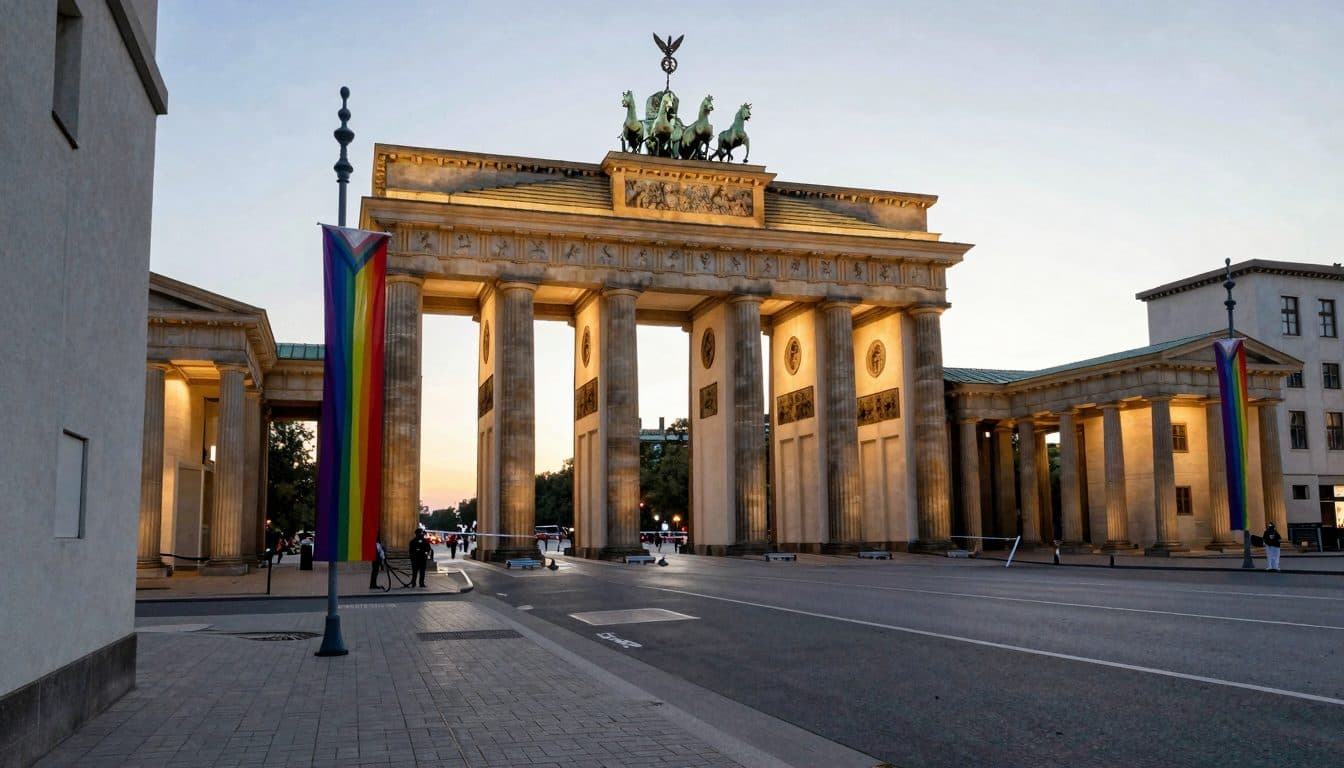
AI-generated image (z-image via Kie.ai)
Summary
Following the suspected Islamist attack on Christopher Street Day in Berlin, which left one person dead and several seriously injured, Chancellor Friedrich Merz and CSU leader Markus Söder have called for a more decisive approach against so-called "Gefährder" (individuals deemed dangerous). The suspect, Abdul B., was already known to authorities before the attack as a high-risk individual and was under surveillance.
Berlin, July 27, 2026
Following the suspected Islamist attack on Christopher Street Day in Berlin, which left one person dead and numerous others seriously injured, Chancellor Friedrich Merz and CSU leader Markus Söder have called for a more decisive approach against so-called "Gefährder" and have, in part, raised the prospect of far-reaching legal tightening.
The Chancellor said in Berlin on Monday that the federal government would have to respond with composure but also with determination. The crucial question was how it had been possible for a man classified as a "Gefährder" to approach the vicinity of Christopher Street Day on Saturday evening unhindered. "Wir werden mit Besonnenheit, aber auch mit Entschlossenheit reagieren müssen und vor allem die Frage beantworten müssen, wie es eigentlich sein kann, dass ein Mann, der so eingestuft ist hier in Berlin, sich am Samstagabend unbehelligt in die Nähe des Christopher Street Days begeben konnte", the Chancellor said further.
Political Reactions
The political debate over the security architecture for dealing with Islamist "Gefährder" received additional momentum on Monday from the CSU parliamentary group's summer retreat at Kloster Banz in Upper Franconia. CSU leader Markus Söder formulated unusually sharp demands there for a restructuring of existing instruments. "Wir müssen die Zügel bei Themen wie Gefährdern deutlich anziehen", Söder said on Monday at the start of the closed-door meeting of CSU Bundestag members.
Söder's Demands in Detail
At its core, Söder is targeting three areas: the revocation of German citizenship, tougher measures depriving individuals of their liberty, and restrictions on mobility. "Jemand, der Gefährder ist, kann nicht auf Dauer zwei Staatsbürgerschaften haben", Söder said. Consideration must be given to revoking the German citizenship of such individuals in order to deport them immediately.
He also picked up on a proposal that had already played a role in the security policy of previous federal governments: a mandatory driver's license renunciation. "Gefährder brauchen keinen Führerschein", Söder said. This was intended to prevent individuals classified as dangerous from moving about freely and preparing possible attacks. He also considers greater surveillance via social media necessary: "Es ist geradezu absurd, dass man deswegen an der Stelle nicht nach einem Täter fahnden und suchen kann."
Dobrindt: Between Agreement and Skepticism
Reactions from the federal government have so far been mixed. Federal Interior Minister Alexander Dobrindt, who, like Söder, belongs to the CSU, called in an interview with the tagesthemen for an "Einschränkung der Bewegungsfreiheit" and named electronic ankle bracelets as a possibility. He reacted cautiously to Söder's proposal on citizenship revocation. It was a "sehr komplexes Unterfangen". This was only possible if there was indeed a second citizenship and if deportation could then be carried out.
Dobrindt also articulated fundamental criticism of the previous handling of the suspect. "Es wäre sinnvoll gewesen, Abdul B. in Haft zu nehmen", the CSU politician said. "Zu Recht stellen sich eine ganze Menge Fragen. Die Überwachungen, die stattgefunden hätten, hätten nicht ausgereicht." The Interior Minister also spoke out in favor of not applying juvenile criminal law in such cases. "Eine Präventivhaft für Gefährder ist aus meiner Sicht zwingend notwendig."
Background of the Suspect
The suspect, Abdul B., was already known to authorities before the attack. According to research by WDR, NDR, and the Süddeutsche Zeitung, Abdul B. had been assessed as a "Hochrisikoperson" (high-risk individual) by a BKA analysis tool a few weeks before the attack on the Berlin CSD. For preparing a terrorist criminal offense, the 21-year-old was sentenced in May 2026 to a juvenile sentence of one year and ten months, but was then released on probation, taking into account the pre-trial detention already served.
Until recently, surveillance measures had been in place against the Islamist. Nevertheless, he was able to approach the vicinity of the event on Saturday evening. In the attack, which occurred on the margins of Berlin's Christopher Street Day, the suspect allegedly seriously injured numerous people, some severely. One woman was killed, according to investigators. Further background on the course of events and the victims was part of the ongoing investigation.
At the center of the political debate is the question of legal consequences. Söder said: "Natürlich muss alles möglich sein, um da schneller zugreifen zu können." People had no understanding of the fact that "Gefährder" were allowed to move about freely. "Es haben Leute in Deutschland wenig Verständnis, dass jemand, der vorbestraft ist, der als Gefährder eingestuft ist, am Ende frei herumlaufen kann." A police classification of a person as a "Gefährder" must have further consequences.
Legal Limits and Scope of Action
With regard to the revocation of citizenship, the federal government points to constitutional limits. Under current law, revocation is only possible under very narrow conditions, such as the voluntary acquisition of another nationality or participation in combat operations of a terrorist organization. Deportation also requires that the destination state is willing or obligated to admit the individual. Dobrindt pointed out that scope for action already exists and needs to be used more consistently.
Parallel to the political debate, investigations are continuing. According to the Chancellor, initial interim results are to be presented by the end of 2027. The Federal Prosecutor General is examining whether the attack is to be classified as a terrorist offense within the meaning of the Criminal Code. The question of whether and how the existing BKA early warning system failed is also subject to review.
Parliamentary deliberation is expected to begin after the summer recess. The Ministry of Justice and the Interior Ministry have announced an inter-ministerial working group to bundle proposals for reforming "Gefährder" law, electronic ankle bracelet regulations, and nationality law. From the ranks of the coalition factions, it was stated that they would be guided by expert hearings and the evaluation of previous practice.
Critics warn against hasty encroachments on fundamental rights. Civil rights organizations point out that preventive detention of persons who have not yet committed a concrete criminal offense must be measured against the fundamental right to liberty under the Basic Law. The introduction of a blanket electronic ankle bracelet requirement for "Gefährder" also raises questions of proportionality and data and personal protection.
Fundamental Rights Debate and Parliamentary Deliberation
For the security authorities, the Abdul B. case remains a central point of reference. Even though the BKA analysis tool had assessed the accused as a high-risk individual, the subsequent measures were insufficient to prevent the attack. Clarifying this gap is likely to shape the reform debate significantly.
Berlin Police corrected initial figures on the injured on Monday. Accordingly, more than a dozen people were injured in the attack, some seriously. The identity of the killed woman has not yet been conclusively confirmed; relatives have been notified. Investigators are following up on tips from the public, including photos and videos from the crime scene.
For the federal government, according to government circles, there is no question that the rule of law must act decisively. "Wir werden mit Besonnenheit, aber auch mit Entschlossenheit reagieren müssen", the Chancellor reaffirmed. The statement signals a balancing act: on the one hand, existing rule-of-law instruments are to be preserved; on the other, political pressure to act is being formulated that will extend beyond the summer recess.
Observers interpret the simultaneous intervention by the Chancellor, the Interior Minister, and the CSU leader as an attempt to demonstrate a unified line among the governing parties. At the same time, Dobrindt's caution on the issue of citizenship revocation points to a differentiation within the Union. Söder's pointed formulation about "Zügel" (reins) and the driver's license renunciation underscores the pressure on the federal government to present concrete steps quickly.
Questions & Answers
Who is the suspect in the attack on the Berlin CSD?
According to investigations so far, the suspect is Abdul B., a 21-year-old Islamist who was already known to authorities before the attack as a high-risk individual and was under surveillance.
What specific demands did CSU leader Markus Söder make?
Söder called for, among other things, the revocation of German citizenship for "Gefährder" with dual nationality, a driver's license renunciation for "Gefährder," and overall a clear "Anziehen der Zügel" (tightening of the reins) in dealing with Islamist "Gefährder."
How did Federal Interior Minister Alexander Dobrindt react to the proposals?
Dobrindt called for a restriction of freedom of movement, for example through electronic ankle bracelets, and considered preventive detention for "Gefährder" imperative. He described citizenship revocation as a "sehr komplexes Unterfangen" that would only be possible if a second citizenship existed and deportation could be carried out.
Berlin CSD Attack: Söder and Merz Demand Tighter | allfacts360