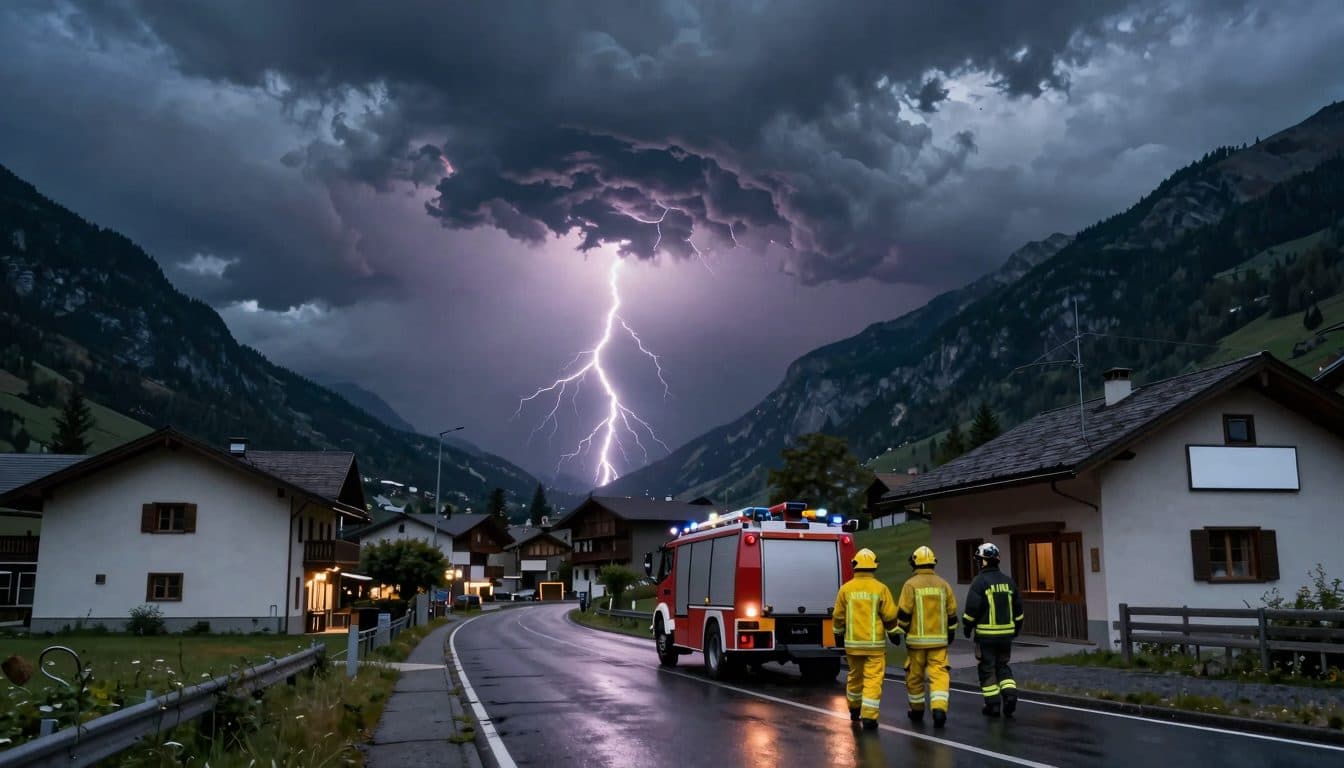
After the Heat Wave: Severe Thunderstorms Sweep Across Parts of Austria
Vienna, July 2, 2026
AI-generated image (z-image via Kie.ai)
Summary
After the end of a 13-day historic heat wave, severe thunderstorms with heavy rain, hail, and gale-force winds are moving across large parts of Austria. In Lower Austria, firefighters were deployed around 60 times, with the districts of Tulln and Neunkirchen particularly affected.
Vienna, July 2, 2026
A 13-day historic heat wave abruptly left Austria on Wednesday, replaced by a cold front bringing severe thunderstorms, heavy rain, hail, and gale-force winds that triggered dozens of fire department operations in several federal states.
Styria Issues Acute Warning
The state of Styria has issued an official acute warning following the abrupt end of a 13-day heat wave. As the state announced, the historic heat wave "bid farewell" suddenly with a cold front. On Wednesday, heavy thunderstorms coming from the north spread across large parts of Styria, according to GeoSphere Austria. An orange severe weather warning is in effect for the majority of the federal state.
In other parts of Austria as well — from Carinthia to Burgenland and in Lower Austria and Vienna — there remains a risk of severe weather. According to GeoSphere, strong gusts can occur in Lower Austria even outside of thunderstorms. Violent thunderstorms are hitting the eastern edge of the Alps, as reported by the private weather service "uwz." One cell in Neudorf/Landsee recently brought 70 liters of rain per square meter and gusts of 77 km/h.
Thunderstorm Warnings in Other Federal States
In Styria, authorities say to expect "local severe weather, hail, and storm peaks of 80 to 100 km/h." The authority warns of a significant worsening of the weather situation due to falling branches, toppling trees, and possible power outages. The private weather service UWZ also reports extreme rainfall amounts and localized flooding.
In Lower Austria, firefighters have been deployed around 60 times since Wednesday afternoon. According to Klaus Stebal from the state command, the districts of Tulln and Neunkirchen were particularly hard hit by the severe weather. In Gloggnitz (Neunkirchen district), firefighters had to be deployed multiple times. Among other things, manhole covers dislodged by larger volumes of water had to be put back in place.
Fire Departments in Lower Austria in Continuous Operation
In Würmla, pumping operations, toppled trees, and contaminated roads were the predominant reports. Intense precipitation was also felt in the south of the federal state. This made Würmla the hotspot for severe weather operations in Lower Austria.
Already in the morning, summer-like highs of up to 36 degrees were reached in eastern and southern Austria under mostly cloudless skies. In western Austria, on the other hand, significantly cooler air was already present, causing temperatures to drop. During the course of the day, thunderstorms formed in large parts of Austria, intensifying in the afternoon especially in the eastern half of the country.
Red Warnings and Safety Advice
For parts of Carinthia, especially the St. Veit an der Glan district, an acute warning has been issued due to the thunderstorm front. The Severe Weather Center (UWZ) is issuing regional warnings at Orange and Red levels for Carinthia, with heavy rain, hail, and in some cases severe gale-force gusts. After a hot and sunny start, a cold front with partly violent thunderstorms is passing over Carinthia in the afternoon.
Red weather warnings are currently in effect for individual districts of Carinthia, Styria, Burgenland, and Lower Austria. In the affected districts, heavy rain, hail, and stormy gusts are possible in the afternoon. GeoSphere Austria explains that the thunderstorms in Lower Austria can be locally intense, with heavy rain, hail, and hurricane-like gusts.
Authorities advise seeking shelter in safe buildings during thunderstorms and closing open windows. On the roads, increased caution and reduced speed are recommended due to aquaplaning-hazardous road surfaces and poor visibility. The state of Styria advises staying away from streams and smaller watercourses, as they can swell rapidly. Additionally, party tents should be secured and awnings retracted.
The weather situation in Styria has deteriorated significantly with the cold front, with violent thunderstorms causing heavy rain, hail, and stormy gusts especially in Upper Styria. The weather service warns of dangerous gale-force gusts and cloudburst-like rain. The UWZ also warns that severe thunderstorms from the Bucklige Welt south of Wiener Neustadt will spread to Burgenland, with extreme rainfall amounts that can trigger localized flooding.
Weather Calming by Thursday
According to the UWZ, the weather situation will gradually calm down during the night to Thursday after the passage of the cold front. On Thursday, conditions in Austria will be mostly calm with a mix of sun and clouds, though individual showers remain possible according to GeoSphere Austria. For the night, GeoSphere Austria forecasts a weak cold front, which, however, will bring no rain except in the western mountainous region.
On Friday, rain will fall mainly north of the main Alpine ridge, that is, in Vorarlberg, Tyrol, Salzburg, Upper Austria, as well as the northern parts of Lower Austria and Vienna. Daily high temperatures will range between 23 and 29 degrees, according to GeoSphere. On Thursday, daily highs will range between 22 and 29 degrees. It will remain warm, however.
On Saturday, conditions are forecast to be generally sunny, except for isolated small rain showers. High temperatures will remain in the 20s. In the eastern half, strong winds are expected, providing refreshment, at least in the Alpine foothills and in the east of the country. Sunday is also expected to be sunny, with isolated showers remaining weak.
Record Heat Also in Northern Germany
Parallel to the development in Austria, the heat wave also broke records in northern Germany. In the first half of 2026, temperature records were broken at almost all Lower Saxon weather stations. On June 26 and 27, just before the first half of 2026 ended, previous highs were exceeded at 47 of 49 examined weather stations in Lower Saxony. In Lüchow (Lüchow-Dannenberg district), for example, 40.2 degrees was measured. This value at the peak of the heat wave on June 27 is, according to the ARD Weather Competence Center, the highest temperature ever documented in Lower Saxony.
It was only the second time ever that more than 40 degrees had been measured in Lower Saxony. The previous record holder had been July 20, 2022. Especially in the Lüneburg Heath and in the Wendland, extremely high values were recorded on the thermometers. Even at night, individual Lower Saxon stations still recorded temperatures between 24 and 25 degrees.
According to meteorologists, massive heat waves had previously occurred only in July and August. In June, conditions had historically been limited to individual hot days. In its early occurrence and in its extent, this first heat wave of 2026 had been "historic." Meteorologists expect the first heat wave of the second half of 2026 as early as the middle of next week.
Meteorologists: Climate Change Is Progressing in Leaps and Bounds
The history of the 40-degree mark in Germany begins on July 27, 1983, in Bavaria. After that, 40 degrees was not reached again until August 2003, in high summer. 2003 was the first mega-summer; since 2018, hot and dry summers have appeared significantly more frequently and more intensely in records in the north. On July 20, 2022, the 40-degree mark was reached in Hamburg for the first time in history. Faßberg 39.5 degrees (previous record 39.0 degrees, July 2022).
According to the ARD Weather Competence Center, it is only a matter of time before 45 degrees is reached in Central Europe in summer as well. Climate change is progressing "not slowly and in a straight line, but in a staircase-like and leap-frogging manner." Meteorologists speak of a heat wave when temperatures of 30 degrees Celsius or more are measured on at least three consecutive days. With the beginning of next week, more rain is also expected again, especially in the eastern half of Austria.
Despite the short-term cooling, conditions in Austria will remain rather sunny and dry — but after a days-long heat wave, cooler weather will now set in sustainably over the coming days. Toward the weekend, increasing high-pressure influence over Austria is expected again, according to forecasts.
Questions & Answers
Which regions of Austria were particularly affected by the severe weather on July 2, 2026?
Particularly affected were Styria, Carinthia, Burgenland, and Lower Austria. In Lower Austria, the districts of Tulln and Neunkirchen, with Würmla and Gloggnitz as focal points, were named.
How many fire department operations were there in Lower Austria during the thunderstorms?
Firefighters were deployed around 60 times in Lower Austria. In Würmla, pumping operations, toppled trees, and contaminated roads were the main focus; in Gloggnitz, among other things, manhole covers torn from their anchors were put back in place.
What temperature records were broken in Germany during the heat wave?
In Lüchow (Lüchow-Dannenberg district), on June 27, 2026, a temperature of 40.2 degrees was measured — the highest ever documented in Lower Saxony. Previous highs were exceeded at 47 of 49 examined weather stations in Lower Sax
Heat Wave Austria: Thunderstorms After Record Heat in Early | allfacts360