Heat, Mudslides and Thunderstorms: Austria Experiences Extreme Weather with Record Temperatures
Vienna, July 1, 2026
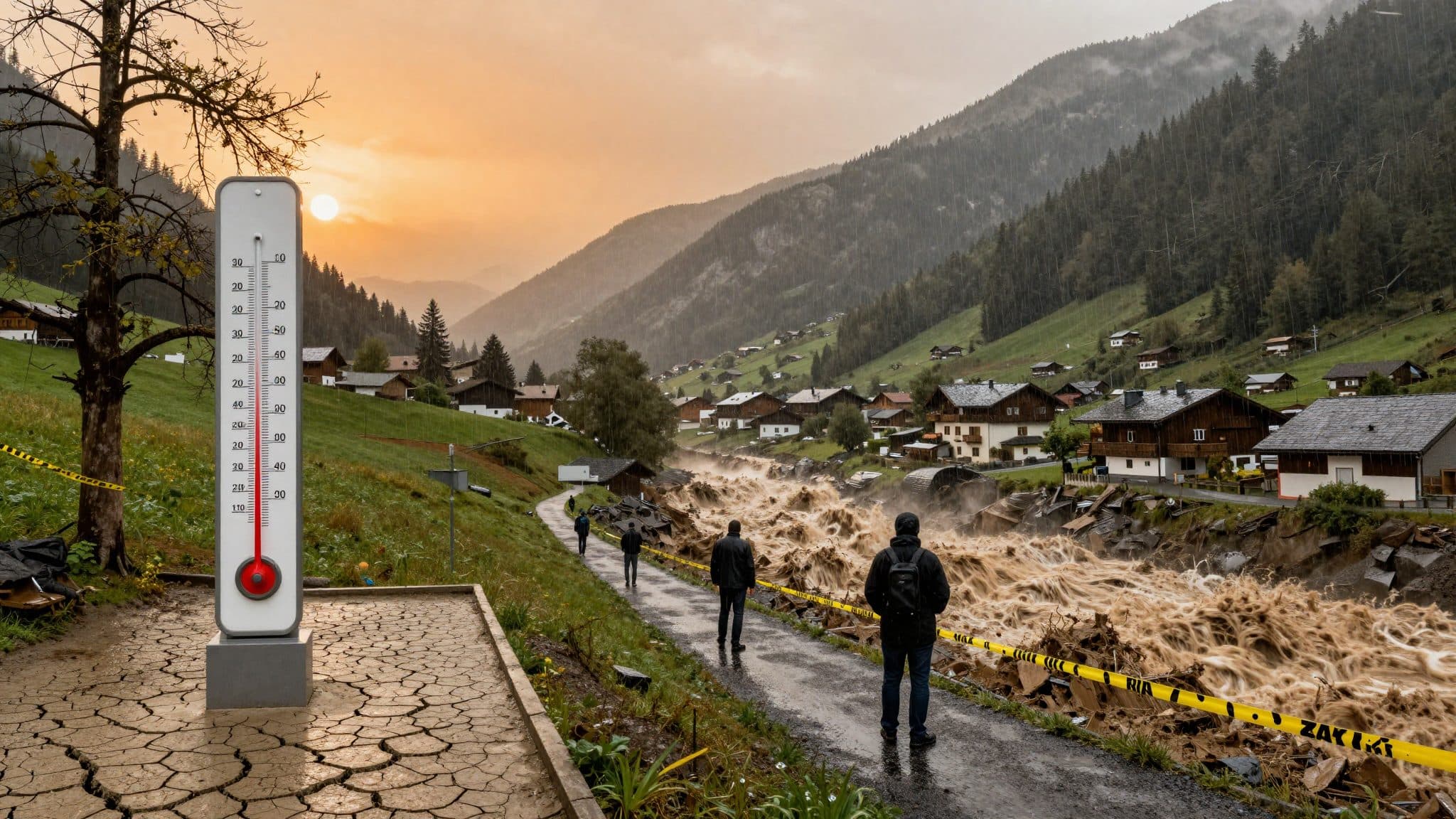
AI-generated image (z-image via Kie.ai)
Summary
Austria is currently experiencing a heat wave with record temperatures near 40 degrees, while in the west and south severe storms with mudslides, hail and power outages are raging. A cold front will bring cooling from Wednesday, but initially the east and south remain hot.
Vienna, July 1, 2026
While Austria suffers under a heat wave with temperatures close to the 40-degree mark, severe storms have triggered mudslides, power outages and evacuations in several federal states, but a cold front will bring gradual cooling starting Wednesday.
Record Values at the 40-Degree Mark
The heat wave pushed Austria to the brink of the 40-degree mark on Monday with extreme values. According to data from the Central Institute for Meteorology and Geodynamics, the Mistelbach and Langenlebarn measuring stations came close to this mark with 39.9 and 39.8 degrees respectively. The Bad Deutsch-Altenburg station even exceeded the 40-degree mark and thus set a new record. Laa an der Thaya (39.5), Wien Stammersdorf (39.2), as well as Wien Innere Stadt and Gänserndorf with 39.1 degrees each also crossed the 39-degree threshold.
The night from Sunday to Monday was the warmest of the year so far in Austria. In Vienna, a new year-round nighttime heat record was measured for the entire federal state: the thermometer showed 27.3 degrees Celsius, according to the available data. The night from Monday to Tuesday was somewhat cooler at 24.1 degrees in Wien Innere Stadt and Bad Tatzmannsdorf, but remained tropical.
While the heat continued to bear down in the east, the west of Austria was already grappling with the consequences of severe storms. In Tyrol, mudslides came down in several valleys after massive thunderstorms. On Sunday, 200 day-trippers were cut off from the outside world after a mudslide in the Kaunertal. They had to be evacuated on Monday via helicopter by the Austrian Armed Forces.
Mudslides in Tyrol and Styria
The storms also caused damage in Styria. In Schladming, around 30 people were trapped on Monday after a mudslide had buried the Untertalstraße over a length of 600 meters. Between Flirsch and Pettneu, a scheduled bus with passengers was hit by a mudslide.
Carinthia was hit by another severe storm on Tuesday afternoon. The strongest thunderstorm cells were located in parts of Carinthia as well as in the Waldviertel in Lower Austria, as reported by the Severe Weather Center. For the districts of Hermagor, Spittal an der Drau and Villach-Land, warning level Red was already in effect as an acute storm warning for thunderstorms and hail. A significant weather warning of level Yellow/Orange was also issued for the districts of Sankt Veit an der Glan and Wolfsberg.
Carinthia: Warning Level Red and Severe Hail
In Carinthia, thunderstorms spread in the late afternoon. From around 5 p.m., the situation worsened, according to reports. In Weißenstein, it began to hail, with hailstones reaching sizes of up to 3 centimeters. In Tschinowitsch towards Maria Gail, a tree fell onto the roadway; the Schütt and Tschinowitsch fire brigades were in operation, HBM Alexander Scharf informed when asked by 5 Minuten.
The impact in Carinthia was significant. Fallen trees left around 1,100 households without power on Tuesday evening. The disruption map of Kärnten Netz showed initial power outages in the Fürnitz (Villach-Land) area, Feldkirchen and in the district of Klagenfurt-Land. The most affected districts were Villach-Land, Spittal, St. Veit and Feldkirchen. According to ORF Kärnten, the area of Central Carinthia was particularly affected.
Kärnten Netz technicians attempted to restore service to the affected households until nightfall. A large proportion of households were expected to have service restored by Tuesday. A yellow thunderstorm warning remained in effect until Wednesday at 00:00, with an additional local orange warning.
Another severe thunderstorm also formed in the Waldviertel. Air traffic control registered radar images strongly suggestive of hail. The thunderstorm moved on from the Gmünd and Schrems area towards Heidenreichstein and Litschau. There was a risk of mudslides and localized flooding. In the region, cloudburst-like rain, gale-force gusts and numerous lightning strikes had to be expected.
Sirens and Power Outages
In Carinthia, sirens sounded in several towns. These included Dellach im Drautal, Velden am Wörthersee, Villach-Stadt and Villach-Land. In the Villach area, sirens wailed multiple times. The thunderstorms moved only slowly northward, while at the same time new thunderstorm cores continually formed on the southern flank of the cells, making the further path and development difficult to predict.
As Skywarn Austria reported on social media, vigorous thunderstorms had developed as expected. In the sultry-hot air, localized heavy rain and gusty winds were to be expected, as meteorologists from GeoSphere Austria warned. Potential hazards included flooding and local mudslides caused by sometimes intense heavy rain due to the slow movement, as well as gale-force gusts near thunderstorms and hail.
According to the State Alarm and Warning Center (LAWZ), several trees were toppled and blocked roads. Accidents also occurred as a result. The worst damage occurred between 5:00 and 7:00 p.m. Whether anyone was injured was initially unclear. The central area around Klagenfurt (city/country), Villach-Stadt, Feldkirchen and Völkermarkt was, according to current warnings, initially spared.
Warmed Waters and Sultry Heat
Austria's waters were also extremely warmed. The water temperature in the Alte Donau, an oxbow of the Danube and a popular local recreation area for thousands of Viennese, was 29.8 degrees on Tuesday morning. Lake Neusiedl reached 28 degrees. Even the Carinthian Weissensee – usually a reliable guarantor of real cooling despite its elevation at 920 meters above sea level – was at 25.5 degrees.
A change in weather is emerging from Wednesday. On Wednesday, a cold front will reach western Austria, causing temperatures from Vorarlberg to Upper Austria to drop to 18 to 26 degrees. In western Austria, the daytime high temperatures on Wednesday are already only 28 degrees in Salzburg and 26 degrees in Tyrol respectively. It is not until Wednesday afternoon that widespread rain showers and thunderstorms can also be expected in the east, though there too with maximum temperatures of up to 34 degrees.
Cold Front Brings Gradual Cooling
In the south and east it initially remains hot, with up to 37 degrees, before in the afternoon sometimes intense thunderstorms with gale-force gusts also hit here. In the Danube region and in the east, a brisk wind blows from west to northwest. Temperatures on the northern side of the Alps reach 22 to 29 degrees from west to east, while the south continues to see hot 30 to 35 degrees.
On Thursday, it should then become noticeably cooler everywhere: the daytime highs are expected to be at comparatively moderate values of up to 28 degrees. For Tuesday, daytime highs of 38 degrees were still forecast – and in parts it became very sultry. Widespread heavy rain, gale-force gusts and local hail were to be expected, which could lead to disruptions to road, rail and air traffic.
Coming weekend, the country will come under weak high-pressure influence according to the Severe Weather Center. With predominantly sunny summer weather, temperatures will rise again, especially in the south and southeast, with highs mostly between 25 and 32 degrees. The risk of thunderstorms is expected to ease toward the end of the week, particularly in Tyrol.
Situation Remains Tense
According to the Severe Weather Center, there is a localized risk of heavy rainfall in a short time, hail and gale-force gusts. This means the weather situation in Austria will remain tense in the coming days – even if the extreme heat stress in the east gradually eases.
For the domestic population, this means continued heightened vigilance. The combination of heat, localized heavy rain, hail and gale-force gusts requires increased attention, particularly in alpine regions where mudslides can block roads and trap people.
The weather character of the coming days is thus split: while western Austria is already experiencing significant cooling, the south and east remain hot for the time being before thunderstorms bring relief there as well. A sustained calming of the weather is, according to current forecasts, only in sight toward the weekend.
Questions & Answers
Welche Temperaturrekorde wurden am Montag in Österreich aufgestellt?
Bad Deutsch-Altenburg überschritt die 40-Grad-Marke und stellte damit einen neuen Rekord auf. Die Stationen Mistelbach und Langenlebarn erreichten 39,9 bzw. 39,8 Grad Celsius, während Wien Innere Stadt und Gänserndorf jeweils 39,1 Grad maßen.
Wie viele Menschen mussten wegen Muren in Tirol evakuiert werden?
Im Kaunertal waren nach einem Murenabgang am Sonntag 200 Tagesausflugsgäste von der Außenwelt abgeschnitten. Sie wurden am Montag mit Hubschraubern des Bundesheeres ausgeflogen.
Wann wird die Hitzewelle in Österreich voraussichtlich enden?
Eine Kaltfront erreicht am
Heat & Severe Weather Austria: Records, Mudslides & | allfacts360