Argentina Provokes England with Falklands Banner: FIFA | allfacts360
Argentine Players Provoke with Falklands Banner After Semifinal Win Over England
Buenos Aires, July 16, 2026
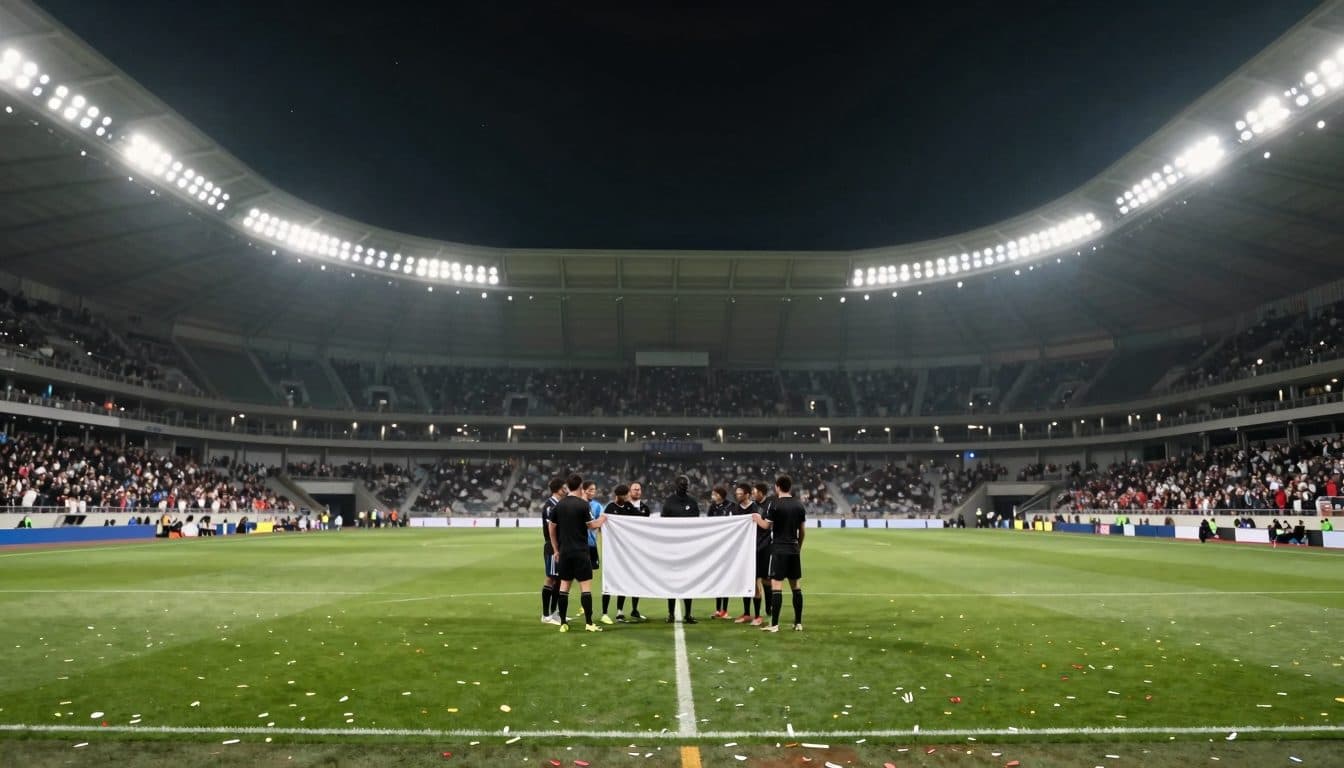
AI-generated image (z-image via Kie.ai)
Summary
Following the 2-1 semifinal victory over England, Argentine players displayed a banner reading "Las Malvinas son argentinas" on the pitch. Great Britain reacted angrily and is demanding an FIFA investigation. The gesture comes amid an unresolved sovereignty dispute over the Falkland Islands.
Buenos Aires, July 16, 2026
Argentine footballers displayed a banner reading "Las Malvinas son argentinas" following their 2-1 semifinal victory over England in Atlanta, USA, triggering a political uproar over the Falklands conflict.
The Argentine team overturned a 0-1 deficit against England late on Tuesday evening (local time) to win 2-1, advancing to a World Cup final for the second time, as it did in 2022 in Qatar. After the final whistle, several players on the pitch presented a banner that, according to the German Press Agency, bore the phrase "Las Malvinas son argentinas," in English: "The Malvinas are Argentine." Among the players holding up the banner was midfielder Lo Celso. In a later statement, Lo Celso explained: "Wir haben versucht, unser Land und all jene, die diesen traurigen Moment unserer Geschichte miterlebt haben, zu repräsentieren, damit sie sich mit uns identifizieren und wir ein positives Bild vermitteln konnten".
Background: The Falklands War of 1982
The gesture referred directly to the Falklands War between Argentina and Great Britain in 1982. At that time, the two countries waged an armed conflict lasting more than 70 days over control of the archipelago located approximately 400 kilometers east of Argentina's southern coast in the South Atlantic. After nearly 1,000 soldiers killed, the war ended with Argentina's surrender. The islands, which Buenos Aires calls the "Malvinas" and London calls the "Falkland Islands," are still administered by Great Britain today, which Argentina does not recognize.
The political charged atmosphere surrounding the match had already begun before kickoff. Argentine Vice President Victoria Villarruel had referred to the English as "pirates" with reference to the disputed islands, further stoking tensions. President Javier Milei also spoke out beforehand. In a radio interview, he said: "Es ist uns gelungen, die UNO dazu zu bewegen, England zu Gesprächen mit uns zu zwingen" and added: "Lasst uns das Ergebnis nicht verwechseln: Es ist nur ein Fußballspiel."
Political Charged Atmosphere Already Before the Match
After the match, Milei praised "enorme diplomatische Fortschritte" in the long-running dispute between Buenos Aires and London, but did not explicitly comment on the banner gesture by his players. Argentina's national team coach Lionel Scaloni had attempted before the match to depoliticize the encounter. "Es ist ein Fußballspiel, ganz einfach", he had said. Other voices around the team also warned against mixing sport and politics. "Das mit Politik zu vermischen, wäre Wahnsinn", an open letter stated. Yet that is exactly what happened after the final whistle.
Midfielder Leandro Paredes, who was also interviewed after the match, declared regarding the islands: "Sie werden immer argentinisch sein." In the Patagonia region, located less than 1,000 kilometers from the Falkland Islands, the claim to the Malvinas is "im öffentlichen Raum sehr sichtbar" according to Rostock political scientist Wolfgang Muno. Muno had said this to the "Tagesspiegel" newspaper before the match.
Reaction from Great Britain
On the British side, the reaction was sharp. British Business Secretary Peter Kyle said on BBC television: "Wir erwarten von der FIFA, dass sie das untersuchen." The British government reacted angrily to the Argentine players' action, according to the German Press Agency. Sources close to the federation said the incidents would be examined closely. FIFA itself has not yet made any public statement.
With regard to the world football governing body, observers pointed to existing regulations. According to these, the display of political, religious, or personal messages on the pitch during an official FIFA competition is fundamentally prohibited. In addition, the South American Football Confederation CONMEBOL has long been critical of the world governing body. The confederation has already pledged its support to FIFA President Gianni Infantino for his re-election in 2027.
FIFA Rules and Open Questions
The discussion surrounding the gesture is part of a series of further sport-political controversies during this tournament. Already in the 1-0 victory over Austria in the group stage, a foul in the lead-up to the winning goal went unpunished. In the 3-2 win over Egypt, a potential penalty for the opponent was not reviewed by the Video Assistant Referee (VAR). These incidents had already raised international questions about the consistency of match officiating.
Beyond the political dimension, Argentina now faces the final. As was the case four years ago in Qatar, the "Albiceleste" has reached a World Cup final and will face Spain on Sunday in East Rutherford (9:00 PM CET, broadcast on ZDF and Magenta TV). In Atlanta, thousands of fans watched the late winning goal and exuberantly celebrated reaching the final. In the streets of Argentine cities, spontaneous motorcades and celebrations broke out after the match.
Preview of the Final Against Spain
It also became known that Argentina's captain Messi has been serving as an ambassador for Saudi Arabia since 2023; Saudi Arabia will host the 2034 World Cup. This role raises additional questions about the entanglement of sport, politics, and business that extend beyond the current occasion. The German sports press commented on the incident with reference to the particular symbolism of the date: July 16, 2026 does not mark the anniversary of the start of the Falklands War, but the archipelago remains an open chapter in international relations.
International observers meanwhile warned against instrumentalizing the victory. In an open letter, it read: "Sport ist kein Krieg: Das Halbfinalspiel ist ein Sportereignis von weltweiter Tragweite, keine bewaffnete Revanche und keine historische Kompensation." The authors pointed out that sporting competition should not serve as a substitute for diplomatic disputes. In doing so, they echoed an idea that coach Scaloni had already articulated before the match.
The spokesperson for the Argentine government was restrained the day after the match. They acknowledged the reactions from Great Britain, but at the same time pointed out that Argentina's position on the Malvinas had remained unchanged for decades. According to British media reports, the Foreign Office in London did not summon any representatives of the Argentine Embassy, but reserved the right to take further steps.
Meanwhile, the Argentine team is preparing for the final against Spain. The sporting preparation is being complicated by the ongoing debate over the banner action. Coach Scaloni announced that he would focus exclusively on the sporting side before the final. Whether FIFA will impose sanctions on players or the federation before the final remained open as of Wednesday morning (local time). The case is likely to remain in the headlines until kickoff on Sunday.
The incident throws a spotlight on the tension between sporting competition and national symbolism. While some see the gesture as an act of patriotism, others view it as a deliberate provocation directed at the opponent. The coming days will show whether FIFA treats the case as a disciplinary matter or as a foreign policy issue. What is clear is that Argentina's advance to the World Cup final will provide material for discussion not only on sporting but also on political grounds.
Questions & Answers
What exactly was written on the banner the Argentine players displayed?
According to the German Press Agency, the banner bore the phrase "Las Malvinas son argentinas," in English: "The Malvinas are Argentine." This asserts Argentina's sovereignty over the Falkland Islands, which are administered by Great Britain.
How did the British government react to the action?
British Business Secretary Peter Kyle said on BBC television that FIFA was expected to investigate the incident. The government in London reacted overall with anger and announced that the on-pitch message would be examined closely.
When and against whom is Argentina playing in the final?
Argentina will face Spain on Sunday in East Rutherford; the match kicks off at 9:00 PM CET and will be broadcast on ZDF and Magenta TV. It is the second consecutive World Cup final for the "Albiceleste" after winning the title in 2022 in Qatar.