Austria debates ankle monitors for radical offenders after Berlin CSD attack
Vienna, July 29, 2026
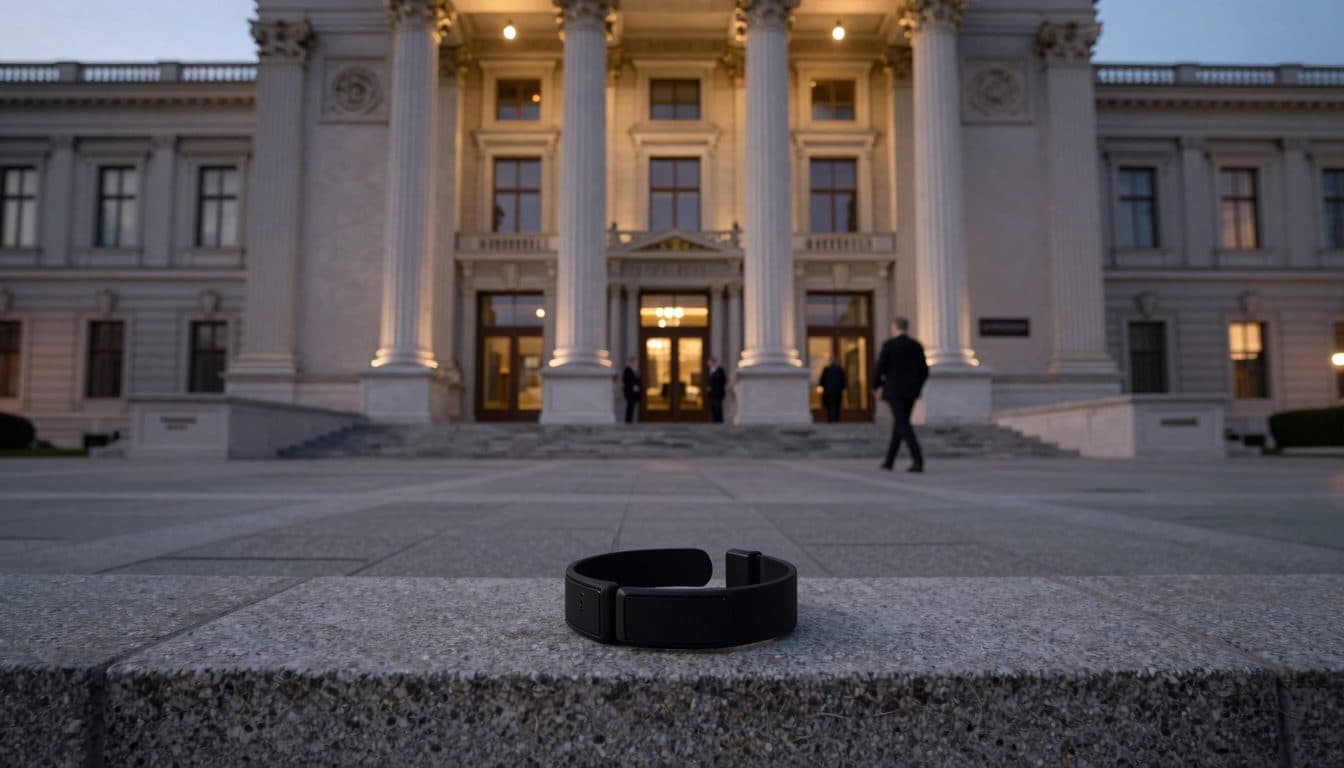
AI-generated image (z-image via Kie.ai)
Summary
Following the attack on Christopher Street Day in Berlin that killed one person and injured 31, Austria's domestic intelligence chief Sylvia Mayer and Interior Minister Gerhard Karner (ÖVP) are calling for the expansion of ankle monitors for radical offenders. An agreement among the ministries is expected in autumn.
Vienna, July 29, 2026
Following the attack on Christopher Street Day in Berlin that killed one person and injured dozens, Austria is intensifying the debate over electronic ankle monitors for radical offenders; domestic intelligence chief Sylvia Mayer and Interior Minister Gerhard Karner (ÖVP) are pressing for an expansion of the tool.
On Saturday evening, the 21-year-old German citizen with Lebanese roots, Abdul B., had driven a small delivery van into the crowd at Christopher Street Day (CSD), killing a 65-year-old woman from Poland. According to the most recent figures from Tuesday, 31 people were injured, as the available information shows; some German reports had previously spoken of 29 injured. He was shot dead by police during apprehension on Sunday, after allegedly threatening officers with a stabbing weapon.
Austria's domestic intelligence authorities see no connection between the Berlin attacker and Austria's Islamist scene. German media had previously reported that Abdul B. had been married under Islamic law in 2023-24 to a woman from Salzburg; however, according to the Directorate for State Protection and Intelligence Service (DSN), a link to the organized scene in the neighboring country could not be established. Abdul B. had previously attempted in vain to join the terrorist organization Islamic State (IS) in Syria.
Course of events and background of the attack
Some months before the act, the man, who already had multiple prior convictions, had been sentenced for preparing a serious act of violence endangering the state, but was free at the time of the attack. The case evokes memories of the Vienna attacker Kujtim F., who had also carried out an attack in November 2020 following a failed attempt to travel to join the IS. At that time, several people were killed in Vienna's city center and many more injured, which had a lasting impact on Austrian security policy.
Against this backdrop, the head of the Directorate for State Protection and Intelligence Service (DSN), Sylvia Mayer, like Interior Minister Gerhard Karner (ÖVP), is calling for the use of ankle monitors for offenders released from prison, as they are "weiterhin radikalisiert sind". This would enable "größerflächige Überwachung dieser einzelnen Personen", and also prevent them from entering "bestimmte Örtlichkeiten", Mayer said on Tuesday to the Ö1 "Morgenjournal".
Mayer and Karner call for expansion of ankle monitors
The government is currently negotiating an expansion in the use of ankle monitors at various levels. However, the Interior Ministry wants to link the issue to an ankle monitor for radical offenders, thereby extending it beyond the previously envisioned area of domestic violence. According to the available reports, there is already fundamental agreement among the ministries on this objective.
A working group of the Justice, Interior, and Women's Ministries is discussing the use of this tool for men who become violent toward women. Whether an understanding can be reached here should become clear in the autumn. The Justice Ministry generally noted that, under Austrian law, a prison sentence may be conditionally suspended under the respective statutory requirements. "Auch eine bedingte Entlassung aus dem Strafvollzug ist grundsätzlich möglich. Sie kommt aber frühestens nach Verbüßung der Hälfte der unbedingten Freiheitsstrafe in Betracht."
Existing legal framework through the TeBG
The Terror Prevention Act (TeBG) also introduced judicial oversight. This provision provides for special supervisory measures following a conditional release, including in cases of terrorist offenses. Austria therefore already has a legal framework that goes beyond existing instruments and could also apply in dealing with released offenders.
Mayer spoke of "eine niedrige dreistellige Anzahl" of Islamist offenders in Austria. She thereby publicly quantified the circle more precisely for the first time and pointed to the particular danger posed by individuals who have served their sentences but whose ideological radicalization persists. These persons continue to require close monitoring in order to prevent attacks.
ÖVP and FPÖ harden their tone
ÖVP parliamentary group leader Ernst Gödl struck the same note in a statement: "Im Rahmen unserer Null-Toleranz-Politik gegenüber straffälligen Gefährdern ist die Ausweitung der Fußfessel auf islamistische Hochrisikogefährder der einzig konsequente nächste Schritt." Karner had also repeatedly emphasized that existing surveillance tools needed to be deployed more consistently, especially against individuals whose dangerousness persists beyond their imprisonment.
FPÖ security spokesperson Gernot Darmann expressed dismay at the figure. It was "eine direkte Folge der verfehlten und brandgefährlichen Politik der offenen Grenzen". He called for a significantly tougher approach: "Wir brauchen keine Beobachtung, wir brauchen eine Null-Toleranz-Politik. Diese Gefährder und ihre radikalen Netzwerke gehören nicht überwacht, sie gehören außer Landes geschafft."
Salzburg Deputy Governor Marlene Svazek (FPÖ) demanded in a statement the immediate "volle Aufklärung" of any Austrian links to the perpetrator. It raised "die dringende Frage, ob der Attentäter möglicherweise von islamistischen Netzwerken beeinflusst wurde, die auch in Salzburg operieren. Oder hatte er gar Mitwisser vor Ort?" She stressed that any relevant contacts or accomplices of the perpetrator must be "ausgeforscht und präventiv daran gehindert werden, es ihrem islamistischen Bruder im Geiste irgendwann gleichzutun".
From the security authorities' perspective, the review of the case has so far come back negative: Austrian domestic intelligence sees no connection between the Berlin attacker and Austria's Islamist scene. This finding is politically delicate, as it places the demands for uninterrupted surveillance on the one hand and for stricter deportation rules on the other into a tense relationship with each other.
Parallels to the Vienna attacker Kujtim F.
The attack is part of a series of Islamist-motivated acts in Europe that receive particular attention also because the perpetrators were sometimes already known to police before the act. Investigators repeatedly point out that a conviction or a period of imprisonment does not necessarily end radicalization. The DSN also emphasizes that the period immediately after release from prison is considered particularly risky.
Parallels to the Vienna attacker Kujtim F. suggest themselves. He too had tried to travel to Syria to join the IS, was prevented from traveling, and subsequently carried out a deadly attack in Vienna. Since then, several legal tightening measures have been adopted in Austria, including the Terror Prevention Act (TeBG). The Berlin case is now seen as a further test of these protective instruments.
Outlook: Decision expected in autumn
With the debate now flaring up around ankle monitors for radical offenders, the political discussion is shifting away from the question of deportation and tougher sentencing toward a technical surveillance solution. Data protection issues, the delineation from the existing ankle monitor for perpetrators of violence against women, and the practical feasibility within the prison system are likely to shape deliberations in the coming months.
Observers also interpret the move as a signal to the public that the security authorities want to draw consequences from the Berlin attack without waiting for the outcome of the still-ongoing investigation. An understanding among the ministries involved is to be reached by autumn. Should this succeed, Austria would be one of the few European countries to deploy electronic surveillance specifically against released Islamist offenders.
Questions & Answers
Who is Sylvia Mayer?
Sylvia Mayer is the head of the Directorate for State Protection and Intelligence Service (DSN) in Austria and put the number of Islamist offenders in the country at "eine niedrige dreistellige Anzahl".
What consequences does the Berlin attack have for Austrian security policy?
Domestic intelligence chief Sylvia Mayer and Interior Minister Gerhard Karner (ÖVP) are calling for the use of electronic ankle monitors for radical offenders released from prison; an agreement among the ministries is expected in autumn.
Why is the Vienna attacker Kujtim F. mentioned in this context?
The Berlin perpetrator Abdul B. had, like Kujtim F. before him, previously attempted in vain to join the Islamic State (IS) in Syria; that case had already led to tightening measures such as the Terror Prevention Act (TeBG).
Ankle monitors for offenders: Austria responds to Berlin | allfacts360