Austrian leaders welcome Montenegro's PES into EPP family, push for next EU enlargement step
Vienna, 29 June 2026
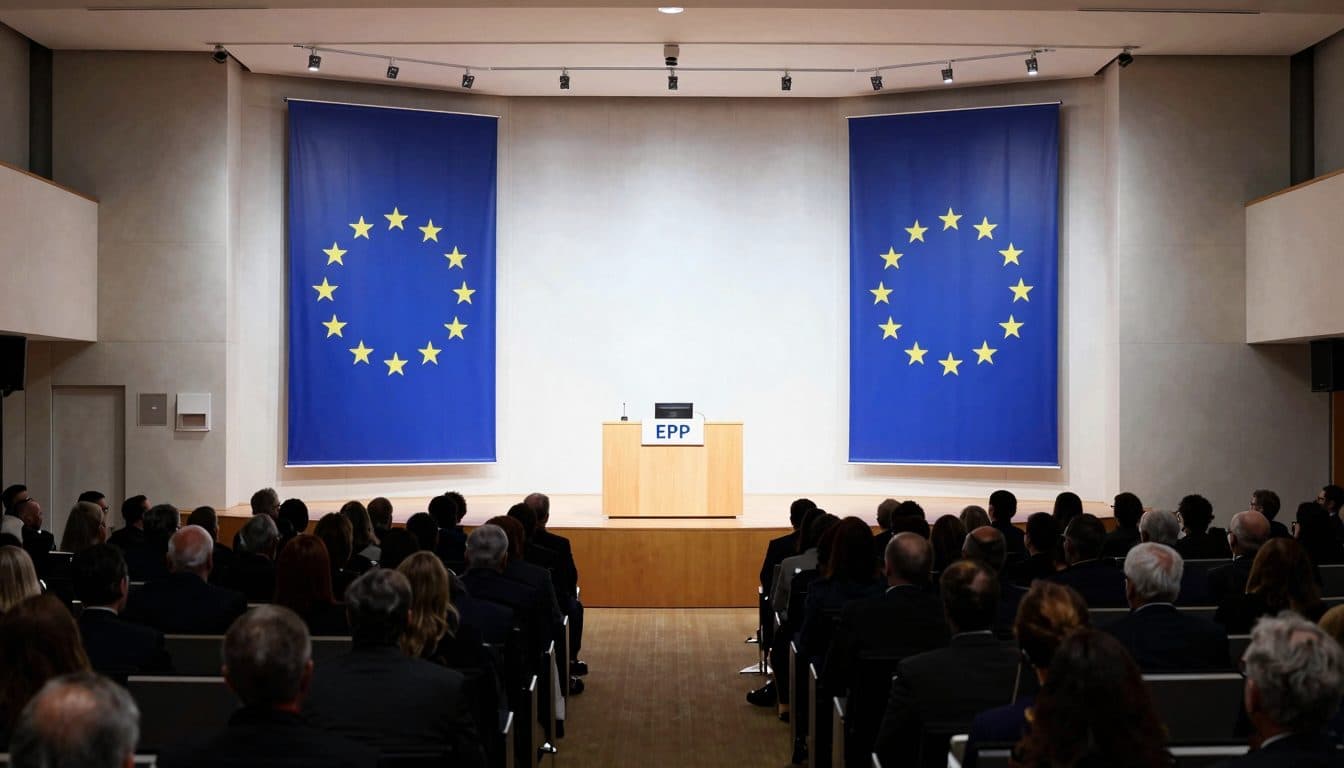
AI-generated image (z-image via Kie.ai)
Summary
Austria's ÖVP leaders used an EPP political assembly in Vienna to welcome Montenegro's PES into the European People's Party family and to argue that Montenegro should join the EU by 2028. Chancellor Christian Stocker, Europe Minister Claudia Bauer and ÖVP Secretary General Nico Marchetti framed enlargement as an investment in European security and prosperity.
Vienna, 29 June 2026
Austria's top ÖVP officials gathered in Vienna on Monday for an EPP political assembly at which they formally welcomed Montenegro's PES into the European People's Party family and renewed calls for Montenegro to become the EU's 28th member state before the 2029 European elections.
At a political assembly of the European People's Party (EPP) in Vienna on Monday, Austrian Chancellor Christian Stocker (ÖVP), Europe Minister Claudia Bauer (ÖVP) and ÖVP Secretary General Nico Marchetti used the platform to send a coordinated message: enlargement of the European Union is not a favour to candidate countries, it is an investment in Europe's own security and economic future. The event also served as the stage at which Montenegro's PES was formally admitted to the centre-right EPP family, a step the Austrian hosts framed as both symbolic and substantive for the country's European trajectory.
ÖVP Secretary General Nico Marchetti described the unanimous admission of PES as a strong commitment. "Mit der einstimmigen Aufnahme unserer montenegrinischen Schwesterpartei PES in die EVP-Familie haben wir ein starkes Bekenntnis abgelegt, für den EU-Beitritt Montenegros ebenso wie für ein geeintes, starkes Europa", sagte ÖVP-Generalsekretär Nico Marchetti today. The party's reading is that party-political alignment with the EPP, the EU's largest political family, lowers one of the political hurdles on the path to accession and ties Montenegro more tightly into European mainstream politics.
A coordinated Austrian message
Montenegrin Prime Minister Milojko Spajic travelled to Vienna in person for the occasion. "Das ist ein wichtiger Moment für Montenegros Weg nach Europa", erklärte auch Spajic, der persönlich nach Wien gekommen war. The presence of the head of government underlined that the party-family admission is being treated in Podgorica as more than a procedural event: it is being read as a signal of momentum on the longer accession track.
Austria's EPP delegation leader in the European Parliament, Reinhold Lopatka, who serves as the EPP's rapporteur on Montenegro, went further than the rhetoric of welcome and put a date on the ambition. "Mein Ziel bleibt klar: Montenegro soll als 28. Mitgliedsstaat noch 2028 Teil der Europäischen Union werden, also vor der nächsten Europawahl im Frühjahr 2029." The 2028 target has been a recurring Austrian ask for several years; Monday's assembly gave Lopatka a domestic Austrian audience and a Montenegrin counterpart in the room at the same time.
A 2028 target for Montenegro
Chancellor Stocker echoed that line in a post on the platform X on Monday, tying enlargement to security and prosperity arguments that have gained ground in EU capitals since 2022. "Die (EU-)Erweiterung ist kein Geschenk an andere, sie ist eine Investition in unsere eigene Sicherheit, unseren Wohlstand und unsere gemeinsame europäische Zukunft", schrieb er heute. In the same post, he added that Austria's own EU membership is "wichtiger denn je" in the current geopolitical climate and that the greatest mistake would be to ignore the present moment amid ongoing crises.
Europe Minister Claudia Bauer, speaking at the assembly in Vienna, framed the political-family admission as a step that should precede formal EU membership. "Wir holen Montenegro in unsere politische Familie, noch bevor das Land Mitglied der Europäischen Union ist." She argued that the future of the Western Balkans lies inside the EU and that a united Europe is, in geopolitically challenging times, "unsere stärkste Antwort." Bauer added that the EU enlargement process has "schon viel zu lange ins Stocken geraten" and that the bloc needs visible success stories. "Wir brauchen Erfolgsgeschichten", sagte Bauer.
Enlargement as a security and prosperity argument
Stocker used his speech at the EPP gathering to call directly for the next accession from the region. "Es ist Zeit für den nächsten Beitritt aus der Region", he said, looking at the Western Balkans. He argued that Austria supports both Montenegro and Moldova in "Überwindung bilateraler Bedenken", a reference to bilateral disputes that have slowed parts of the enlargement track. Stocker also floated institutional ideas for candidate countries, suggesting that accession states could be brought into EU structures earlier through gradual integration rather than waiting for the formal membership moment.
The Austrian messaging on Monday threaded together three arguments that have dominated EU enlargement debates in Vienna for years: security, prosperity and political symbolism. By hosting the EPP assembly and using it as the venue for PES's admission, the ÖVP positioned Austria as the political engine for the next Western Balkan accession, while keeping the door open for Moldova as a parallel candidate. Austrian officials have long framed enlargement as an investment in stability on the EU's south-eastern flank.
Practical hurdles and political calendar
Beyond the political theatre of Monday's assembly, the practical calendar for Montenegro remains demanding. Accession talks have been open since 2012, with several chapters provisionally closed and others blocked by bilateral disputes and rule-of-law concerns. Austrian officials, including Lopatka, argue that no other candidate country currently meets the preconditions for accession as clearly as Montenegro does. The 2028 target therefore functions both as a political deadline and as a way to focus technical negotiations in Brussels and Podgorica.
Stocker also returned to a theme he has stressed in recent European Council meetings: that the EU's decades of peace and prosperity have been a "Geschenk" that should not be taken for granted, and that European institutions need to do more than merely administer existing arrangements. Quoting the slogan, he said the EPP should "Nicht nur verwalten, sondern auch gestalten." The phrase has become something of a tagline for the Austrian chancellor's EU agenda and recurs in his interventions on enlargement, competitiveness and security policy.
For the Austrian government, the political calculation is straightforward. Austria holds the rotating EU Council presidency in the second half of 2026 and has identified enlargement as one of its signature themes. Securing a visible win on the Western Balkans track, even if that win is primarily a party-political one like Monday's EPP admission of PES, helps Vienna argue at home and in Brussels that enlargement is moving again. The risk, EU diplomats note, is that calendar pressure to deliver a 28th member by 2028 collides with the slower pace of reforms in candidate countries.
The Monday assembly also gave ÖVP and EPP officials a chance to coordinate messaging on Moldova, which like Montenegro has been granted EU candidate status and has opened accession talks. Stocker said Austria supports both states in overcoming bilateral concerns and reiterated that the "Zukunft der Westbalkan-Staaten liegt in der EU." The phrasing implicitly groups the Western Balkans with Moldova as part of the same strategic frontier, a framing that Austrian diplomats have promoted in recent years as a way to keep enlargement politically alive across different EU Council configurations.
Moldova and the broader Western Balkans track
In her speech, Bauer also insisted that any conversation about the EU's future has to include enlargement, security and stability together. "Wenn wir über die Zukunft der EU sprechen, müssen wir auch über die Erweiterung, die Sicherheit und Stabilität Europas sprechen", sagte Europaministerin Claudia Bauer (ÖVP) in ihrer Rede. The argument connects enlargement policy to the broader debate about European sovereignty and the bloc's capacity to act in a contested geopolitical environment, themes that have gained prominence in Austrian EU policy since Russia's full-scale invasion of Ukraine.
Taken together, Monday's events amount to a renewed Austrian push, with EPP backing, to put Montenegro at the front of the enlargement queue and to attach a concrete political deadline to that ambition. Whether the 2028 target is met will depend on negotiations in Brussels that Austria can influence but not control. What Austria can do, and did on Monday, is keep the political spotlight on enlargement at a moment when several EU capitals have been distracted by other crises.
For now, the ÖVP's message from Vienna is that the party-family door is open and that the formal accession door should follow soon. "Die Zukunft der Westbalkan-Staaten liegt in der EU", erklärte der ÖVP-Politiker. The phrase captures the Austrian position in a single sentence: the Western Balkans' future is inside the Union, and Austria intends to keep pushing for that outcome in the months ahead.
Questions & Answers
Who is pushing for Montenegro's EU accession from Austria?
Chancellor Christian Stocker, Europe Minister Claudia Bauer, ÖVP Secretary General Nico Marchetti and the ÖVP's EPP delegation leader Reinhold Lopatka have all publicly backed Montenegro joining the EU, with Lopatka setting a target of 2028.
Why did the EPP political assembly in Vienna matter for Montenegro?
The assembly was the venue at which Montenegro's PES was formally admitted to the European People's Party family, a step Austria's ÖVP framed as a political commitment to Montenegro's European path.
What is the 2028 accession target and why does it matter?
Lopatka said Montenegro should become the EU's 28th member state by 2028, ahead of the 2029 European elections, making the timeline a political deadline for negotiations in Brussels and Podgorica.
Austria backs Montenegro EU accession, 2028 target | allfacts360