Berlin CDU confirms Kai Wegner as lead candidate for September elections
Berlin, 10 June 2026
AI-generated image (flux-2/pro-text-to-image via Kie.ai)
Summary
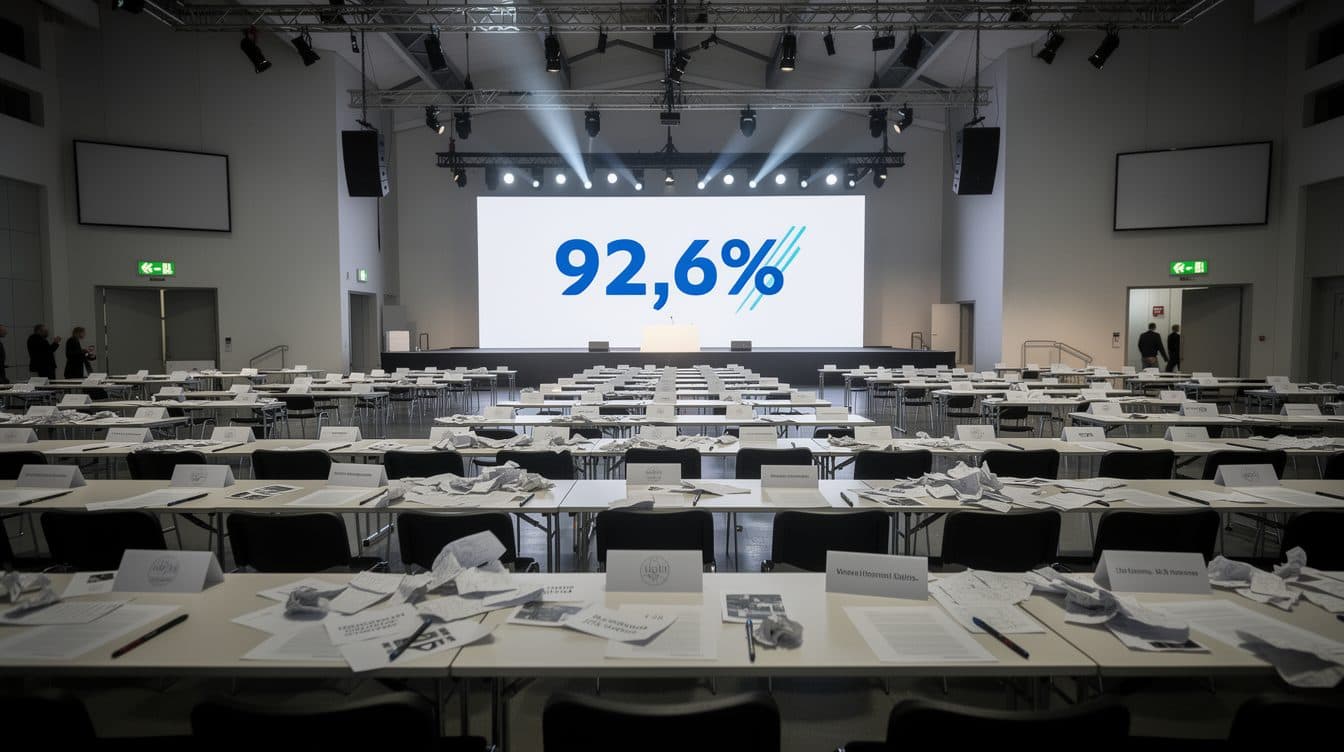
At the Berlin CDU regional congress in Neukölln, Kai Wegner was confirmed as Spitzenkandidat for the 20 September Abgeordnetenhaus elections with 92.6% of the vote. Despite criticism over the handling of the major January blackout and the State Secretary Hundt affair, the delegate base backed the incumbent mayor.
Berlin, 10 June 2026
The delegates of the Berlin CDU confirmed on Tuesday evening, during a regional congress held in Neukölln, Kai Wegner as the party's Spitzenkandidat for the city parliament (Abgeordnetenhaus) elections on 20 September 2026, with 252 votes in favour out of 272, equal to 92.6%.
Update of 10 June 2026: what changes since yesterday
Update of 10 June 2026: at the Berlin CDU regional congress held in Neukölln, incumbent mayor Kai Wegner was confirmed as lead candidate (Spitzenkandidat) for the Abgeordnetenhaus elections with 92.6% of the vote. Compared with previous designations – in 2021 nearly 90% by secret ballot and in November 2022 a show-of-hands vote with no opposing votes and only one abstention – the result appears marked by an internal challenge that had initially been considered unlikely.
What changes compared with the previous version: on Tuesday evening came the official confirmation of Wegner's renomination, arrived in a secret-ballot vote interrupted for the count. The CDU list, including the electoral programme, was adopted at the same congress. As reported by dpa, Wolfram Wickert, a delegate from the Kreisverband Mitte, surprisingly announced an alternative candidacy for the top of the ticket, arguing that "Die CDU brauche einen anderen Spitzenkandidaten", a challenge that made the outcome not entirely a foregone conclusion.
The political context: Wegner and the black-red coalition
Wegner, 53, has led a black-red coalition between CDU and SPD in Berlin since 2023, after becoming mayor at the third ballot in April 2023. He is the city's first Christian Democratic head of government in more than twenty years. In 2021 the Berlin constitutional court had ordered a repeat of the 2021 vote due to serious electoral irregularities, a circumstance that led to the early elections of February 2023, won by the CDU with 28.2% under Wegner's leadership.
In the most recent polls the CDU has slipped to 19-20%, a level that would deprive the current governing coalition of its majority. The party nonetheless remains in the lead in the surveys. The SPD is fielding regional chairman Steffen Krach, the Greens parliamentary group leader Werner Graf, Die Linke group vice-chair Elif Eralp and the AfD parliamentary group leader Kristin Brinker.
In his speech, which lasted over an hour and was met with prolonged applause, Wegner listed the results of three years of black-red government: more security, a better position for Berlin in education rankings, 80,000 new apartments built during the legislative term, and an administrative reform which – he said – has been adopted, establishing clear responsibilities within the administration. "Wir sind erfolgreich gewesen. Es waren drei gute Jahre für Berlin", Wegner declared, adding "Wir haben geliefert. Die Verwaltungsreform ist beschlossen".
The government results claimed by Wegner
The mayor also reiterated the construction of the 17th section of the A100 motorway ("Wir werden den 17. Bauabschnitt der A100 realisieren!"), the building of housing on the edge of the Tempelhofer Feld, and categorically ruled out expropriations of homes in Berlin ("Mit mir wird es Enteignungen von Wohnraum in Berlin definitiv nicht geben. Ich schließe das kategorisch aus"). "Wir müssen mehr bauen", he added. After the count, Wegner commented on the result by saying: "92,6 Prozent in geheimer Abstimmung - das ist Unterstützung. Ich will Regierender Bürgermeister bleiben - was denn sonst!".
The occupant of the Rotes Rathaus defined the upcoming elections as a "Schicksalswahl" ("Ich glaube, diese Wahl ist eine Schicksalswahl. Es geht ums Ganze") and indicated among the objectives an appointment at a Bürgeramt within 14 days, already achieved through reforms. On public housing, he cited the 80,000 apartments built in the current legislative term as proof of the executive's effectiveness.
On the political front, Wegner remains weakened by several recent episodes. On 3 January 2026 an arson attack attributed to the left-wing extremist milieu left 100,000 people in south-western Berlin without electricity and heating, in some cases for several days. On the same day Wegner did not visit the affected neighbourhoods and later admitted to having played tennis for an hour at noon, a circumstance initially concealed. "Auch wenn er meint, dazu sei 'alles gesagt': ist es nicht", writes the Tagesspiegel, according to which the contradictions about the mayor's activities on the first day of the crisis have not yet been fully clarified.
The January blackout and crisis management
Added to the criticism over the handling of the blackout are those over the affair of State Secretary for Digitalisation Matthias Hundt, recruited from Dresden and kept in office for about two and a half months before being removed, despite having withdrawn the resignation request he had initially submitted. According to information from the Tagesspiegel, Wegner claims to have met him for the first time in August 2024 in Berlin at an "Arbeitstreffen zu Themen der Luftverkehrsbranche", but online records show that already in December 2022 Wegner and Education Senator Katharina Günther-Wünsch had met Hundt at a training event where he gave a talk entitled "Was Berlin von Sachsen lernen kann"; on LinkedIn Hundt then specifically thanked Günther-Wünsch, who reciprocated with a "Gefällt mir".
Wegner declared that he had not been aware, at the time of the appointment, of Hundt's background: the failure in a previous selection process in Dresden, the lawsuit he filed and lost, the poor reputation in the CDU-led Saxon government, and the prosecution's investigation for suspected insolvency offences (Insolvenzstraftaten). "Von alledem will Wegner nichts gewusst haben, als er Hundt engagierte und auf dessen Expertise und den 'sehr beeindruckenden' Lebenslauf verwies", writes the Tagesspiegel. Hundt is entitled to a transition payment of about 50,000 euros. The SPD candidate Steffen Krach publicly attributed responsibility for the "personnel disaster" to Wegner.
The Hundt case and opposition criticism
On the judicial and administrative front, other shadows hang over the Senate: the Berlin Court of Audit (Landesrechnungshof) found wrongdoing in the awarding of 2.6 million euros by the cultural administration, a matter for which the Senator for Cultural Affairs Sarah Wedl-Wilson (not a member of any party) resigned in April after about a year in office. The Berlin Administrative Court (Verwaltungsgericht) also ruled unlawful the night-time closure of Görlitzer Park ordered by the Senate, finding that the competence lay with the Bezirksamt of Friedrichshain-Kreuzberg. The winter road maintenance service has been criticised for inadequate performance during a recent cold snap.
On a personal level, a controversy concerns the alleged start of the private relationship between Wegner and Education Senator Günther-Wünsch. The Tagesspiegel describes a persistent "Fördergeldaffäre" of which Wegner says he was unaware. According to the commentary signed by Tagesspiegel editor Lorenz Maroldt ("Vielleicht war Wegner zu selbstsicher geworden und ist jetzt umso verunsicherter"), the mayor – while remaining the face of the CDU – is going into the campaign with falling delegate support and with eleven departures among senators and state secretaries, of which only one from the SPD side.
Other shadows: from the Fördergeldaffäre to Görlitzer Park
The potential internal alternatives in case of a replacement cited by the media are Finance Senator Stefan Evers and the president of the city parliament Cornelia Seibeld. At the congress the electoral programme was also adopted, and Wegner closed his speech with the line: "Dafür braucht es eine CDU in der Verantwortung". The news of the confirmation was reported by Deutschlandfunk on 9 June 2026.
Wegner, who has led Berlin in coalition with the SPD since 2023, now faces the campaign for the 20 September vote, presented as a "Schicksalswahl". The 92.6% result – with 252 yes votes out of 272 – was read by him as a sign of support despite the internal tensions. The coming weeks will be decisive in determining whether the Berlin CDU base, which backed him in Neukölln, will confirm this trust also at the ballot box.
Towards the 20 September elections
The national political context adds further weight to the consultation. Berlin, which is the capital of Germany, will vote about three and a half months after the CDU congress, in an electoral year considered crucial by the party's own leaders. The stability of the black-red coalition will depend on Wegner's ability to translate the internal mandate into an electoral offer capable of stemming the bleeding in the polls.
Questions & Answers
With what result was Kai Wegner confirmed as lead candidate of the Berlin CDU?
At the regional congress in Neukölln, on Tuesday evening Wegner obtained
Wegner Berlin CDU lead candidate 92.6% Neukölln congress | allfacts360