Billion-Euro Contract for 2-Gigawatt Offshore Converter Goes to Rostock
Berlin/Rostock, 17 June 2026
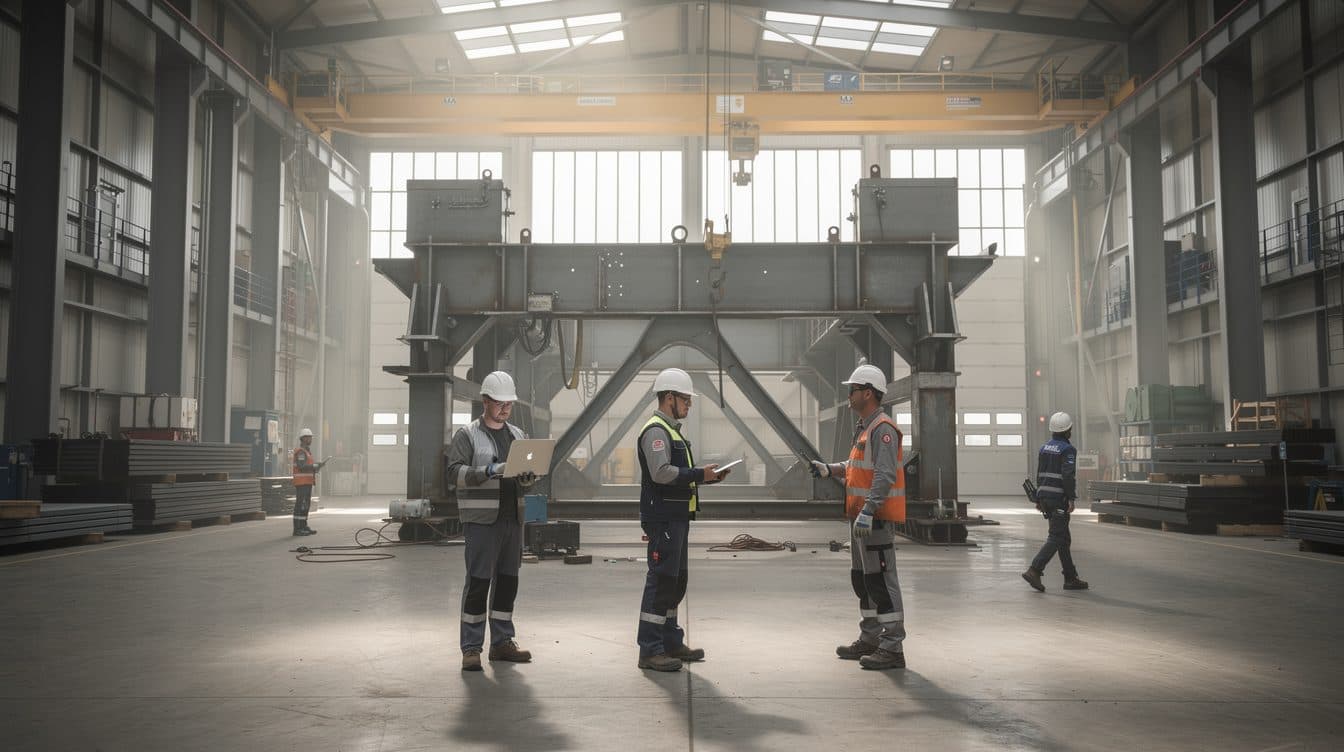
AI-generated image (flux-2/pro-text-to-image via Kie.ai)
Summary
The transmission system operator 50Hertz has awarded the construction of an offshore converter platform with two gigawatts of capacity to a consortium of Siemens Energy and Neptun Smulders Offshore Renewables. The contract volume for the facility manufactured in Rostock-Warnemünde is estimated at around 2.5 billion euros and is scheduled to go into operation by the end of 2034.
Berlin/Rostock, 17 June 2026
The transmission system operator 50Hertz awarded the construction of an offshore converter platform with a capacity of two gigawatts to a consortium of Siemens Energy and the joint venture Neptun Smulders Offshore Renewables on Wednesday in Berlin, with the majority of production to take place at the Rostock site.
The contract is part of the offshore grid connection project North Sea Connector 2 and, according to 50Hertz, has a volume of around 2.5 billion euros, provided a second, equally dimensioned converter system is also awarded. The system is to feed electricity from a wind farm some 200 kilometers west of the island of Sylt into the German grid and, according to the current planning schedule, go into operation at the end of 2034.
Who is building what – and where?
The contractor is a consortium of Siemens Energy and the joint venture Neptun Smulders Offshore Renewables, which was founded in 2023 specifically for such projects. Behind the joint venture are the Neptun Werft in Rostock-Warnemünde, which belongs to the Meyer Group from Papenburg, as well as the Belgian construction company Smulders, a subsidiary of the French group Group Eiffage.
According to the company, the platform will be approximately 90 meters long, 50 meters wide, and 60 meters high – roughly the size of the area of a Bundesliga football pitch. The technical superstructures weighing around 20,000 tons are to be manufactured predominantly at the Neptun Werft in Rostock-Warnemünde, while the hull will be built by Smulders in the Netherlands. Siemens Energy is supplying the electrical components, including transformers, switchgear, and converters.
Voices from politics and business
50Hertz CEO Stefan Kapferer spoke of a good signal that, for the first time, a German shipyard is building the main share of a facility of the new 2-gigawatt standard. "It proves that domestic shipyards can now submit competitive offers for the construction of offshore platforms," said Kapferer. According to the Stiftung Offshore Windenergie, converter facilities were most recently manufactured at German shipyards in 2018, at that time still in the up to 900-megawatt class.
Federal Minister for Economic Affairs Katherina Reiche (CDU), who appeared publicly in Berlin together with 50Hertz, described the contract as "really encouraging signal." She demonstrated the scale behind the deal: "That would then be roughly 100 of these little beauties." She was referring to the Federal Government's forecast that, by 2045, around 33 converter platforms with a contract volume of 1.5 to 2 billion euros each will be needed for the German market alone.
Jobs and site prospects
Manuela Schwesig (SPD), Minister-President of Mecklenburg-Vorpommern, called the award "excellent news for Mecklenburg-Vorpommern. The two concrete major projects stand for industrial value creation, good jobs, and future technologies." She expressed her conviction: "We can do that in Rostock." Schwesig also pointed out that the planned converter systems are "not off the shelf" and referred to the still open question of a long-term industrial perspective for the coastal region.
According to Neptun Managing Director Ralf Schmitz, the award marks "a significant milestone for the Neptun werft and thus also for the entire Meyer Werft Group." Production start in Warnemünde is planned for 2028. Schmitz spoke of timeframes "until 2035" and emphasized that the contract must be "not the end of development" but rather "the beginning of a long-term industrial perspective for the coastal region."
50Hertz expects that up to 500 new collectively bargained jobs will be created in the vicinity of the shipyard, with a further 500 positions to be added at suppliers and service providers during the construction phase. Daniel Friedrich, district head of IG Metall, spoke of a "important breakthrough for the industrial location and the employees in the region."
Technical background: Why a converter is needed
Karina Würtz, Managing Director of the Stiftung Offshore Windenergie, assessed the award as "an important milestone for [...] the entire German offshore wind energy industry." By 2050, according to European plans, facilities with a total capacity of 300 gigawatts are to be built in the North Sea – electricity that has to be brought ashore via increasingly powerful converters.
The background is a technical limit of AC transmission: At capacities above one gigawatt and over distances beyond 100 kilometers, classical AC technology reaches its physical limits. The so-called converters transform the electricity arriving from the sea via high-voltage direct current (HVDC) into alternating current out at sea, which is then fed into the existing grid. A land-based counter-station is planned in Mühlenbeck near Schwerin, where the direct current is converted back.
Outlook: Will North Sea Connector 1 follow?
The areas at the Marinearsenal in Warnemünde required for construction are, according to information from Mecklenburg-Vorpommern, initially available until 2041. 50Hertz expressed confidence that the ongoing talks on a second converter system of the same size – then for the North Sea Connector 1 – could be concluded soon. If this contract were also to come about, the volume for Neptun Smulders would add up to the aforementioned around 2.5 billion euros, predominantly for production and services in Mecklenburg-Vorpommern.
The previous focus of contracts for such facilities lay outside Germany: After 2018, corresponding contracts were awarded to, among others, Spain, Singapore, Indonesia, and the United Arab Emirates, according to the Stiftung Offshore Windenergie. With the current contract, a significant part of the value creation is returning to the German coast.
Reiche also sees this as an industrial policy signal: The contract shows "what potential lies in our industry and what capacity the location Germany possesses." Schwesig attached to this the expectation that Mecklenburg-Vorpommern will play "an important role in the energy transition" and at the same time called for follow-up contracts: "Now it is crucial that further orders follow this contract."
If demand grows as forecast, the contract just awarded could indeed be only the prelude. 50Hertz referred to the Federal Government's plans, according to which dozens of further converter platforms will be needed for the German market alone in the coming just under two decades. For the shipyards on the Baltic coast and their suppliers, that would mean a quarter century under the sign of the energy transition – and possibly a decisive building block for the maritime industry in Mecklenburg-Vorpommern to develop new pillars beyond the shipbuilding tradition.
Questions & Answers
Who received the billion-euro contract for the offshore converter platform?
The contract was awarded to a consortium of Siemens Energy and the joint venture Neptun Smulders Offshore Renewables, which is backed by the Neptun Werft in Rostock-Warnemünde and the Belgian company Smulders.
Why is the converter roughly 200 kilometers west of Sylt important for the energy transition?
The facility is to transport electricity from a North Sea wind farm to land as high-voltage direct current and convert it there into alternating current, with which 50Hertz, according to its own statements, is for the first time having a facility of the new 2-gigawatt standard manufactured predominantly in Germany.
What consequences does the contract have for jobs in Mecklenburg-Vorpommern?
According to 50Hertz, around 500 new jobs can be created at Neptun and Smulders, with a further 500 positions to be added at suppliers and service providers during the construction phase.
Billion-Euro Contract: 2-GW Offshore Converter from Rostock | allfacts360