Bitcoin back above $65,000 as oil and gas retreat; Ether leads crypto rally
Frankfurt, July 22, 2026
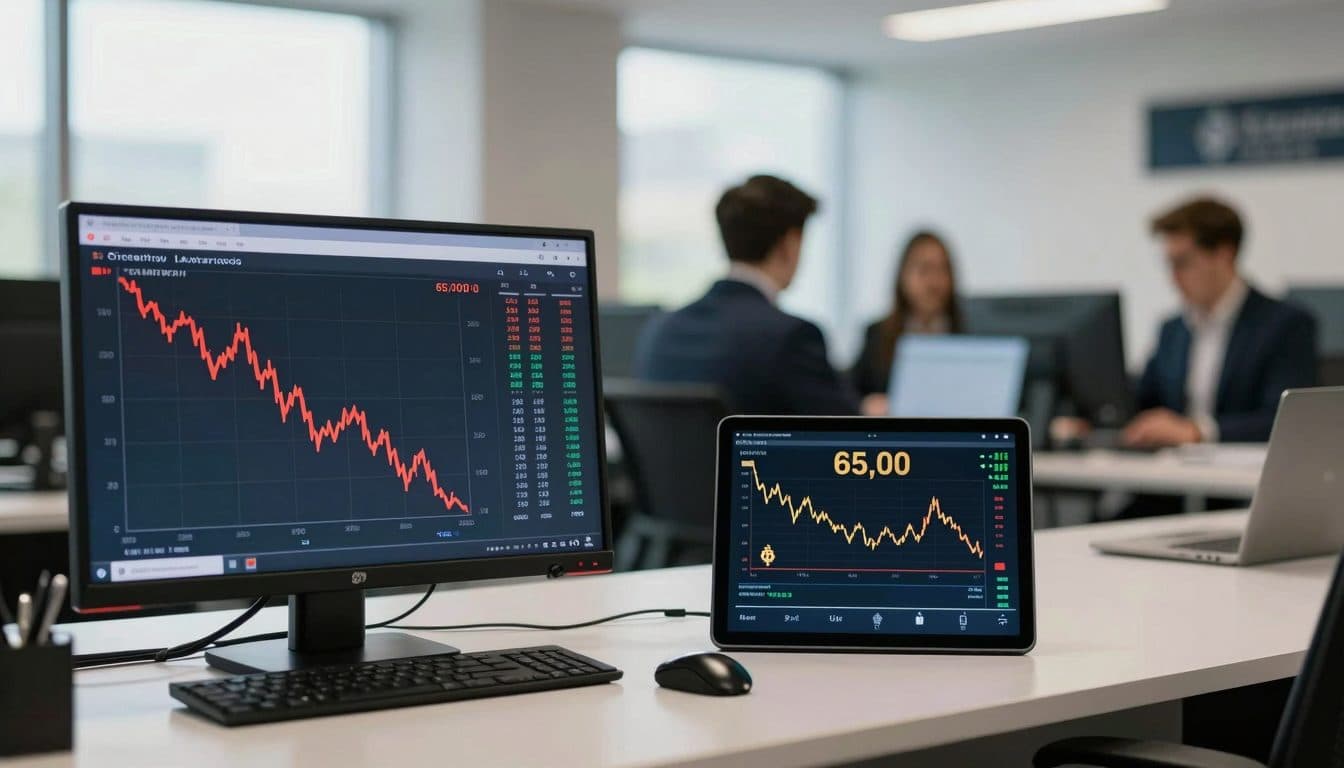
AI-generated image (z-image via Kie.ai)
Summary
Bitcoin has reclaimed the $65,000 threshold, trading around $65,500, supported by falling oil prices and signals of de-escalation between the United States and Iran. Ether was the strongest asset of the day, up more than 4% over 24 hours.
Frankfurt, July 22, 2026
Bitcoin has reclaimed the $65,000 threshold and in the Asian and European session of Wednesday, July 22, 2026 it was trading around $65,500, while Ether emerged as the best-performing asset among the major cryptocurrencies and futures on the Nasdaq and S&P 500 advanced by roughly half a percentage point.
Bitcoin back above $65,000
The cryptocurrency market opened the week in decisively positive territory. According to benchmark data reported by market services, Bitcoin was up 1.90% in 24 hours at $65,465.04 and 2.19% on a weekly basis, thus returning above the psychological $65,000 threshold. Bitcoin's dominance over the rest of the market remains high, at 58.6%, a signal that the recovery of the pioneering cryptocurrency continues to drive the entire sector.
Bitcoin above $65,000: crypto rally led by Ether | allfacts360
Ether was the real protagonist of the day, with a rise of 4.65% in 24 hours to $1,964.54 and 5.96% over the week. Analysts described Ether's performance as «the clear outperformer among the major assets». The other major cryptocurrencies also benefited from the rebound: Solana rose 2.57% to $76.66, BNB 0.75% to $574.49, TRON 0.25% to $0.3317, Dogecoin 0.33% to $0.07310 and Zcash 3.58% to $504.20. Zcash stood out as the second-best weekly performer, behind only Ether. HYPE recorded a +2.83% in 24 hours, rising to $60.03, while UNUS SED LEO gave up 0.32% to $9.72.
Ether leads the crypto rally
The crypto rally is taking place against a macro backdrop in which the pressure on energy prices has eased significantly. Brent fell 4.7% to $92.19 a barrel, after briefly crossing the $100 mark for the first time in two months. WTI futures also opened Monday's session with a gap lower, shedding about 5% and settling around $85. Analysts at ANZ Research recalled how «le ostilità nel Mar Rosso abbiano alimentato i timori di ulteriori strozzature nelle forniture», thus offering a geopolitical reading of the move in oil prices.
Oil sharply lower as Brent and WTI drop
On the currency front, the Australian dollar and the euro gained ground against the US dollar. EUR/USD moved to 1.1386, up 0.1%, while EUR/JPY touched 186.49. The GBP/USD pair rose to 1.333. These movements reflect a combination of lower risk aversion and anticipation of the Federal Reserve meeting scheduled for July 28 and 29.
Currencies, geopolitics and Fed watch
On the geopolitical front, the United States and Iran observed a second consecutive day without resorting to airstrikes, after a phase of extreme tension. According to reports, Iran has signaled its intention to suspend airstrikes as long as the US does the same. The war, which began at the end of February, had already experienced a fragile truce in the second quarter, which quickly collapsed. Whether the pause in hostilities holds or not is considered by operators to be one of the two decisive factors for the short-term direction of crypto markets.
Vikram Subburaj, CEO of the Indian exchange Giottus, commented in writing that «i prezzi reagiscono anche agli sviluppi macroeconomici». Subburaj also recalled that markets currently price in a 36.3% probability of a 25-basis-point rate hike by the Federal Reserve. Another prominent analyst, Joao Wedson, founder and CEO of analytics firm Alphractal, noted on X that historically about 900 days pass between each Bitcoin halving and the bottom of the following bear market. Wedson added that the current cycle is on day 827, which suggests the possibility of a final bottom within the next two months, should the historical pattern repeat itself.
European stocks positive, Wall Street slightly higher
Sentiment on European equity markets remained cautiously positive. The Euro Stoxx 50 gained 0.5% to 6,238.63 points, the DAX 0.5% to 24,876 and the FTSE 0.3% to 10,674.21. The European technology sector rose 0.9%. Nasdaq and S&P 500 futures, at the open of the session, both showed a gain of about half a percentage point, confirming the day's risk-on stance.
On the commodities front, beyond oil, precious metals also showed divergent trends. Gold edged down to $4,045.23 an ounce (-0.05%), while silver rose 0.7% to $58.05. Platinum gave up 0.6% to $1,590.44.
Corporate earnings and M&A moves
In the European blue-chip space, corporate results drew attention. SAP, according to analysts at Metzler, posted solid second-quarter 2026 results that should help dispel some of the concerns linked to artificial intelligence. Atoss Software continued its double-digit trend of revenue and profit growth, improving margins and confirming alignment with annual targets. The picture was different for Volkswagen, which cut its 2026 revenue and volume targets: the stock, after a sharply lower open, recovered most of its losses to close only slightly down by 0.1%. Adidas limited its decline to 3.6% after an initial phase of weakness.
On the European M&A scene, an initial offer of €48.50 per share, with a high stock component, was unanimously rejected by the board of directors and the supervisory committee of the target company. Subsequently, an improved offer was tabled at €51.5 per share, payable in cash and WSP shares. Arcadis was among the strongest performers of the session, up 8.7% to €42.84.
On the trade front, the United States announced new tariffs of between 10% and 12.5% on its main trading partners, replacing the temporary 10% global tariff linked to the policies of President Donald Trump, set to expire on Friday. The Lovinklaan Foundation, which controls 19% of the shares in a portfolio company, was cited as a factor slowing possible rapid takeover scenarios thanks to its long-term orientation.
Tariffs, indicators and outlook
In Germany, the composite PMI for private sector output — manufacturing and services combined — rose to 51.9 from 50.0 the previous month, confirming an improvement in economic sentiment above the expansion threshold. The German manufacturing PMI also moved back above the critical 50-point threshold in July.
Overall, operators remain focused on the two key events of the week: the Fed's monetary policy decision and whether the pause in airstrikes between Washington and Tehran holds. Ether's rally, Bitcoin's stabilization above $65,000 and Brent's pullback represent the three signals that, at least for now, are supporting a recovery in risk appetite across international financial markets.
According to Subburaj, «il calo del prezzo del Brent toglie pressione ai timori inflazionistici», thus offering further oxygen to assets more sensitive to the cost of money. The cross-reading of energy, geopolitics and rate expectations remains the main thread of this market phase, with cryptocurrencies once again representing one of the privileged vehicles for expressing the recovery of risk-on sentiment.
Questions & Answers
What are Bitcoin and Ether trading at after the July 22, 2026 rally?
Bitcoin is back above $65,000, trading around $65,465 with a daily gain of 1.90%. Ether touched $1,964.54, up 4.65% in 24 hours, making it the best performer among the major cryptocurrencies.
Why did oil fall and what effect does it have on markets?
Brent fell 4.7% to $92.19 a barrel after briefly crossing $100, with WTI down about 5% to $85. According to Giottus CEO Vikram Subburaj, the decline in Brent eases inflationary concerns and supports risk appetite.
What factors could condition the short term for cryptocurrencies?
Operators point to two key events: the Federal Reserve meeting on July 28 and 29 and the holding of the pause in airstrikes between the United States and Iran, which has now extended into a second consecutive day.