End of US-Iran ceasefire sends Wall Street into tailspin
New York, July 08, 2026
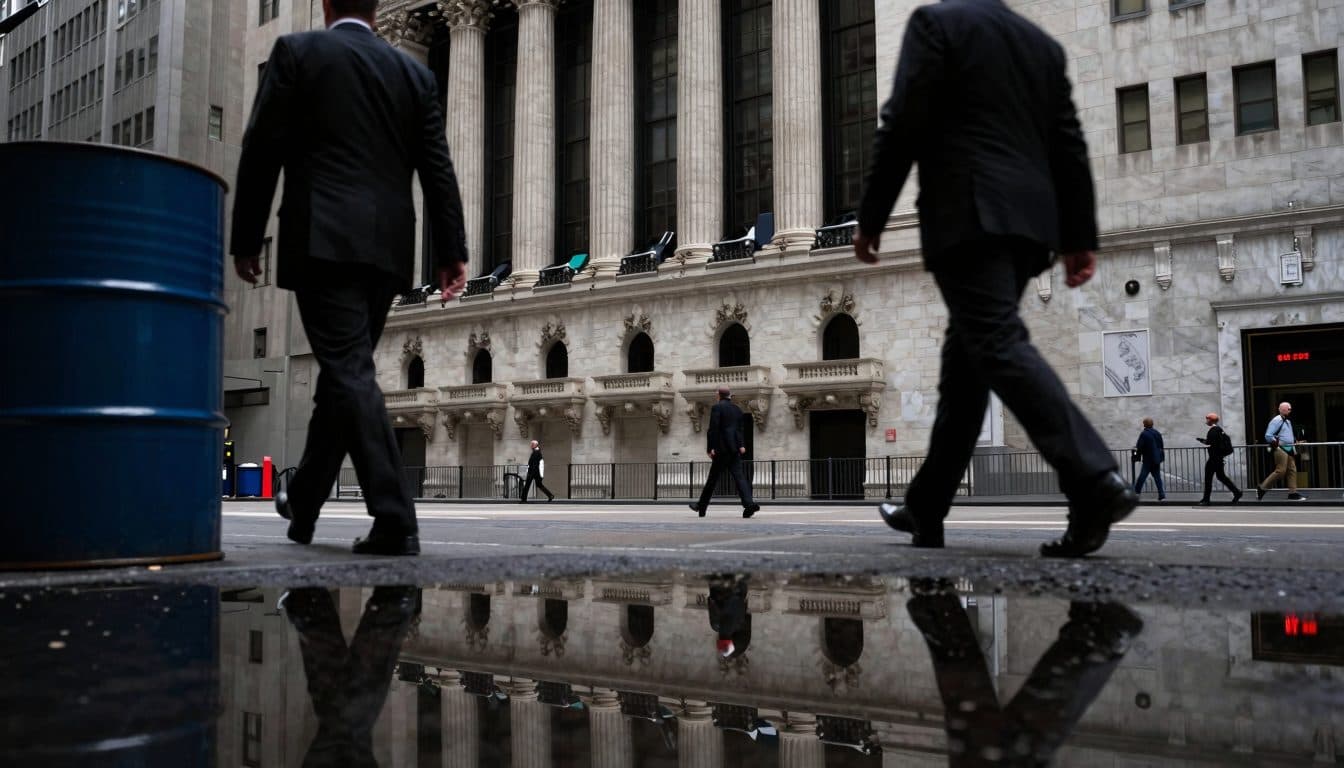
AI-generated image (z-image via Kie.ai)
Summary
Following the end of the fragile ceasefire between the US and Iran in the conflict over the Strait of Hormuz, Wall Street came under significant pressure on…
New York, July 08, 2026
Following the end of the fragile ceasefire between the US and Iran in the conflict over the Strait of Hormuz, Wall Street came under significant pressure on Wednesday, dropping by more than 800 points while oil prices rose by around 7 percent and investors increasingly priced in interest rate hikes by the US Federal Reserve.
President Donald Trump declared the ceasefire in the Strait of Hormuz, which had been agreed with Iran only a few weeks earlier, to be over. „Ich denke, es ist vorbei“, said Trump. The background was apparently Iranian attacks on ships attempting to pass through the strait. The US responded with airstrikes on dozens of targets along the Iranian coast. This escalates a conflict that has kept global markets on edge for months.
The Dow Jones Index lost 1.4 percent to 52,207 points, after having reached a record high just two days earlier. The S&P 500 fell by 0.7 percent, and the Nasdaq indices also lost up to 0.7 percent. The US indices thus continued the downward slide from the previous day. In Germany as well, the DAX came under pressure and slipped below the 25,000-point mark, after having risen above 25,900 points at the start of the week.
Reaction in the stock markets
„Die jüngste Eskalation stellt die bislang ernsthafteste Bewährungsprobe für die Waffenruhe dar“, explained Deutsche Bank market strategist Jim Reid. The flight from risk assets drove yields on ten-year US Treasuries up by 6 basis points to 4.59 percent. Higher market interest rates, growing rate hike speculation, and increased demand for safety also supported the dollar, whose index rose by 0.2 percent.
Nervousness spilled over directly into the energy market. The US benchmark WTI rose by 6.6 percent to $75.08, while Brent gained 8.4 percent to $80.39 – an increase of roughly ten percent within just a few trading sessions. At the beginning of July, a barrel of the North Sea grade had still cost around $70. The war-related peak of more than $115 from early May, however, remains well out of reach. „Rohöl ist und bleibt das Schmiermittel der Weltwirtschaft“, said Gabriele Widmann in an interview with the ARD financial editorial team.
Energy prices and inflation pressure
Concerns about a supply shortage also buoyed the shares of energy companies. Chevron rose by 1.9 percent, Exxon Mobil gained 0.2 percent. The losers, by contrast, were primarily technology and chipmakers: Intel shed another 4.5 percent, while AMD and Micron lost up to 2.1 percent. Apple was little changed, but Broadcom rose by 4.5 percent, after Apple announced that it would invest more than $30 billion in Broadcom products over the next five years and shift the production of more than 15 billion chips to American soil.
Robust chip demand also helped Nvidia: the stock rose another 0.6 percent, after having bucked the downward trend the previous day. Several analyst firms – including Bernstein Research, DZ Bank, UBS, and RBC Capital Markets – continue to rate the stock as „Outperform" or „Kaufen". Gold, by contrast, was not in demand in this market environment: the gold price fell by 1.6 percent per fine ounce to $4,040, silver lost 4.1 percent, and platinum 4.3 percent.
In the bond market, expectations solidified that the US Federal Reserve, under its new chairman Kevin Warsh, could resume the rate hiking path. According to the CME FedWatch tool, the probability of a rate hike by year-end rose to 38.5 percent. Previously, on Tuesday before the end of the ceasefire, markets had priced in only about a 25 percent probability of a rate hike this month. Higher energy prices have recently pushed inflation significantly above the Fed's two-percent target – an additional burden.
Monetary policy in focus
The International Monetary Fund (IMF) had recently warned in its latest outlook about the consequences of a flare-up of the Middle East conflict: „The possibility of renewed Middle East conflict looms large and could extend commodity price volatility, further threaten supply chains, raise prices, and weigh on financial conditions", it stated. The growth forecast for 2026 was lowered to 3.0 percent, from 3.5 percent the year before. In addition, the Trump administration is preparing a new round of global tariffs that could put additional pressure on import prices in the second half of the year.
Background to the escalation: In February, the US and Israel had attacked Iran for the first time, after which world markets entered a period of heightened volatility. A few weeks ago, the US and Iran agreed on a fragile ceasefire. Iran criticized the latest attacks as a „schwerwiegenden Verstoß" against the framework agreement and responded with airstrikes. IEA chief Fatih Birol had previously feared the worst energy crisis of all time; the IEA had distributed roughly 400 million barrels of oil from emergency reserves to member countries to ease the situation.
On the supply side as well, signs of normalization are mounting. According to a Bloomberg report, around ten million barrels of oil are now being transported through the strait daily – about half of pre-war levels. Saudi Arabia recently exported only around ten percent less than before the war, while the United Arab Emirates were still 15 percent below that level. More also came from Brazil, Kazakhstan, and Venezuela; Russia is likely to have exported a record volume in June, and China has tapped its reserves, estimated at 1.3 to 1.4 billion barrels, importing as little oil as it has in almost ten years.
Supply and background
The goal of diversification is also being pursued by Europe and individual Gulf states: „Beispielsweise versuchen Saudi-Arabien und die Vereinigten Arabischen Emirate über Pipelines ihre Abhängigkeit von Transporten durch die Straße von Hormus zu reduzieren", explained Thomas Benedix, commodities expert at Union Investment. Up to seven million barrels of oil from the Gulf states are rerouted daily via alternative routes. „Europa importiert immer noch große Mengen an fossilen Energierohstoffen und da versuchen wir ja schon unsere Importbasis zu diversifizieren", Widmann added. „Ein Land, das es schafft, seine Energieversorgung, den Rohstoff selbst zu produzieren, ist natürlich viel unabhängiger gegenüber solchen Konflikten."
Should the situation deteriorate further, experts consider triple-digit oil prices possible again. The Swiss major bank UBS nonetheless expects a surplus of 2.9 million barrels per day in the fourth quarter and an annual average of $84 for 2026 – the so-called „Ketchup-Effekt" following an opening of the Strait of Hormuz could rapidly expand supply. The OPEC+ oil cartel had also raised its production target for August by 188,000 barrels per day.
In Germany, the rise in oil prices is so far barely noticeable at the pump. According to the ADAC, fuel prices recently rose mainly because of the end of the tank discount: „Wir sehen zwar einen deftigen Anstieg der Kraftstoffpreise im Vergleich zur Vorwoche, dies ist jedoch auf das Ende des Tankrabatts vor einer Woche zurückzuführen", the ADAC said. In the US, retail prices rose by less than one cent per gallon overnight, according to AAA. WDR economics expert Ulrich Ueckerseifer nonetheless called it a „Frechheit" if gas stations were currently raising prices.
Impact on consumers
Sentiment in the markets remains tense. Bitcoin fell by 2.9 percent, and the euro traded slightly weaker at $1.1398. The coming trading days will show whether the diplomatic crisis over the strait can be quickly contained again – or whether investors must prepare for a longer phase of rising energy prices and growing geopolitical risks.
This text was written on July 8, 2026, by Alexander Hahn.
Questions & Answers
How has the IEA responded to the conflict?
The International Energy Agency under its chief Fatih Birol distributed around 400 million barrels of oil from the emergency reserves of member countries to contain a feared energy crisis.
End of US-Iran ceasefire sends Wall Street into tailspin | allfacts360