Bundestag Approves Zero-Percent Diät Increase – States Divided on Lawmakers' Pay
Berlin, 13 June 2026
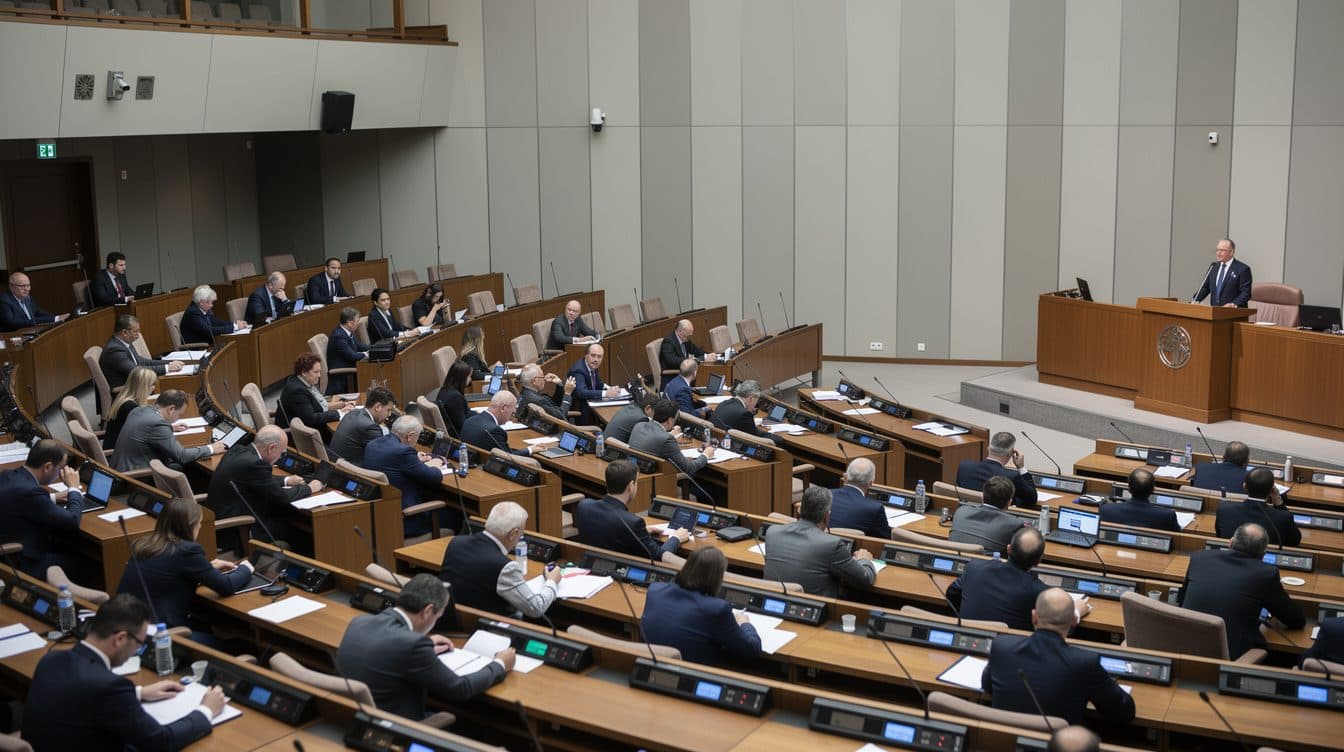
AI-generated image (flux-2/pro-text-to-image via Kie.ai)
Summary
The Bundestag is shaping up to approve a one-time zero-percent increase on lawmakers' pay, backed by all factions. In the states, however, parliaments are handling the index-based adjustment mechanism in very different ways, as examples from Hesse, Bavaria, and North Rhine-Westphalia show.
Berlin, 13 June 2026
In the Bundestag, a one-time zero-percent increase on Diäten is taking shape, while in the states, lawmakers' pay continues to rise in very different ways and remains politically controversial in some cases.
Background: How the Automatic Mechanism Works
The factions in the Bundestag are preparing a draft law that would suspend, for one year, the automatic increase in lawmakers' pay scheduled for 1 July 2026. According to parliamentary sources, the draft is jointly sponsored by the CDU/CSU and SPD and also has the support of the other factions. This would put on hold for one year the mechanism introduced in 2014 that links Diäten to the salaries of judges at Germany's highest federal courts.
Without the suspension, the monthly compensation of the 630 Bundestag members would have risen by 497 euros to around 12,330 euros on 1 July under the index model, up from approximately 11,833 euros previously. This follows from an automatic mechanism in the Members of Parliament Act that ties the pay to average wages. The planned zero-percent increase is seen as a political signal in times of strained public budgets.
Union faction leader Jens Spahn has spoken out in favor of suspending the Diät increase. The CDU/CSU and SPD now want to suspend this automatic mechanism once – and send a savings signal in financially difficult times with a one-time zero-percent increase in the Bundestag. The debate on the substance itself is fundamentally supported by all factions.
Debate in the Bundestag
While the Union and SPD frame the suspension as a pragmatic contribution to savings, the AfD and Die Linke go further. They are calling for a permanent abandonment of the annual adjustment. All factions support the suspension, with the AfD and Die Linke additionally demanding a permanent abandonment of the annual adjustment. The question of a lasting reform of the automatic mechanism therefore remains open for now.
At the state level, the picture of Landtag members' pay is highly varied. In many parliaments, the index-based adjustment is not tied to a parliamentary vote but takes place automatically according to a formula linked to a wage or income index. This has repeatedly drawn criticism in the past.
Hesse: More Pay, Less Conflict
In Hesse, following the most recent adjustment, members receive 10,362 euros per month – a rise of 4.3 percent – plus an expense allowance of 1,544 euros. A spokeswoman for the SPD in Hesse stated that the index model had successfully put to rest the previously frequent debates over adjustments to lawmakers' pay in the Hessian Landtag. Criticism of the level of pay, however, has not been put to rest.
In Baden-Württemberg, the Landtag voted 108 to 32 in favor of sticking with the index model. Basic compensation there stands at 9,322 euros. Only the AfD had called for a zero-percent increase. The vote makes clear that parliamentary majorities stand behind the automatic mechanism, even if parts of the opposition fundamentally reject it.
Baden-Württemberg and NRW: Majority for the Model
In North Rhine-Westphalia, members currently receive 11,463.66 euros per month. There are no plans to scrap the increase. A spokesman for the CDU Landtag faction in NRW said that compensation is oriented "an der Lebenswirklichkeit der Menschen und wird nach transparenten, nachvollziehbaren Regeln angepasst". The AfD announced plans to introduce a motion in the Landtag to suspend the increase.
In Rhineland-Palatinate, monthly compensation has stood at 8,571 euros since the beginning of 2026, representing a 3.1 percent rise. A new regulation is expected after the summer break, according to the Mainz Landtag.
In the Saarland, pay was raised retroactively to April to 7,173 euros, up from 6,977 euros previously. Further adjustments are planned through 2028.
Saxony-Anhalt is planning a raise from 8,736.66 euros to 9,138 euros. Here too, the linkage to statistical indices means the adjustment does not have to be renegotiated in the plenary each year.
Bavaria: Criticism from the Public Sector
In Bavaria, the basic compensation of Landtag members is rising by 4.1 percent to 10,595.07 euros, with an additional expense allowance of 4,415.02 euros. The increase is going ahead as scheduled, even as parts of the public sector are waiting for a pay raise.
This discrepancy in timing has drawn sharp criticism. The Bavarian GdP chairman Florian Leitner said it triggered "völliges Unverständnis", said the Bavarian GdP chairman Florian Leitner: "Bislang sind wir davon ausgegangen, dass wir gemeinsam Verantwortung für unser Land tragen und alle ihren Beitrag leisten, aber scheinbar wird seitens der Politik mit zweierlei Maß gemessen." The police union sees this as a clear signal of lacking solidarity.
In Brandenburg, the opposition BSW faction has proposed foregoing the increase. The SPD-CDU coalition is still reviewing the proposal; a waiver along the lines of the Bundestag is considered possible. The state government has not yet taken a final position on the matter.
Brandenburg: Review in the Landtag
The debate over the automatic mechanism introduced in 2014 is not new. Even at the time, the decision to tie the annual adjustment to a fixed mechanism was accompanied by accusations of self-serving behavior. Supporters point to the relief it provides parliaments from recurring debates; critics see it as a decoupling from the budgetary situation at hand.
The fact that self-regulation via indices works similarly in the states becomes clear from a look at the underlying data: in most cases, adjustments are linked to a wage or income index compiled by the respective state statistical office, and in some cases to public-sector pay indices. This makes the procedures comparable, but it leads to very different political assessments of the results.
Outlook: Open Reform Debate
For the Bundestag, the planned zero-percent increase represents a postponement for now, not a permanent reform. Should the adjustment take effect again in 2027, it would once more be tied to general wage trends. A fundamental debate over parliamentary law has thus been triggered, but not concluded.
Overall, it is clear: while the Bundestag is setting a sign of restraint with the one-time zero-percent increase, the states are handling the mechanism in very different ways. The range of reactions on the issue of lawmakers' pay stretches from clear approval in Hesse and Baden-Württemberg to open disputes in Bavaria and Brandenburg.
Questions & Answers
Was ist die geplante Nullrunde im Bundestag?
Union und SPD haben einen Gesetzentwurf vorgelegt, der die für den 1. Juli 2026 vorgesehene automatische Erhöhung der Abgeordnetenbezüge einmalig aussetzt. Alle Fraktionen tragen den Verzicht mit.
Wie hoch sind die Diäten in den Bundesländern?
Die Bezüge variieren stark: In Bayern etwa steigt die Grundentschädigung auf 10.595,07 Euro, in Hessen auf 10.362 Euro, in Baden-Württemberg auf 9.322 Euro, in Nordrhein-Westfalen auf 11.463,66 Euro und im Saarland rückwirkend auf 7.173 Euro.
Warum sorgt das Thema in Bayern für Kritik?
Während die Bezüge der Landtagsabgeordneten planmäßig steigen, werden Teile der bayerischen Beamtenbesoldung verschoben. Der bayerische GdP-Vorsitzende Florian Leitner kritisierte das als Ausdruck zweierlei Maßstäbe.
Zero-Percent Diät Increase in the Bundestag: All Factions | allfacts360