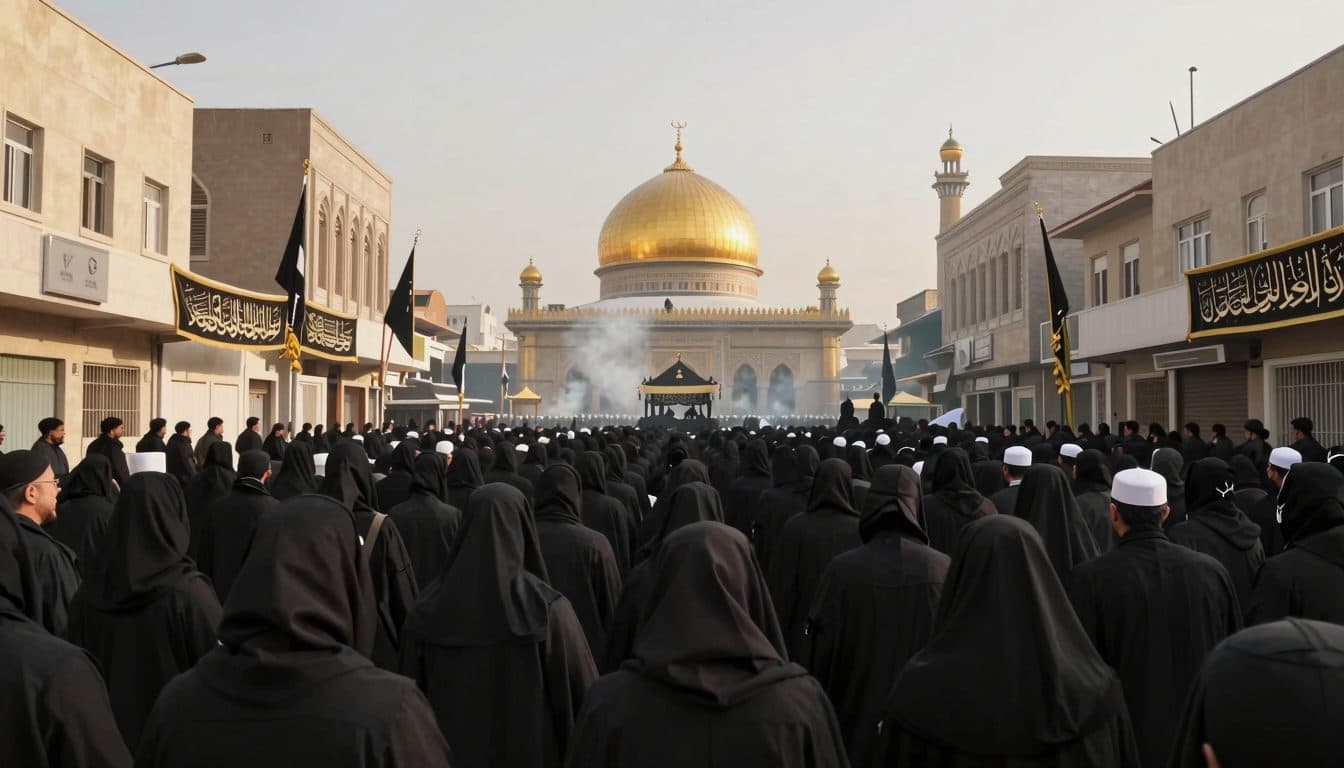
Burial of Ayatollah Ali Khamenei in Mashhad after six-day mourning ceremony
Tehran, July 9, 2026
AI-generated image (z-image via Kie.ai)
Summary
More than four months after his killing in a U.S.-Israeli airstrike, Ayatollah Ali Khamenei will be laid to rest on Thursday at the Imam Reza Shrine in Mashhad. A six-day mourning ceremony attended by millions precedes the funeral, and his son Mojtaba Khamenei stands at the center as successor.
Tehran, July 9, 2026
Ayatollah Ali Khamenei, who served for 37 years as Supreme Leader of the Islamic Republic of Iran, will be laid to rest on Thursday at the Imam Reza Shrine in his birthplace of Mashhad in the northeast of the country.
On February 28, 2026, the first day of the Iran war, he was killed in an American-Israeli airstrike on his official residence in Tehran. The burial therefore takes place more than four months after his death. Islamic tradition actually calls for burial as quickly as possible, often within 24 hours.
Mourning procession from Tehran via Qom to Iraq
The public mourning ceremonies began on Saturday in Iran's capital, Tehran. Millions of followers accompanied the former spiritual and temporal leader, who had ruled the Islamic Republic with an iron fist. The body was first laid out publicly in Tehran and carried through the streets.
The mourning procession then traveled to Qom and on to the Shiite pilgrimage sites in Iraq. To Qom the body was transported by helicopter, and to Najaf in Iraq by airplane. Roads are being closed off, the Revolutionary Guards are securing the procession, and the airspace over Tehran is being temporarily shut down.
The Iranian leadership justifies the delay with the tense situation and the organizational effort involved. The additional time is intended to make it possible to hold the multi-day mourning ceremonies without interruption and to coordinate the expected millions of visitors. Four months on, the Islamic Republic bids farewell to its long-standing revolutionary leader with a six-day mourning ceremony.
Mojtaba Khamenei as the new Supreme Leader
At the center of attention is also Mojtaba Khamenei, who was appointed the new Supreme Leader after the death of his father. Since the airstrike of February 28, in which he too was injured and his wife and daughter were killed, the new revolutionary leader has not appeared publicly. His brothers have already taken part in the mourning ceremonies.
Several family members died along with Khamenei, among them his 14-month-old granddaughter. On posters and in state media, Khamenei is referred to as the «Märtyrerführer Irans» (martyr leader of Iran), not only as «Führer der islamischen Welt» (leader of the Islamic world). The official slogan reads «Wir müssen aufstehen» (We must rise).
More than a thousand schools are serving as accommodations, as are mosques, sports halls, and universities. According to the «New York Times», apps are providing additional sleeping arrangements and showing free bus connections. For individual visitor groups, visas are said to have been issued with simplified procedures or free of charge.
International guests and selected Quran verses
Represented so far have been, among others, Pakistan, Armenia, Tajikistan, Georgia, Russia, China, India, Turkey, Afghanistan, Bangladesh, and Saudi Arabia. In addition to state delegations, representatives of Hezbollah, Hamas, and the Houthis also took part in the mourning ceremonies.
Iran welcomed individual guests with deliberately selected Quran verses. Hezbollah and Hamas received verses on steadfastness and loyalty. The Turkish delegation, by contrast, was received with a verse criticizing those who stay away from the struggle.
According to the Iranian burial committee, Shiite communities in Pakistan also asked for the body to be brought into the country for a mourning procession. Owing to the tight schedule, however, this was not possible. The Iranian burial committee also refuted rumors that Khamenei had already been buried in secret. The body had been kept during the entire time in compliance with religious and legal requirements and had not been buried.
Tensions in Iranian society
According to one study, only about 30 percent of the population now identify as Shiite Muslims. Particularly in the Iranian diaspora, his death also triggered celebrations. The mourning ceremony therefore takes place in a society that has undergone profound religious and political change.
The security measures are extensive. Revolutionary Guards are securing the procession, roads have been closed off, and the airspace over Tehran has been temporarily shut down. The burial itself is being held in private.
The burial is planned for this Thursday at the Imam Reza Shrine in his hometown of Mashhad. The Imam Reza Shrine is regarded as one of the most significant religious sites of Shiite Islam and is visited every year by millions of believers.
Security precautions and historical experience
At the funeral of the revolutionary leader Ayatollah Khomeini, the ceremonies had to be temporarily halted in 1989 because of the enormous crush of attendees. At the mourning ceremony for General Qassem Soleimani in 2020, dozens of people lost their lives in a stampede. These historical experiences shape the current security concept.
Following the funeral ceremonies, Mojtaba Khamenei is expected to appear more prominently in public as the new Supreme Leader. His first public appearance since the start of the war has been the subject of intense discussion for weeks in Iranian media and the diaspora.
Outlook on the era after Khamenei
If the burial on Thursday follows the six-day mourning ceremony, the Islamic Republic closes a chapter that began with the death of its long-standing head of state on February 28. The coming days will show how the religious and political order re-forms under the new leader Mojtaba Khamenei.
Questions & Answers
Who was Ayatollah Ali Khamenei?
Khamenei served for 37 years as the Supreme Leader of the Islamic Republic of Iran and at the same time as its spiritual and temporal head. He was killed on February 28, 2026, in an American-Israeli airstrike on his official residence in Tehran.
Why was Khamenei's burial delayed by several months?
The Iranian leadership justified the delay with the tense security situation and the organizational effort required for the six-day mourning ceremony. The additional time was intended to make it possible to coordinate millions of visitors from within the country and abroad.
Where will Khamenei be buried and who succeeds him as Supreme Leader?
The burial is being held in private on Thursday at the Imam Reza Shrine in his birthplace of Mashhad in northeastern Iran. As his successor as Supreme Leader, his son Mojtaba Khamenei was appointed, who has not appeared publicly since the airstrike.
Khamenei's burial in Mashhad: mourning ceremony, successor | allfacts360