Six Days of National Mourning: Iran Prepares Funeral for Ayatollah Khamenei
Tehran, 03 July 2026
AI-generated image (z-image via Kie.ai)
Summary
The Iranian leadership plans to bid farewell to the killed Ayatollah Ali Khamenei in Tehran on Saturday with a six-day period of national mourning. The burial of the Supreme Leader is scheduled for Thursday in his hometown of Mashhad.
Tehran, 03 July 2026
The Iranian leadership will begin a six-day period of national mourning on Saturday for Ayatollah Ali Khamenei, who was killed at the end of February and whose body is to be interred on Thursday in his hometown of Mashhad.
Schedule of the Mourning Ceremonies
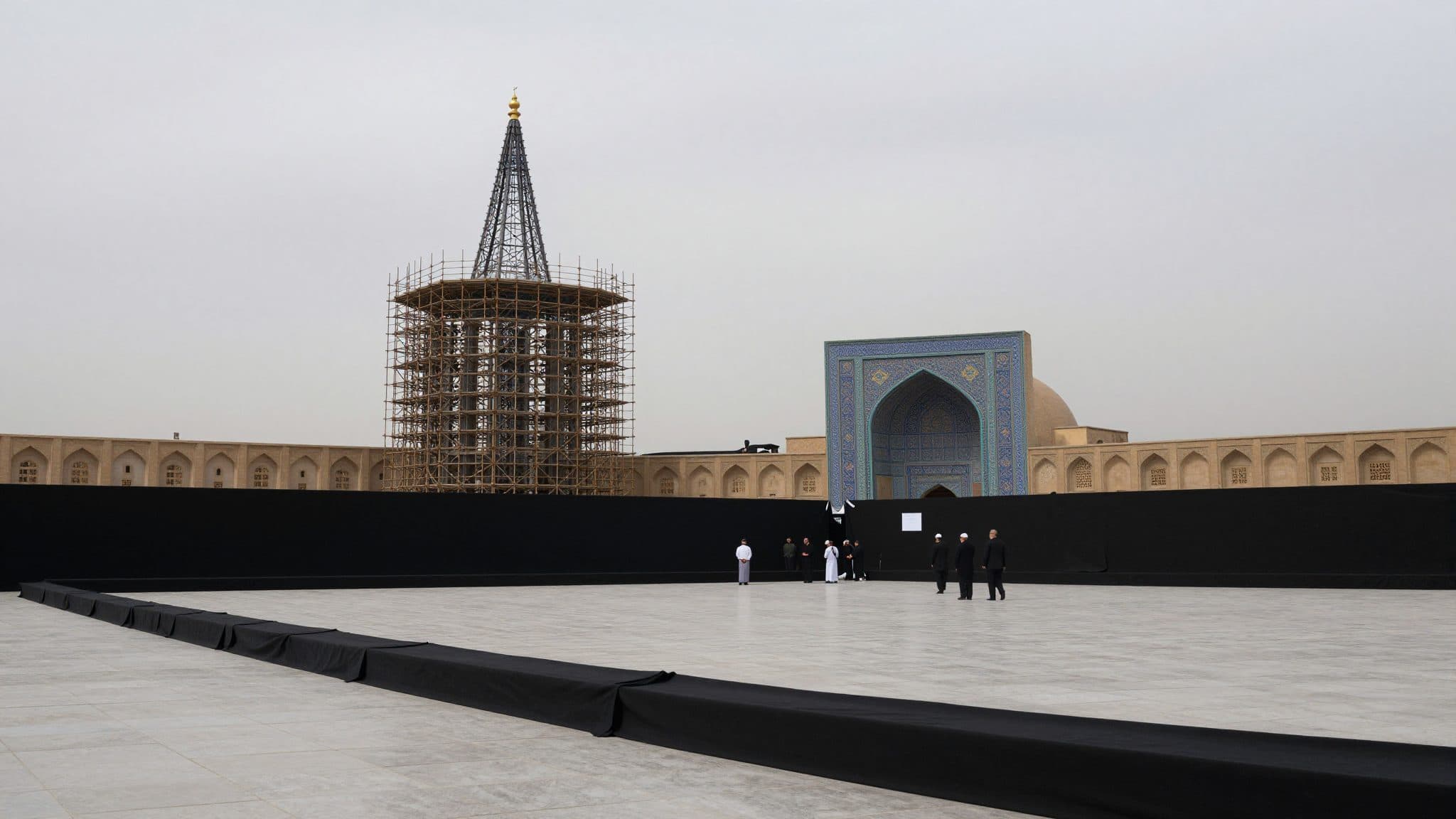
The official mourning ceremonies for Ayatollah Ali Khamenei will begin on Saturday in Tehran, as reported by Iranian state television. Already on Friday, the head of state's coffin had been brought to the large Musalla mosque near the city of Abbas Abad. Photos on Friday showed mourners carrying Khamenei's coffin, draped in the Iranian flag, into the complex in the capital designed for large ceremonies. On scaffolding inside, workers were busy with a metal construction, as images disseminated by state media show.
Khamenei was killed at the end of February by Israeli airstrikes. He had been Supreme Leader since 1989 and led the Islamic Republic of Iran for nearly 37 years. He was succeeded by his son Mojtaba Khamenei. Media reports say he was injured in the targeted killing of his father. The son and successor is considered seriously injured and has not appeared publicly to date. Mojtaba Khamenei expressed reservations about the framework agreement with the US but ultimately gave his approval, wie aus Verhandlungskreisen verlautete.
Shortly before, numerous state guests had been received in Tehran for the mourning ceremonies. Iranian state television showed, among others, government representatives from China, Belarus, Iraq, and Turkmenistan landing in the capital. Russia, China, India, and Pakistan will also be officially represented. Envoys from Afghanistan, Armenia, and Venezuela are also expected to attend the funeral. Pakistani Prime Minister Sharif likewise announced his visit.
International Guests and Excluded States
European states, the United States, and Israel were expressly not invited, according to Iranian statements, because in Tehran's view they had positioned themselves «on the wrong side of history.» This was also confirmed by Foreign Ministry spokesman Ismail Baghaei. Altogether, representatives from around thirty countries are expected at an initial mourning ceremony, as the official in charge of organization, Ali-Akbar Pourjamshidian, announced.
Several million people are expected at the ceremonies, including high-ranking representatives of the Iranian government and the military. According to Parliament Speaker Mohammad Bagher Ghalibaf, the regime expects between 10 and 20 million mourners in Tehran alone. Other official figures put the number at 15 to 20 million people in the capital. Overall, several million visitors are expected at the nationwide ceremonies.
The authorities have made extensive logistical preparations. To accommodate domestic and foreign guests, Tehran's highways have been converted into makeshift parking lots in recent days. Mosques, schools, sports halls, and universities have been repurposed as accommodations. There will be significant traffic restrictions; a vast area of the inner city will be closed to cars. The preparations are already causing traffic jams, as certain streets have been closed to delivery vehicles.
From Saturday onward, three days of commemoration are planned in the Iranian capital. During this time the capital will be «completely closed and a non-working day,» as the authorities have ordered. For security reasons, Iran intends to close its airspace for several days. Hundreds of thousands of security personnel are to be deployed. Tens of thousands of security forces have been assembled in the major cities.
Military Threats and Security Measures
The Revolutionary Guards are responsible for crowd control in the key cities. On Friday, the Iranian armed forces warned of attacks on Iran. «Any miscalculation will be met with a determined and even harsher response than ever before. A response that will be recorded forever in their history of shame,» read a statement by the Revolutionary Guards that Iranian media disseminated.
Khamenei's coffin has already been displayed in the large Musalla mosque near the city of Abbas Abad. Enormous portraits of Ali Khamenei cover the facade of the Musalla, whose architecture corresponds to the main building of a mosque. In the Musalla, the major Friday prayers, official memorial ceremonies, and religious gatherings are held. Khamenei's body, who led the Islamic Republic of Iran for nearly 37 years, will be publicly displayed in the Musalla in Tehran starting Saturday.
Mourning ceremonies are planned in a total of five cities. The ceremonies, originally planned for early March, had initially been postponed because of the war. The ceremonies will continue until Monday. Khamenei's body is then to be taken to the pilgrimage city of Qom and to Iraq. A funeral procession will move through Iraq and the Shia holy cities of Najaf and Karbala on 8 July. Two days earlier, a funeral procession will move through the holy city of Qom.
Burial in Mashhad
Ali Khamenei will finally be interred on 9 July in the holy city of Mashhad in northeastern Iran, his hometown. Officially, the regime has justified this decision with security risks, the danger of further attacks, and logistical challenges. A delay of several months is highly unusual and departs from normal religious tradition, explains Iran expert Negar Mortazavi, Senior Fellow at the Center for International Policy in Washington. They have been waiting for months for the opportunity to bury him.
A good four months after the start of the Iran war and Khamenei's death, the political leadership in Tehran is staging his funeral as its greatest triumph. The regime is staging the mourning act as a sign of unity. Ghalibaf called on Thursday for strong participation in the mourning ceremonies, in order in this way to «avenge» Khamenei's death. He invited «the entire Iranian people (...) through your presence to write a glorious chapter in the history of Islamic Iran.»
The leadership wants to demonstrate unity and support for the Islamic Republic both internally and externally. One aim of the mourning ceremonies, in the words of Pourjamshidian, is «to strengthen national cohesion and unity among the various political, social, and religious components of the country around the central role of the Leader.» Iranian Vice President Mohammad Reza Aref, who is organizing the funeral, described it at the end of June as «the most important event of the 21st century.»
Staging as a Display of Power
The exile medium «Iran International» reports on state efforts to get the population to participate. These include offers such as free meals, overnight accommodation, and bus arrivals from rural areas. At the same time, they have also brought militias and supporters of this regime from Iraq to Tehran — and they will fill the streets, as Natalie Amiri reports, who for many years headed the ARD studio in Tehran.
Natalie Amiri paints a mixed picture of the mood. The people in Iran are in deep despair. They have truly been through hell in recent months. When news of his death spread, there were spontaneous — and risky — celebrations of joy in Iran. Many Iranians find themselves in a dilemma: they do not want the regime, but they also do not want more bombs, observers report.
Amiri also describes that people have already left Tehran heading north: that people have already set off toward the north. The coming days will be very empty, especially in Tehran, with regard to the Iranians who live there. Ten to fifteen percent of Iranians stand behind this regime. That is still a few million, Amiri continues. That will be the image that goes out via the media. They will suggest unity, they will continue to show the triumphal euphoria they are in, because they won — because they were not toppled.
Mood Among the Population
At the same time, the staging raises questions about the distribution of power. «Ayatollah Khamenei was not only Iran's Supreme Leader but also one of the most influential religious and political figures in the Shia world, with followers and allies throughout the Middle East,» explains Iran expert Mortazavi. «Internationally, the funeral is an opportunity to demonstrate that the state, after an unprecedented military confrontation, remains functional and capable of organizing a major national event,» says Mortazavi.
Domestic power questions are also in play. Parliament Speaker and chief negotiator Mohammad Bagher Ghalibaf spoke of «one of the most defining moments in the history» of the country. He led the Iranian negotiating delegation in talks with the United States, initially in Pakistan and later in Switzerland. Foreign Minister Abbas Araghchi, who earned a doctorate in political philosophy in England and has experience with the Revolutionary Guards, signed the framework agreement with Washington to end the war together with Massoud Pezeshkian.
Power Relations and the Question of Succession
The ceremonies are also an occasion to introduce his son and successor Mojtaba Khamenei to the public. Mojtaba Khamenei is weaker than his father, according to analyses. He has indeed already moved up, but since his appointment has not appeared publicly to date. Israel-Iran expert Beni Sabti told the AFP news agency: Niemand sollte sich von seinem Auftreten täuschen lassen - er weiß, wie man mit dem Westen redet.
A fragile ceasefire currently holds; Washington and Tehran have agreed on a framework agreement to end the war. For more than five weeks, the United States and Israel then waged war against Iran, until representatives from Washington and Tehran agreed on a ceasefire in early April. Dozens of Iranian generals and influential politicians were also killed. State television has devoted large parts of its programming in recent days to broadcasting documentaries about Khamenei and to warning notices, since the mourning ceremonies will take place in scorching hot temperatures.
The mourning ceremonies for Ali Khamenei take place six months after mass protests in Iran against the high
Khamenei Funeral: Six Days of Mourning in Iran Starting | allfacts360