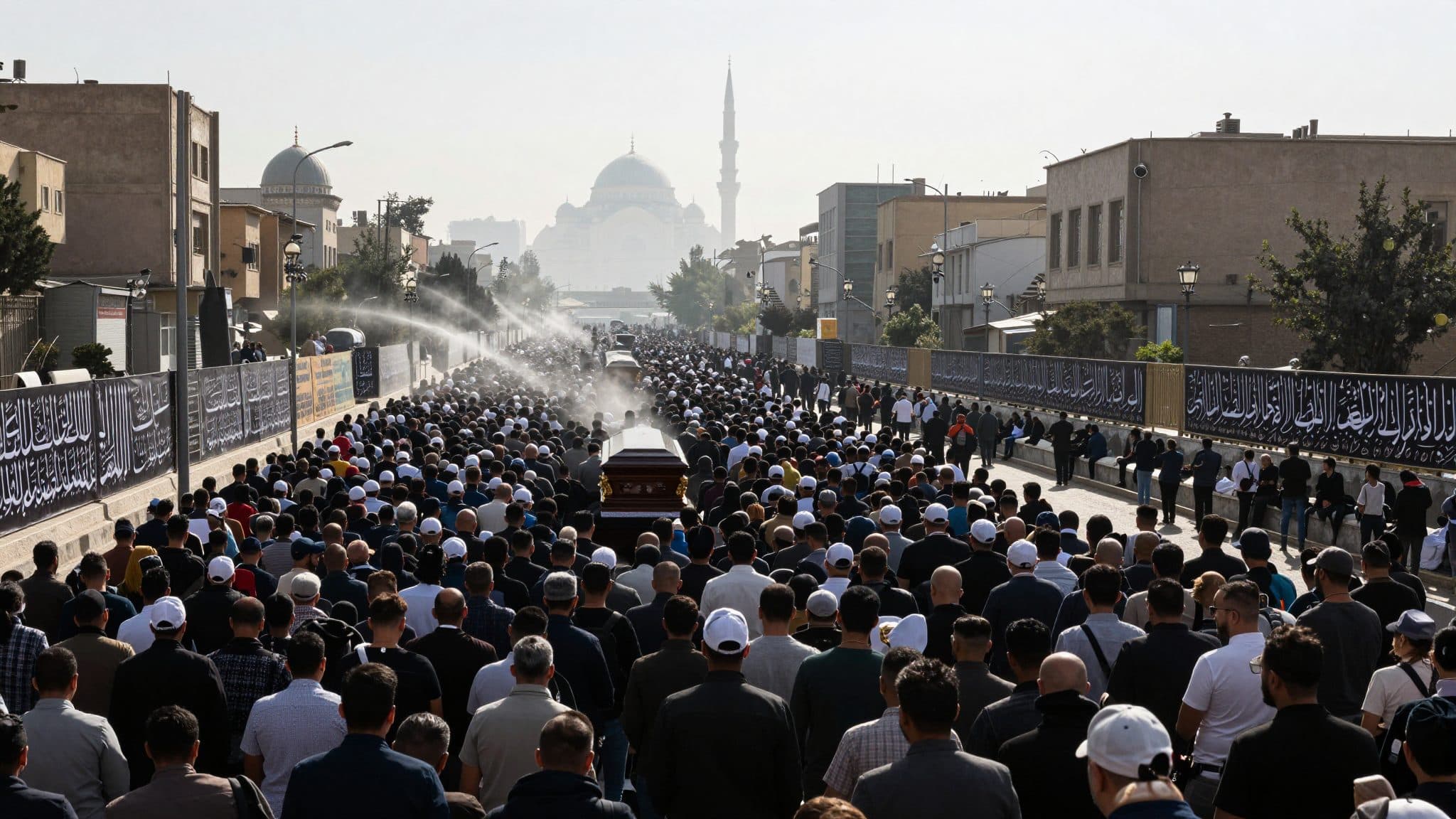
Millions at Funeral Procession in Tehran: Regime Stages Show of Force After Khamenei's Death
Tehran, July 7, 2026
AI-generated image (z-image via Kie.ai)
Summary
On Monday, according to official figures, several million people marched through Tehran with the coffin of the killed Ayatollah Ali Khamenei. The six-day mourning ceremonies are seen by observers less as mourning than as a political staging by the regime.
Tehran, July 7, 2026
Following the death of Iranian Supreme Leader Ayatollah Ali Khamenei in US-Israeli attacks on June 28, several million people in Tehran followed the funeral procession through the capital on Monday, according to official figures, while observers interpret the ceremonies as a show of force by the regime.
Background: Death of the Supreme Leader
The Monday procession marked the first highlight of the six-day mourning ceremonies. According to authorities, millions of people lined the streets of Tehran as Khamenei's coffin, together with three killed family members, was carried through the capital. At temperatures around 40 degrees Celsius, artificial mist provided cooling, while the crowd shouted "God is great," as reported by Deutschlandfunk. The authorities expect up to 20 million participants in total over the entire mourning period.
Prior to this, the coffin had lain in state for three days in the "Grand Mosalla," a vast mosque complex. On Tuesday, the procession was to continue to the theological stronghold of Qom, before finally ending in Khamenei's birthplace, Mashhad. In Mashhad lies the only shrine in Iran to one of the twelve Shia imams, the eighth Imam Reza. In Qom, the influential Ayatollah Makarem Shirazi was to lead the funeral prayer, in Mashhad Noori Hamedani, as reported by Iranian media. In Tehran, the 97-year-old Grand Ayatollah Jafar Sobhani appeared as the prayer leader.
Stations of the Funeral Procession
According to the assessment of Middle East expert Hans-Jakob Schindler, the Iranian regime is putting in a "quite considerable effort" for these mourning ceremonies. This is "driven by necessity: the need to restore confidence in the state," the BBC quoted expert Vali Nasr as saying. An entire "era" is being "buried," a newspaper analysis stated. The leadership is using the mourning ceremonies as a show of force, having after all "brought the US to its knees" with the move on the Strait of Hormuz.
The symbolism is notable: The regime has placed the mourning days around July 4, while the US celebrates its 250th Independence Day. Observers had previously mostly spoken of "hundreds of thousands" in Tehran, but even that figure would be impressive. In fact, the population was called on to participate via SMS, according to "Zeit," and at least those who are well-disposed toward the regime or economically dependent on the state came. "Even if one assumes that the overwhelming majority of the population is either opposed or indifferent to the regime, 10 to 20 percent remains—9 to 18 million people who stand behind this regime and are in part financially dependent on it," Schindler said. Filling the streets with these people had therefore "never been a problem" for the regime.
Rhetoric of Revenge
A huge banner was unfurled that read: "We will kill Trump!" Revenge is the recurring motif at the mourning ceremonies. "Just as with Hyder, his flank was pierced," boomed from large loudspeakers at the start of the funeral procession. Alluding to the negotiations that had begun on a deal with the US, the crowd shouted: "We don't want a deal—we want Trump's head." And early on, cries such as "Death to America, death to Israel" surged up.
The rial, the Iranian currency, continues to collapse. The economic situation is "disastrous" and the regime needs money if it does not want to lose complete control over the economy, experts told the broadcaster. There is "absolutely no progress." The Iranians did get the oil trade back, but that has had "zero impact" on the economic situation. Women without headscarves and alcohol in restaurants are currently being tolerated more, reported the "New York Times." Women without headscarves and alcohol in restaurants are currently being tolerated more, according to the "New York Times" as well. Reform forces had already been "only reformers within the existing system" before the war, Schindler said. They were not "radical reformers" for democracy. Even those have already been "neutralized for years."
Economic Situation and Society
With the US and Israeli attacks, the regime was able to reinforce the external enemy image again, above all through the attack on a girls' school at the start of the war, with an official death toll of 168. Khamenei, killed by the "arch-enemy" as a "martyr," serves as a symbolic figure better than a supreme leader who died in old age in bed, as experts believe. "Chamenei is no longer remembered today as a political leader who led the regime into every conceivable abyss, but rather as a martyr who was killed by the enemies of Islam, the enemies of Iran," said expert Perthes.
His son and successor Mojtaba Khamenei has not been seen at the mourning ceremonies so far. He has not made any public appearance at all since the death of his father in the US-Israeli attacks on June 28. Mojtaba is a "war invalid," state media report—presumably so severely injured that he is unable to appear. State television described him as a "war invalid," but gave no further details. According to Iranian media, the 56-year-old is not scheduled to lead a prayer. "Such a presence (...) could have conveyed an image of internal unity and national cohesion in the eyes of the world public," he wrote.
Question Surrounding the Successor
Mojtaba's absence raises questions. Letters have been passed from the Revolutionary Guards to state bodies, allegedly composed by Mojtaba Khamenei. "Statements are said to have been made that no one can comprehend," the report states. This suggests "that there is quite possibly the possibility that the Revolutionary Guards are in fact manipulating Mr. Mojtaba Khamenei to suit their purposes." Ali Khamenei's 56-year-old son, Mojtaba, was indeed appointed as his successor in March.
According to Schindler's assessment, the current war has merely led to there now being "various factions within the Revolutionary Guards," "namely their economic complex, their political complex, and their security apparatus and military complex, which together exercise this distribution of power within the regime." The "Süddeutsche Zeitung" assumes in an analysis that after the era of Revolutionary Leader Ayatollah Ruhollah Khomeini and that of Khamenei, the third phase of the Islamic Republic has now begun: the rule of the Revolutionary Guards. The role of the spiritual supreme leader is "only a very thin veneer of religious superstructure."
International Reactions
Mohammad-Jafar Ghaempanah, Vice President for Administrative Affairs, has recently even questioned, according to the "New York Times," whether Khamenei must always have the last word. Ali Vaez of the think tank International Crisis Group even draws a comparison with the situation in China after Mao: "This new leadership understands that it needs a new social contract," he told the BBC. A few weeks later, however, they did not shy away from negotiations with the "arch-enemy" either. In the hope that Iran would return to the 2015 nuclear deal that Trump destroyed in 2018, they tried for a long time to keep the channel of contact open. It was only in 2023 that Tehran and Riyadh normalized their relations.
The balance sheet of international reactions has so far been mixed. Iran is said to have invited only state guests from countries that behaved "neutrally" in the war—whether it was enough to have taken a critical stance toward the US-Israeli attack is unclear: that would apply to many. The authorities reported the visit of "hundreds" of delegations from around the world. That makes the balance sheet look rather less brilliant, even if the authorities report the visit of "hundreds" of delegations from around the world. In small nighttime rallies, judicial prosecution and the death of the negotiators were even called for, reported the "New York Times."
Power Relations Within the Regime
Experts do not expect a new wave of protests anytime soon, unless the ultra-hardliners take command. "Pragmatists" in power could stabilize the situation, observers estimate. The war and the reordering of the situation in Iran are in any case "far more consequential and far-reaching than we have previously assumed," according to Nasr. Every opponent must therefore ask themselves whether they are prepared to "end their life on the street" by trying to organize a demonstration. That is "astonishing," says Schindler.
With around 93 million inhabitants, Iran is a large country—and although large parts of the population repeatedly demonstrate against the regime in Tehran, there continue to be people who profit from it. Mashhad is considered a particularly pious, conservative city—but even there, demonstrations took place in January 2026. Khamenei had been in power since 1989, and thus much longer than his predecessor, the founder of the Islamic Republic in 1979, Ruhollah Khomeini. This report was broadcast on 06.07.2026 on the Deutschlandfunk program.
The mourning ceremonies for Ayatollah Ali Khamenei last a total of six days. They have even gone far beyond what was observed in 1989 for the state's founder, Ruhollah Khomeini, observers reported. Over 1,000 ships are waiting off the Strait of Hormuz for free passage. Over 1,000 ships are waiting off the Strait of Hormuz for free passage. The strong symbolism of the Iranian regime choosing the days around July 4 for the monster
Khamenei Funeral March in Tehran: Show of Force by the Iran | allfacts360