Millions mourn Ali Khamenei in Iran as funeral rites enter second day
Tehran, 06 July 2026
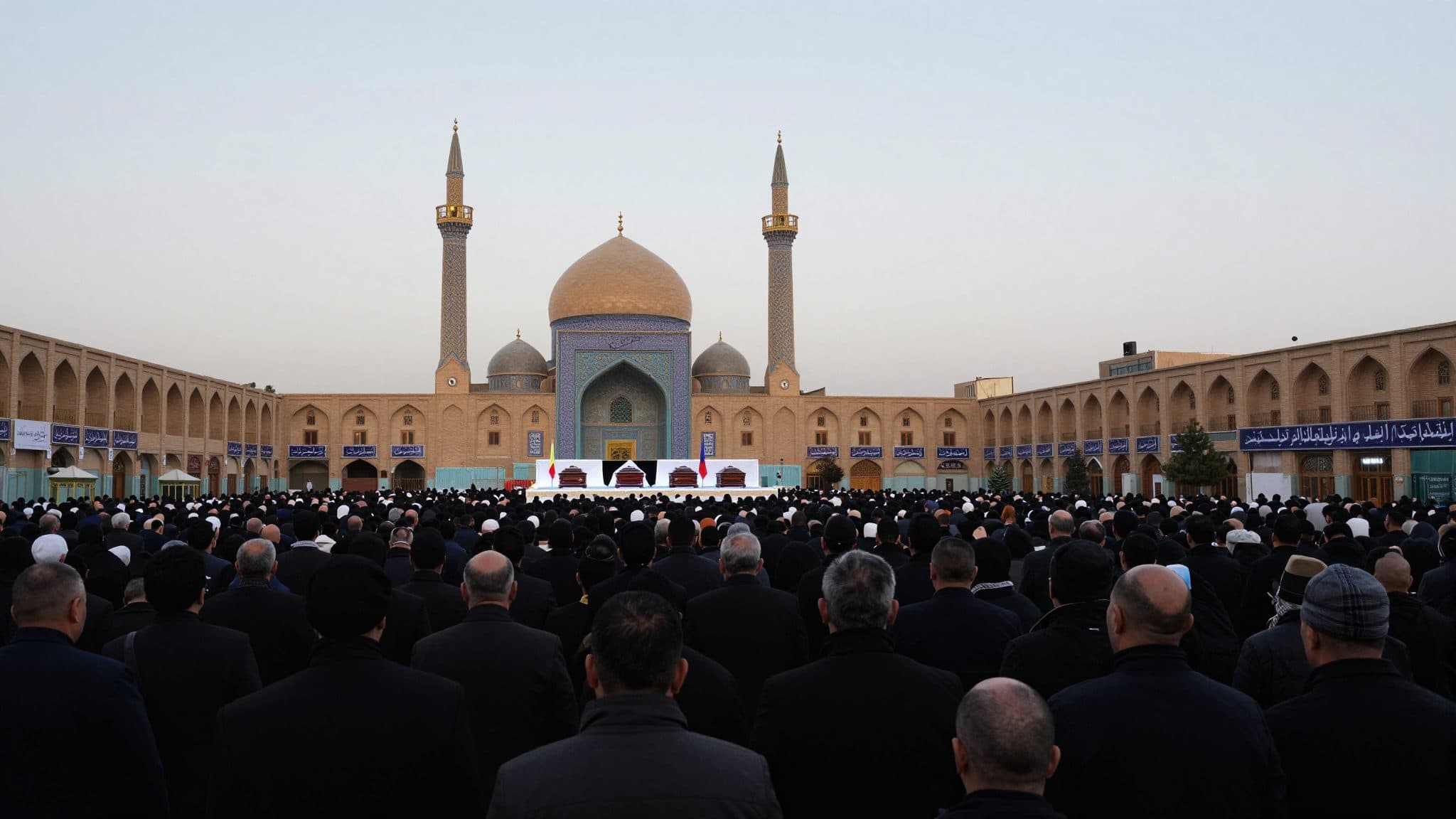
AI-generated image (z-image via Kie.ai)
Summary
Iran is holding six days of public mourning for Ayatollah Ali Khamenei, who died alongside relatives in strikes on June 28. Authorities in Tehran expect up to 20 million participants across the week-long ceremonies, while the absence of his wounded son Mojtaba has drawn attention.
Tehran, 06 July 2026
Iran is observing six days of public mourning for Ayatollah Ali Khamenei, who died alongside several relatives in strikes attributed to the United States and Israel on June 28, with authorities in Tehran expecting up to 20 million people to take part in ceremonies running through the week.
Ayatollah Ali Khamenei, who led the Islamic Republic for 37 years, was killed on June 28 in strikes that Iranian authorities have attributed to the United States and Israel. State media reported that several members of his family were killed at the same time, including his daughter, his son-in-law, his daughter-in-law and a 14-month-old granddaughter. The combined coffins, five in total and draped in the Iranian flag, were displayed on a podium at the Grand Mosalla mosque complex in Tehran.
The public mourning began on Friday and is expected to last six days, with the coffin to be paraded through the streets of Tehran and onward to the holy city of Qom, 150 kilometers south of the capital. Iranian authorities initially projected more than ten million participants, but have since revised the estimate upward to as many as 20 million, in what state media have called the funeral of the century. The sheer scale has put severe strain on the capital's logistics, with state television reporting that roughly 4,000 people received medical treatment at the edges of the ceremonies.
Six days of mourning, millions in the streets
On the second day of mourning, Sunday's prayers at the Mosalla complex were led by the 97-year-old Grand Ayatollah Jafar Sobhani, one of the most influential clerics of the Islamic Republic, as shown in state television footage. According to state media, subsequent prayer services in Qom will be led by the influential Ayatollah Makarem Shirazi, who is 99, and in Mashhad by Nouri Hamedani, who is 101. Organizers distributed refreshments to mourners as temperatures climbed above 35 degrees Celsius along the route to the mosque.
Khamenei had stood at the head of the clerical system since 1989, making him the most powerful figure in the state. He succeeded Ayatollah Khomeini and held the title of Supreme Leader, the country's highest office, for the remainder of his life. At the time of his elevation, observers noted that he lacked the requisite theological rank for the position, a circumstance that became a recurring critique of his rule over the following decades.
A 37-year rule ends
The funeral program has drawn particular attention because of the conspicuous absence of Mojtaba Khamenei, the late Supreme Leader's son and widely seen heir. Iranian media reported that no public role had been planned for the 56-year-old, and that he would not be leading the prayer at his father's funeral. Reports indicate Mojtaba Khamenei was severely wounded in the June 28 attack, with state television describing him as a war casualty, though it provided no further details.
Trump, quoted in a separate report, remarked that with all Iranian leaders in attendance, Washington could eliminate them 'with one strike', but added: 'Aber das werden wir nicht tun, denn dann hätten wir niemanden mehr, mit dem wir verhandeln könnten.' In a separate broadcast, Trump praised his own political record, spoke of a 'golden age' for the United States, and used laudatory language about his war against Iran.
Calls for vengeance in Tehran
Against that backdrop, mourners in Tehran filled the Mosalla complex and surrounding streets. On banners and in chants, supporters of the Islamic Republic called for vengeance. According to reporting, followers chanted 'tötet Trump' and 'Tod für Amerika' and held red placards reading 'Rache' or 'Tötet Trump'. Some observers noted that the rhetoric in the capital stood in sharp contrast to the tone in Washington, 10,000 kilometers away.
The political backdrop is fragile. Studies cited in the reporting suggest that only around 30 percent of Iran's population identifies as Shia Muslim, while separate estimates put regime support at no more than 20 percent of the country's 93 million people. The youth-led protest movement of 2022 and 2023, which under the slogan 'Woman, Life, Freedom' swept the country, was a direct challenge to the theocratic order. A writer noted in an accompanying commentary that the regime under Mojtaba Khamenei and the Revolutionary Guards, who currently hold de facto power, is attempting to stitch together the country's fractures with nationalist propaganda, religious symbolism and a relaxation of morality laws.
A fractured society under pressure
Those morality laws themselves have remained in force. In June, the young singer Parastu Ahmadi was sentenced to 74 lashes for appearing in public with uncovered hair, a case that human rights groups had highlighted as emblematic of the pressures on ordinary Iranians. According to one report, 40 people have been executed for resistance against the regime and its order since the war began, and 6,000 have been arrested.
The succession question remains open. Mojtaba Khamenei, whose exact whereabouts and condition have not been independently confirmed, was reported by state television as a war casualty. A separate commentary observed that his absence from the funeral prayers could have projected an image of inner unity and national cohesion to the world, quoting the writer: 'Eine solche Anwesenheit hätte (...) ein Bild der inneren Geschlossenheit und des nationalen Zusammenhalts vor den Augen der Weltöffentlichkeit vermitteln können.'
History and symbolism at the funeral
The funeral ceremonies are also unfolding against a deep well of Iranian historical and religious symbolism. The reporting invokes the legend of Rostam from the Shahnameh, the Book of Kings, composed around 999 AD by the Persian poet Firdausi; the relief at Naqsh-e Rostam depicting the Sasanian king Shapur I receiving the Roman emperor Valerian as a captive after his victory in 260 AD; and the martyrdom of Imam Hussein, killed along with his family and companions at the Battle of Karbala in 680 AD against the Umayyad caliph Yazid. Khomeini, the founder of the Islamic Republic, explicitly compared the Shah Reza Pahlavi to Yazid, an analogy that helped mobilize the masses for the 1979 revolution.
For the leadership now steering the Islamic Republic, these references offer a frame through which to recast the current moment as one of national resilience. Yet the practical challenges are immediate. Heat, crowd control and the medical emergency around the Mosalla compound are pressing concerns, with the IRNA news agency reporting that around 4,000 people received medical treatment at the periphery of the ceremonies on Sunday alone.
Logistics and the international gaze
Internationally, the funeral places Iran's clerical leadership in an uneasy spotlight. As foreign leaders and global media observe the ceremonies, the absence of Mojtaba Khamenei from public view has fueled speculation about both his health and the question of who will now consolidate power in Tehran. The Revolutionary Guards, who hold de facto control, are reportedly balancing calls for vengeance with the need to project stability.
For ordinary Iranians, the week ahead will mean continued closures, mass processions and an emotional reckoning with the end of an era that began in 1989. The funeral rites, by their sheer scale and their political symbolism, are intended to mark not just the death of one man but the reaffirmation of a system under acute strain.
As the coffin moves through Tehran toward Qom, the ceremonies will continue to provide both a stage for the regime's projected unity and a measure of the distance between the official narrative and the mood on the streets of a country where, by some estimates, no more than one in five citizens actively supports the ruling order.
Questions & Answers
Who was Ayatollah Ali Khamenei?
He served as Supreme Leader of the Islamic Republic of Iran from 1989 until his death on June 28, 2026, and was the most powerful figure in the Iranian state for 37 years.
Why is Mojtaba Khamenei absent from the funeral?
Iranian media reported that no public role was planned for the 56-year-old son and expected heir, and state television described him as a war casualty following the June 28 attack, without providing further details.
How many people are expected at the funeral ceremonies?
Iranian authorities initially projected more than ten million participants and later raised the estimate to up to 20 million across six days of mourning that began on Friday.
Khamenei funeral: Iran mourns as son Mojtaba absent | allfacts360