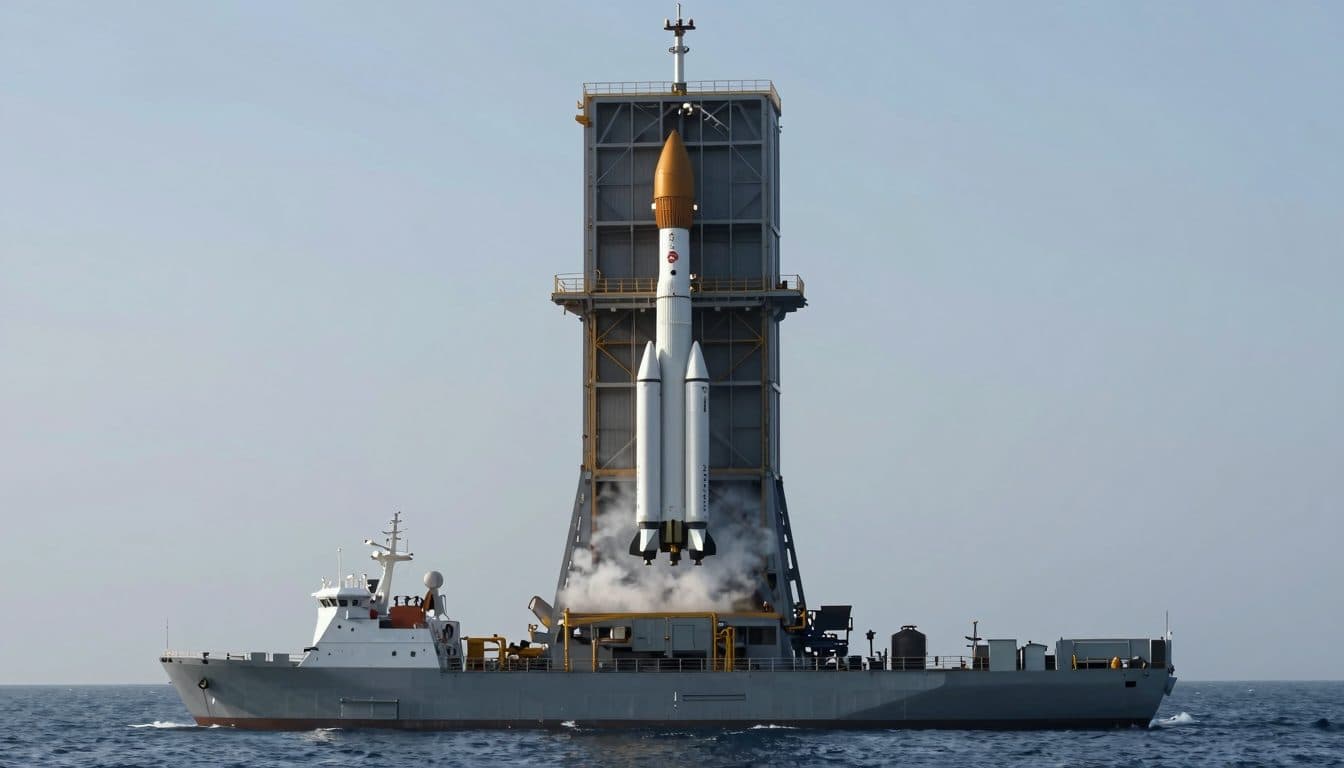
China recovers a launch vehicle stage for the first time in a controlled manner over the sea
Beijing, July 10, 2026
AI-generated image (z-image via Kie.ai)
Summary
During the maiden flight of the new "Long March 10B" launch vehicle, China recovered the first stage in a controlled manner on a platform at sea for the first time. According to the state news agency Xinhua, the recovery vessel "Linghangzhe" ("Pathfinder") waited for the stage and caught it with a cable structure.
Beijing, July 10, 2026
During the maiden flight of the new "Long March 10B" launch vehicle, China recovered the first stage of a launch vehicle in a controlled manner on a platform at sea for the first time, as the state news agency Xinhua reported on Friday.
First-time controlled recovery at sea
A video released by the agency shows the rocket stage flying toward the platform with its engine running and sinking almost vertically into a tall, rectangular frame. Special metal hooks then folded out and engaged the taut cables of the catching device. In this way, the stage of the new "Long March 10B" rocket was caught on a platform at sea.
The rocket had launched from the Hainan spaceport and delivered a satellite into the intended orbit. At the same time, it was said to be the first time worldwide that the first stage of a rocket had been recovered using such a cable-catching device. It was the first flight of the new rocket.
According to the newspaper "China Daily", the recovery vessel "Linghangzhe" ("Pathfinder") waited for the rocket stage. The ship tracked it and continuously adjusted its position. Xinhua spoke of a "bedeutenden Durchbruch". According to the state newspaper, China is thus the second country after the USA to possess a reliable technology for reusable rockets.
Technical data of the rocket
According to information from the source material, the rocket itself is around 70 meters high and around 5 meters wide. It can reportedly transport up to 16 tons into low Earth orbit and is primarily designed for cargo missions. The rocket lifted off at noon (local time) from the Wenchang spaceport on the southern coast of China.
Test for the crewed Moon variant
Based on the available information, the flight constitutes the first orbital test of the "Long March 10" family. The test was intended to validate key technologies for the more powerful crewed Moon variant "Long March 10", which is to take Chinese astronauts as well as a lunar lander to the Moon before 2030. According to reports, 21 engines of the YF-100K type are to be used at launch.
For the first time, the country brought back the first stage of a launch vehicle in a controlled manner. China has been pushing this development for years, as it would enable satellites and other payloads to be brought into space more cheaply. In addition to the state space program, several private Chinese companies are also working on the technology.
Race with SpaceX
The US space company SpaceX in particular is significantly further ahead with reusable rockets. Elon Musk's company has been landing boosters on land-based platforms or ships for years and reusing the stages multiple times. With Friday's recovery, China is catching up in international comparison, even if the procedure has not yet technically reached the same level of maturity.
After launch, the recovery was carried out by the first stage returning toward Earth. Shortly after liftoff, the stage reportedly flew back vertically toward the catching device and was captured by the framework above the sea platform. Footage from the agency shows the procedure from multiple angles.
According to its own statements, China intends the operation to reduce costs for transporting satellites and other payloads into orbit. Reusable rockets are regarded in the space industry as the key to increasing launch frequency and driving down prices per kilogram of payload. If such returns succeed reliably, material consumption per launch drops significantly.
According to the available information, the test proceeded without major complications: the rocket delivered a satellite into the planned orbit, and the stage was subsequently caught in a controlled manner. Xinhua writes that China has thereby taken another step toward the planned crewed lunar mission.
Significance for China's space plans
Observers interpret the flight as a signal to the international space community. Beijing is pursuing the goal of sending its own astronauts to the Moon in the coming years. The "Long March 10" variant is to serve as a heavy-lift launcher for the lunar mission, while the "10B" will primarily take on cargo tasks.
According to the state newspaper, the recovery of the stage is evidence of the maturity of the Chinese space program. It described it as a premiere for the country and an important technological leap. However, it remains to be seen whether the technology will function reliably in routine operations and whether the stages can actually be reused multiple times.
China and the USA are also engaged in an increasingly intense competition in space. While SpaceX has been routinely returning stages with its Falcon 9 series for years and is working on the next generation with Starship, China has so far mainly built up experience with conventional, non-reusable rockets. Friday's operation now closes a gap.
Outlook on further tests
The Wenchang spaceport on the southern Chinese island of Hainan has for years been the most important launch site for Chinese heavy-lift rockets. Launches from here include rockets of the "Long March 5" and "Long March 8" types. The region has favorable geographic conditions because launches can take place over the open sea.
Based on the available information, it remains unclear how quickly China can transition the new technology into regular use. Although the state newspaper speaks of a technological leap, it also points out that further testing is needed. The financial advantage of reusable stages also depends on how often and how quickly they can fly again.
What is clear after Friday's flight is that China has successfully demonstrated the first step toward the controlled return of launch vehicles over the sea. The rocket fulfilled its primary mission – transporting a satellite – while also bringing its stage back to Earth intact. The space agencies now want to evaluate the data and prepare further tests.
Xinhua spoke of a "bedeutenden Durchbruch". The recovery was said to be the first time worldwide that a rocket first stage had been caught at sea using a cable-catching device, the report continued. The procedure is considered technically demanding because the stage must be maneuvered with high precision into the relatively small catching framework.
Questions & Answers
What is the "Long March 10B"?
According to the available information, the "Long March 10B" is a new Chinese launch vehicle that is around 70 meters high and can transport up to 16 tons into low Earth orbit. Its maiden flight took place on July 10, 2026, from the Hainan spaceport.
Why is the recovery at sea a step forward?
China has recovered the first stage of a launch vehicle in a controlled manner on a platform at sea for the first time. Xinhua spoke of a "bedeutenden Durchbruch" and pointed out that such rockets should in future bring satellites into space more cheaply.
How does the technology differ from SpaceX's?
According to its own statements, China caught the stage at sea for the first time using a cable-catching device. SpaceX, by contrast, routinely lands boosters on platforms or ships and is significantly further ahead with reusable rockets.
Long March 10B: China recovers rocket stage at sea | allfacts360