China Auto Market Collapse May 2026: Sales Down 22 Percent | allfacts360
China's Auto Market in Freefall: Sales Plunge 22 Percent
Beijing, June 16, 2026
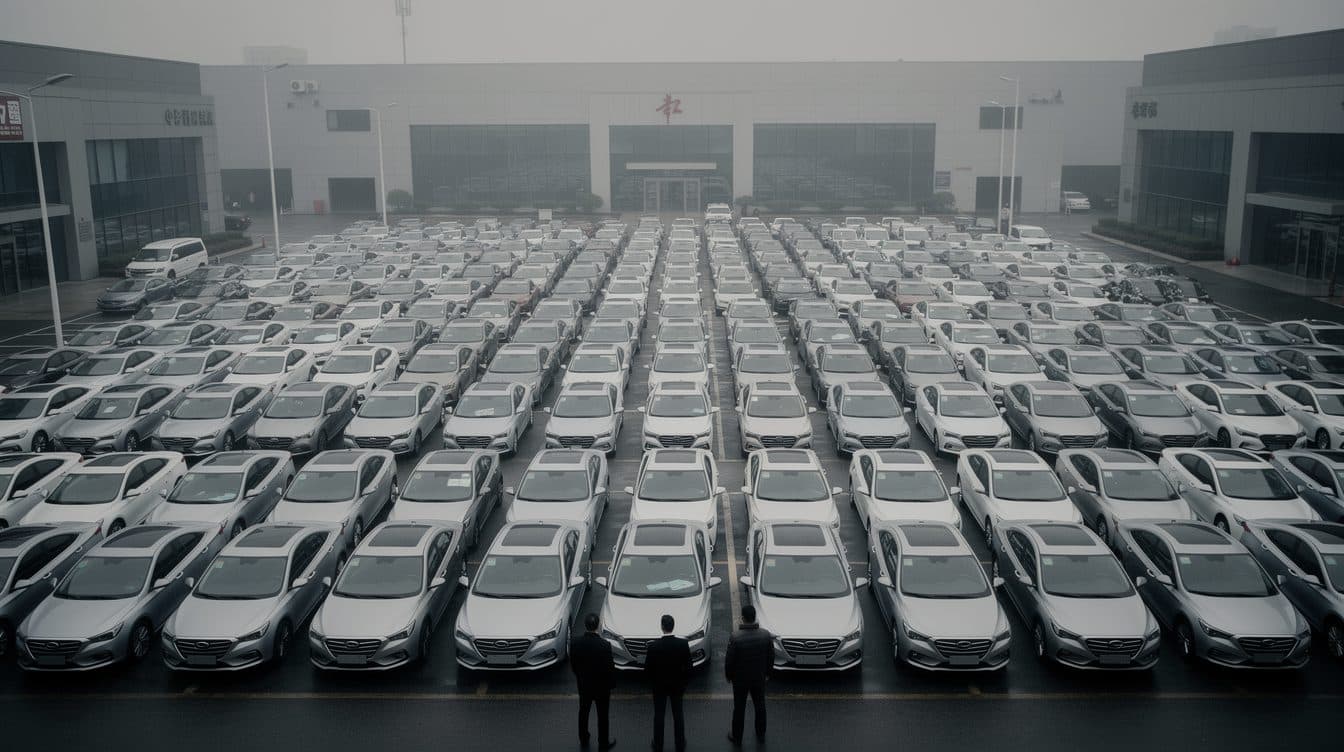
AI-generated image (flux-2/pro-text-to-image via Kie.ai)
Summary
In May 2026, passenger car sales in China dropped by around 22 percent compared to the same month last year, according to the CPCA. The association cut its full-year forecast to minus eleven percent, while Volkswagen and other manufacturers are adjusting their plans to the shrinking market.
Beijing, June 16, 2026
In May 2026, passenger car sales in China plunged by around 22 percent year-on-year to roughly 1.5 million vehicles, as reported by the Chinese association CPCA.
Causes of the Collapse
The downturn on the Chinese auto market deepened markedly in May 2026. As the passenger car manufacturers' association CPCA announced, about 1.5 million vehicles were sold in May – a decline of 22 percent compared to the same month the previous year. Between January and May, sales also fell by nearly 20 percent measured against the value of the same prior-year period, according to data from the Chinese passenger car association (CPCA). The downward trend that had already been emerging in previous months is thus continuing with full force.
CPCA Secretary General Cui Dongshu cites the withdrawal of state aid as the main cause: "above all, the decline in state support is weighing on the market. Added to this are the high gasoline prices since the start of the US-Iran war at the end of February and the weak purchasing power of many consumers. The reasons are clear. This pushes into the distant future the long-held expectation that China's middle class would fuel the auto market for years to come. According to official figures from state media, the country counts more than 400 million people as middle class – but consumer sentiment has collapsed.
Price-Sensitive Customers and Pull-Forward Purchases
Chinese auto expert Beatrix Keim points out that the market had known about the planned changes to subsidies for electric cars since around October 2025. "The market had known about the changes in EV incentives since around October 2025. That is why purchases were pulled forward. This amplified the current slump. At the same time, manufacturers and dealers had pushed additional vehicles into the market, which further inflated the statistics. "Chinese customers are extremely price-sensitive and react very strongly to such changes, said Keim.
The ongoing real estate crisis in China is adding to the pressure on consumers. "The ongoing real estate crisis in China is weighing on wealth and confidence. Many households are stuck in ongoing mortgage repayments, Keim explained: "According to Keim, many customers are struggling with repayments on real estate loans. For many households, a car is therefore a purchase that can more easily be postponed.
Combustion Engines Under Pressure, NEVs Continue to Grow
Conventional models are hit particularly hard: in May, sales of conventional gasoline and diesel vehicles plunged by 39 percent, while so-called New Energy Vehicles (NEVs) – i.e., electric cars and plug-in hybrids – recorded only a single-digit percentage decline. However, since the beginning of the year, NEVs have been especially hard hit by the cut purchase incentives. At the same time, the NEV share of the overall Chinese passenger car market rose to over 60 percent. Since the start of the war and the rise in fuel prices, the pressure then shifted toward conventional combustion engines.
German manufacturers are feeling the downturn firsthand. Volkswagen Group China stated in Beijing: "The Chinese automobile market is under increasing pressure. "Volkswagen Group China cannot escape this trend. We are adjusting our plans accordingly, it added. The group does not expect the market to recover over the course of the year and forecasts a volume of below 21 million new vehicles for 2026. At the same time, Volkswagen stresses that it is well positioned with its model offensive in the NEV segment. Mercedes-Benz stated that the Chinese auto market remains "competitive, dynamic and in transition.
Reactions from German Manufacturers
The performance of Chinese manufacturers is also changing. While groups such as Geely and BYD initially did not respond to inquiries, the electric car manufacturer Nio reported 150,526 deliveries worldwide from January to May – an increase of 68.7 percent year-on-year. "For Nio, long-term trends are in the foreground and not short-term market fluctuations, the company stated. Chinese manufacturers are increasingly trying to offset declining domestic sales through exports: in May, Chinese passenger car exports rose by around 75 percent year-on-year, according to the CPCA.
Industry expert Peter Fintl, however, does not see this as a lasting remedy. The export route is more of a "vent than a "lifeline, he said – markets in Europe and South America are increasingly pushing for local production. "The export tool gives Chinese manufacturers breathing room, but it carries the brutal price war right to our doorstep, Fintl warns. Cui Dongshu also pointed to global growth opportunities: "Cui sees particularly large opportunities for Chinese manufacturers in Central and South America, Australia, Southeast Asia and Africa.
Exports as a Vent – with Risks
According to Cui's assessment, the long-term prospects remain fundamentally intact. Passenger car density in China is still well below German levels, and the market is not saturated. Nevertheless, the association has sharply cut its full-year forecast: instead of the originally expected decline of one percent, the CPCA now assumes a minus of eleven percent for 2026. "The industry association CPCA now expects a decline in sales of eleven percent for 2026 – instead of the originally forecast one percent.
Keim sees the rapid growth of the past primarily as a result of subsidy policy. That phase is now waning, and the price battle will continue. A comparison with Europe also shows the structural shift: in the EU, electric cars reached almost 20 percent market share by April 2026, while combustion engines posted double-digit declines. "Mercedes-Benz and BMW also profited from the combustion engine market in China for a long time. In NEVs, however, Chinese manufacturers are often faster, cheaper and closer to the expectations of Chinese customers, Keim explained. The high-margin combustion engine business of German premium manufacturers is thus coming under double pressure – from shrinking domestic markets and from intensified competition in the EV segment.
Outlook: No End to the Price Battle in Sight
The International Energy Agency also notes that high oil prices could even further fuel the global EV boom in the medium term, as countries are likely to step up purchase premiums for electric vehicles. For China, this means: the current downturn could accelerate the already rapid shift toward electric cars – with far-reaching consequences for manufacturers, suppliers and the global competitive order. The coming months will show whether this is a cyclical dip or the beginning of a new, permanently lower growth path.
Volkswagen concluded by stating that it would consistently pursue its China strategy and respond with the NEV model offensive. The industry thus remains in a phase of uncertainty: between weak domestic economic activity, global export pressure and a technology push that is reshaping the balance of power.
Questions & Answers
How sharply did passenger car sales in China fall in May 2026?
According to the CPCA, around 1.5 million vehicles were sold in May 2026 – a decline of about 22 percent compared to the same month the previous year. Between January and May, the decline was nearly 20 percent.
What reasons does CPCA Secretary General Cui Dongshu cite for the sales decline?
Cui Dongshu points above all to the decline in state support, high gasoline prices since the start of the US-Iran war at the end of February, and the weak purchasing power of many consumers. The real estate crisis is also placing an additional burden on households.
How are Volkswagen and other German manufacturers reacting to the market collapse?
Volkswagen Group China stated that the market is under increasing pressure, lowered its expectation to below 21 million new vehicles for 2026, is adjusting its plans and is relying on a model offensive in electric cars. Mercedes-Benz and BMW, which long profited from the combustion engine business in China, are coming under increased competitive pressure in the NEV segment from faster and cheaper Chinese providers, according to expert Beatrix Keim.