China Sanctions 56 US Companies: Trade Dispute Escalates
Beijing, June 22, 2026
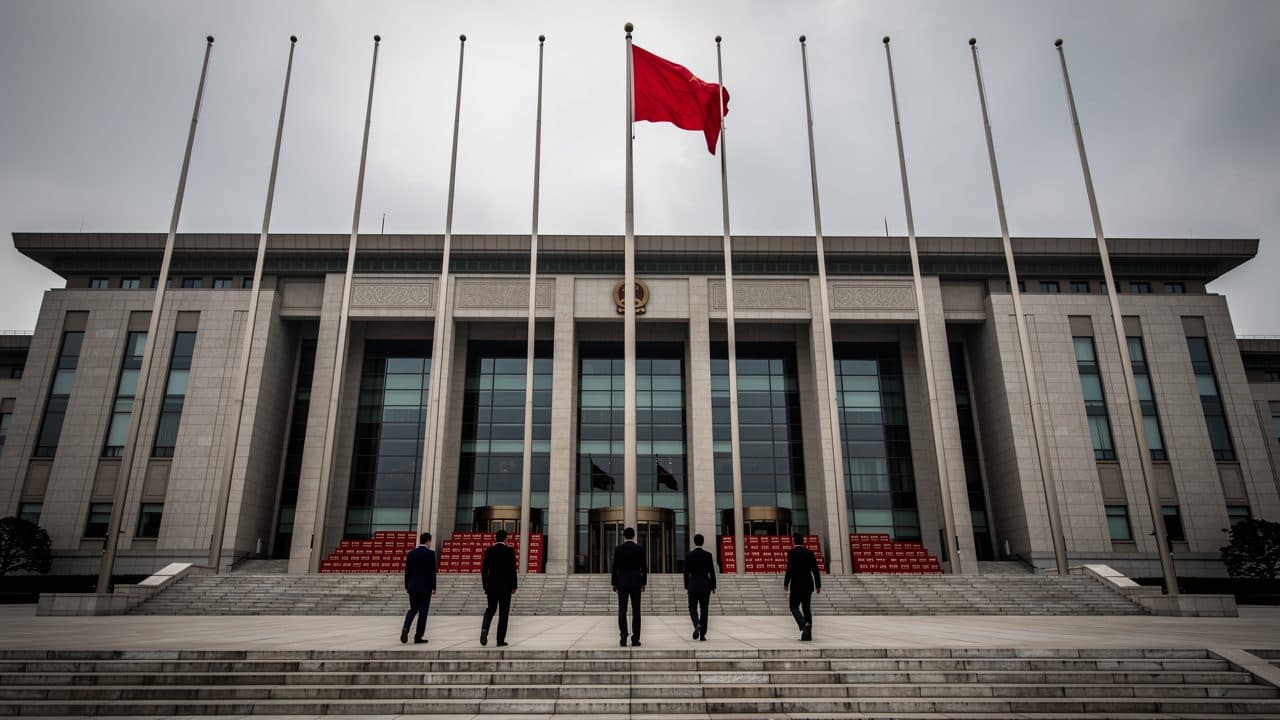
AI-generated image (flux-2/pro-text-to-image via Kie.ai)
Summary
China has imposed sanctions on a total of 56 American companies in the ongoing trade and technology conflict with the United States. While Beijing's Vice Premier Ding Xuexiang warned of geopolitical conflicts and a fragmentation of supply chains, President Xi Jinping announced a reciprocal visit to Washington.
Beijing, June 22, 2026
China has imposed sanctions and export controls on a total of 56 US companies in the ongoing trade and technology dispute with the United States, including major arms manufacturers, drone makers, and rare earth producers.
What Beijing Has Announced
As China's Ministry of Commerce announced on Monday in Beijing, ten companies linked to the US military were placed on an export control list. According to information from Beijing, these include defense, drone, and security companies such as engine manufacturer Aveox, Red Cat Holdings, Teal Drones, Oshkosh Defense, L3Harris Maritime Services, as well as the rare earth producers MP Materials and USA Rare Earth. Chinese exporters are no longer permitted to supply dual-use goods to these companies, and ongoing export transactions must be halted immediately.
China's Ministry of Finance, meanwhile, stated that Chinese authorities in the public procurement sector may no longer purchase products from 46 US corporations. Affected are, among others, major arms manufacturers and the defense divisions of large companies, including Lockheed Martin, RTX (formerly Raytheon), and Boeing. Companies with US investments in China are exempt from the measure.
Background: The US List of June 8
The measure's background is a US government decision from June 8: on that day, the Pentagon had published an updated list of 188 Chinese companies and affiliated entities that it classifies as so-called Chinese military companies. Among them are prominent names such as Alibaba, one of China's largest internet and e-commerce conglomerates, and BYD, China's leading manufacturer of electric vehicles. The e-commerce giant Alibaba, the search engine operator Baidu, and the automakers BYD and NIO are also on the US list.
Beijing immediately issued sharp criticism of the US list and threatened retaliation. A spokesperson for China's Ministry of Commerce said it was a response to the "unprecedented" designation of a number of Chinese companies as supporters of the Chinese military by the United States. The measure also serves to protect "national security." The action is a reaction to the "malicious practice" of the US government and serves to safeguard national security.
Ding Xuexiang's Warning of Fragmentation
China's Vice Premier Ding Xuexiang used a speech in Beijing to address the tensions with Washington on a fundamental level. Dialogue must prevent economic and trade policy issues from being used as instruments of pressure, he demanded. This could lead to geopolitical conflicts and wars, protectionism is increasing, and the risk of fragmentation of industrial and supply chains is rising.
Ding Xuexiang also warned that individual countries invoking national security as a pretext for trade restrictions could trigger geopolitical conflicts and wars. In doing so, the Vice Premier picked up on an argument that other emerging economies had also advanced in recent months, such as India and Brazil. Observers interpret the speech as an attempt to sharpen the Chinese position in the international debate on supply chains and export controls.
Strategic Objectives of the Sanctions
The now-affected US companies reflect the strategic fields in which Beijing wants to exert pressure. Aveox, Oshkosh Defense, L3Harris Maritime Services, and Teal Drones operate in the defense and drone sector, which has gained significantly in importance since Russia's war of aggression against Ukraine and in light of potential conflicts over Taiwan. Others, such as MP Materials and USA Rare Earth, are intended to build US supply chains for rare earths and magnets — an area previously dominated by Chinese companies. Also affected are MP Materials and USA Rare Earth, which produce rare earths.
Several of the companies operate in the defense, drone, or security sector. With the new restrictions, China is therefore specifically targeting those industries considered security-relevant in Washington. At the same time, Beijing is signaling that it is willing to use its control over the value chain for rare earths, in which China dominates, as leverage — a pressure point that Western governments have described as a vulnerability for years.
Impact on Trade in Dual-Use Goods
The export controls have immediate economic consequences. Chinese exporters may no longer supply dual-use goods to these ten US companies — that is, no products that can be used both for civilian and military purposes. These include certain metals, semiconductors, specialty chemicals, and machinery. According to information from Beijing, exporters may no longer supply the companies with goods that can have both civilian and military use. Ongoing export transactions must be halted immediately.
The sanctions intensify the conflict that has been simmering for months. After his renewed inauguration at the beginning of 2025, US President Donald Trump had ignited a bitter trade war with China through special tariffs. In mid-May, Trump traveled to Beijing for a state visit. In October, both sides then agreed on a preliminary pause in the dispute.
Xi Visit to Washington in Autumn
Despite the current tensions, there is a diplomatic thread: China's President Xi Jinping is planning a reciprocal visit to Washington in the autumn. Should the trip take place, it would be the first personal meeting of the two heads of state since Trump's visit to Beijing. It is unclear whether the new sanctions will affect the schedule of the visit. Observers in Beijing interpret the date as deliberately chosen to build negotiation pressure without fully closing the diplomatic door.
International reactions to the Chinese measures initially remained restrained. In Brussels and Tokyo, the development is being closely monitored, as both the European Union and Japan pursue their own programs to build independent supply chains for rare earths. Should China further restrict the export of these strategic raw materials, these programs could gain urgency. The US government initially made no public statement on the new sanctions.
International Reactions and Consequences
For the affected US companies, inclusion on the export control list means above all a loss of market access. Lockheed Martin, RTX, and Boeing generate the bulk of their revenue with the US Department of Defense and allied armed forces, but components from China continue to play a role in the production of individual parts. The sourcing of rare earths from China is also difficult to replace for US manufacturers of magnets and high-performance electronics.
The measure is part of a series of Chinese responses to Western industrial policy. In recent months, Beijing has already tightened export controls on gallium, germanium, and certain rare earths. The newly published list of 56 companies is novel in its scope, as it is the first to directly target US defense suppliers and companies that are supposed to drive the establishment of alternative supply chains in the US.
Beijing justifies the action by referring to national security. The measure also serves to protect "national security." Critics in the West see it as retaliation for the US list that classifies Chinese tech and auto companies as military companies. Both sides accuse each other of misusing economic tools for political purposes — a charge that Ding Xuexiang explicitly directed at Washington in his speech, but which is also levelled against Beijing in the US.
The coming weeks will show whether the escalation triggers further rounds. Should the US expand its export controls vis-à-vis China, Beijing is likely to respond with further measures according to its own logic. Observers in Beijing and Washington see the Xi visit expected in the autumn as the last major opportunity to at least partially contain the conflict. (AFP)
Questions & Answers
Which US companies are affected by the Chinese sanctions?
A total of 56 US companies are affected: 46 are subject to a procurement ban for Chinese authorities — including Lockheed Martin, RTX, and Boeing — and ten are on an export control list, including Aveox, Oshkosh Defense, L3Harris Maritime Services, MP Materials, and USA Rare Earth.
Why is China responding with the new measures?
Beijing justifies the sanctions as a response to the update of the US list of June 8, which classifies 188 Chinese companies — including Alibaba, Baidu, BYD, and NIO — as supporters of the Chinese military; China speaks of a "malicious practice" by the US government.
What concrete consequences do the export controls have?
Chinese exporters may no longer supply dual-use goods to the ten listed US companies — that is, no products with potential civilian and military use; according to Beijing, ongoing export transactions must be halted immediately.
China Sanctions 56 US Companies: Trade Dispute Escalates | allfacts360