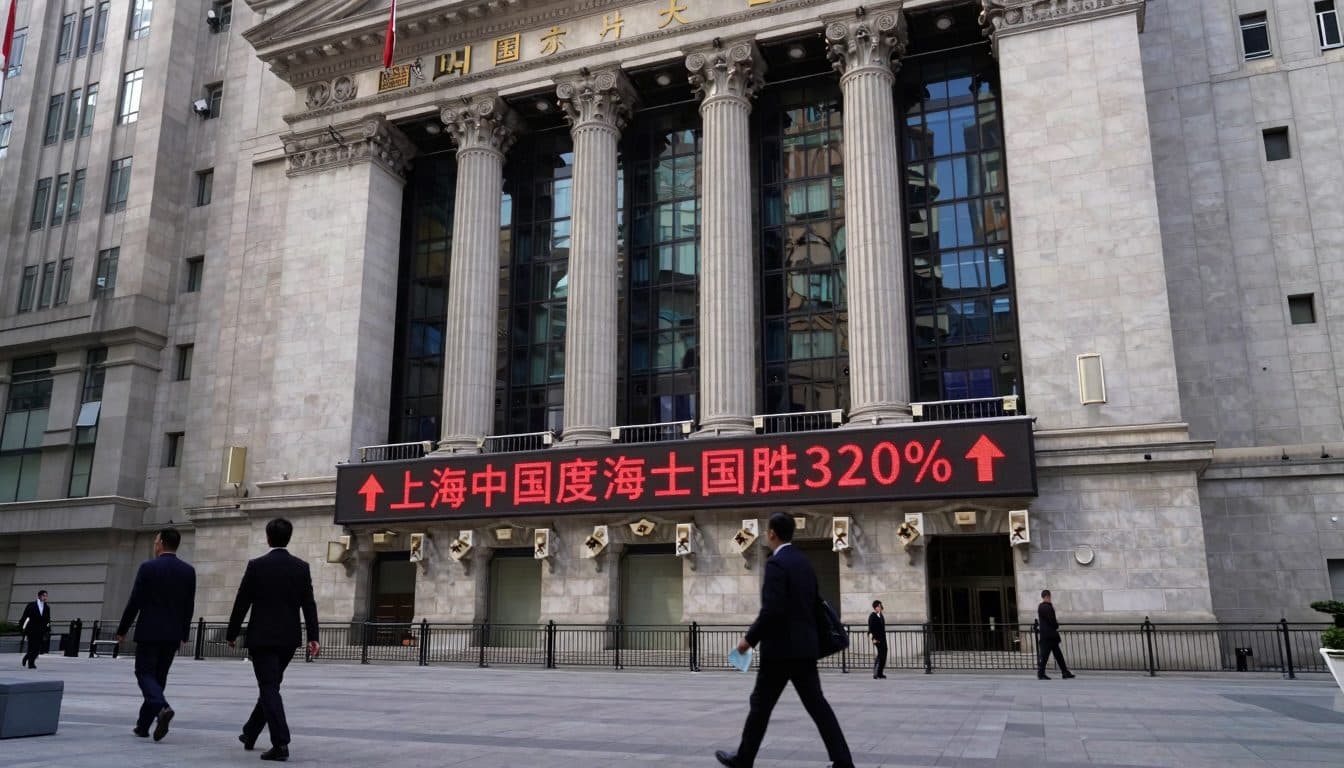
Chinese memory chip maker CXMT makes dazzling stock market debut in Shanghai
Shanghai, July 28, 2026
AI-generated image (z-image via Kie.ai)
Summary
Chinese DRAM manufacturer CXMT made a spectacular debut on the Shanghai stock exchange on Monday: the share closed its first trading day up 465.82 percent. The IPO generated the equivalent of around 9.3 billion US dollars for the company and is considered one of China's largest IPOs in years.
Shanghai, July 28, 2026
Chinese memory chip maker CXMT (ChangXin Memory Technologies) carried out an IPO on the STAR exchange in Shanghai on Monday that far exceeded expectations and represents one of the largest IPOs in the People's Republic in years.
Record-breaking first trading day
According to dpa-AFX, CXMT placed around 6.7 billion shares at an issue price of 8.66 yuan, raising the equivalent of just under 9.3 billion US dollars. The 58 billion yuan (around 7.5 billion euros) that CXMT raised with the IPO sends a clear signal for the growing capital market dynamics in China's technology sector.
The response on the first trading day was enormous: the CXMT share opened at 46.90 CNY and closed on the Shanghai stock exchange at 49.00 CNY, a gain of 465.82 percent compared to its issue price. Based on calculations using the issued shares, this would imply a valuation of 8.76 trillion yuan – almost 1.14 trillion euros.
At this valuation, CXMT would be worth more than Micron, currently around 1.04 trillion US dollars (914 billion euros). At times, the company's market capitalization stood at around 487 billion dollars, surpassing that of US group Intel. CXMT briefly overtook even Tencent as the highest-valued company in the People's Republic.
The strong interest is rooted in CXMT's strategic significance. ChangXin Memory Technologies, or CXMT for short, was founded in 2016 in Hefei in the eastern Chinese province of Anhui. Today the company is China's largest manufacturer of DRAM memory chips. CXMT is now the fourth-largest manufacturer of DRAM memory chips worldwide – behind Samsung, SK Hynix and Micron.
Background: The rise of a Chinese chip conglomerate
Over the past twelve months, the company has significantly expanded its market share. The globally rising demand for chips for artificial intelligence applications has also contributed to this. These chips are used in computers, servers and data centers. They are also important for artificial intelligence applications. Above all, the AI chips of the US company Nvidia continue to set the global benchmark for training powerful AI models.
With revenue of 50.8 billion yuan (6.6 billion euros) in the first quarter of 2026, the company is already financially strong. Its current valuation stands at 3.7 trillion yuan, the equivalent of almost 480 billion euros. CXMT is considered the most advanced Chinese company in the memory chip market and is targeting, in its own words, a capacity of around 500,000 wafer starts per month in the medium term.
The money from the IPO is now to be invested in new production facilities and the development of more powerful memory chips. The funds are to flow into an expansion of manufacturing capacities and into research. As early as the end of 2026, CXMT could reach 350,000 wafer starts per month (Wpm). This would reduce the gap to Micron (385,000 Wpm), the third-largest memory manufacturer worldwide ahead of the Chinese group, to less than ten percent. However, Micron is also currently expanding its manufacturing capacities.
Geopolitical context and US restrictions
The high valuation is not, however, shared without reservation across the board. In addition, CXMT's margins are lower; such a high valuation could be excessive. Micron, with 18.8 billion US dollars (16.5 billion euros, DRAM only) over a roughly comparable period, generates significantly higher revenue. Japanese investment and financial services provider Nomura Holdings has issued a price target of 116 yuan for the share, according to the FT.
Geopolitical factors also play a role. In recent years, the USA has restricted China's access to modern chip technologies. This was intended to slow the development of China's semiconductor industry. Their sale to the People's Republic was effectively banned by the USA at the end of 2025. US export controls and Dutch licensing requirements block China's access to the most advanced EUV systems, making immersion DUV technology the most viable path for domestic chip manufacturing.
CXMT received support from the central government, state funds and local authorities. Beijing's attempt to ensure semiconductor self-sufficiency also with the help of manufacturers of lithography machines is gaining credibility, according to market circles cited by Dow Jones Newswires. CXMT also manufactures HBM but appears unable to cover Huawei's needs for AI accelerators such as the Ascend 950 (g+).
Outlook: Lithography machines and Asian markets
The demand also surprised analyst Tilly Zhang, who spoke with the Financial Times. This makes the IPO one of the largest of the year in Asia. The first Chinese immersion DUV lithography systems are to be delivered this year to Semiconductor Manufacturing International (SMIC), Hua Hong Semiconductor, and CXMT itself.
On the second trading day (Tuesday), there were profit-taking moves: by the close, there had only been comparatively small profit-taking moves, with the CXMT share closing 4.08 percent lower at 47.00 CNY. While Japan's Nikkei 225 fell noticeably on Tuesday and South Korea's KOSPI in particular dropped sharply, the Hang Seng in Hong Kong at times bucked the general trend in Asia, even posting a gain of 0.41 percent, while the Shanghai Composite closed down 1.16 percent.
Despite these advances, China remains dependent on Western technology. Moreover, the Chinese systems are not yet considered by industry observers to have reached the performance level of ASML systems, and individual components still come from Japanese suppliers. ASML delivered around 130 immersion systems last year, according to CFO Roger Dassen, giving it a market share of roughly 98.7 percent in the global immersion business. For 2027, the company plans a 30 percent capacity increase, according to its own statements, with a further expansion for 2028 under review.
The stock will likely soon become part of index funds. This increases demand. Analysts rate CXMT predominantly positively: UBS, DZ BANK and JP Morgan recommend the stock as a buy or with "Overweight" – an indication of further potential, but also of the volatility that such valuations bring.
Questions & Answers
Who is CXMT?
CXMT (ChangXin Memory Technologies) was founded in 2016 in Hefei in the eastern Chinese province of Anhui and is today China's largest manufacturer of DRAM memory chips as well as the fourth-largest worldwide, behind Samsung, SK Hynix and Micron.
How much money did CXMT raise with the IPO?
CXMT placed around 6.7 billion shares at an issue price of 8.66 yuan, raising the equivalent of just under 9.3 billion US dollars, or 58 billion yuan (around 7.5 billion euros).
Why is the IPO politically relevant?
The IPO underscores China's drive for technological independence, as the USA has restricted access to modern chip technologies and Chinese companies are increasingly relying on their own manufacturing, such as immersion DUV lithography systems.