Coalition Committee Debates Taxes, Pensions, and Care
Berlin, 1 July 2026
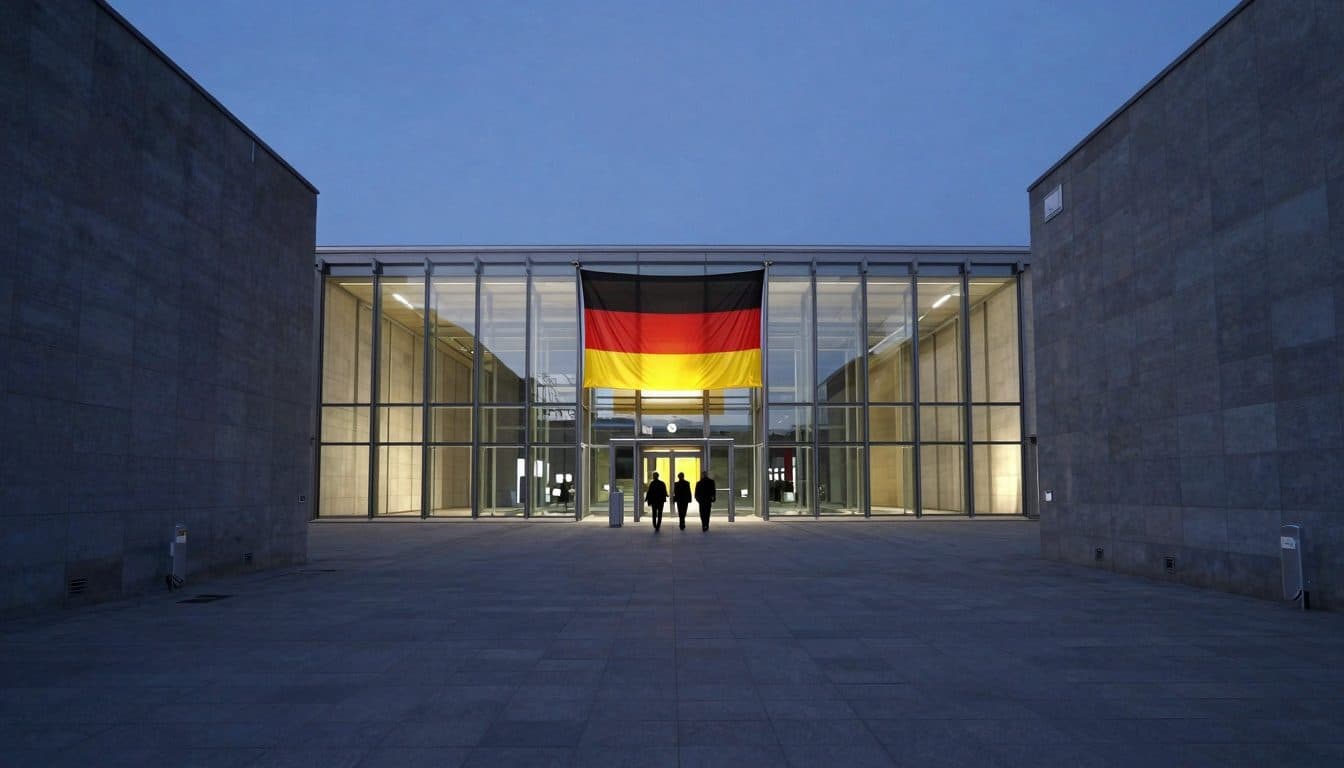
AI-generated image (z-image via Kie.ai)
Summary
The leaders of the Union and SPD are meeting on Wednesday at the Chancellery for what is expected to be the decisive coalition committee meeting before the summer break. On the agenda are tax relief, pension reform, the stabilization of health and long-term care insurance, as well as reducing bureaucracy and increasing labor market flexibility.
Berlin, 1 July 2026
The leaders of the Union and SPD met on Wednesday at the Chancellery for what may prove to be the decisive deliberations on their reform package before the summer break.
The leaders of the CDU, CSU, and SPD gathered on Wednesday afternoon at the Chancellery, including the party chairs and the chairs of the Bundestag parliamentary groups. The session began at 2:30 p.m. According to government spokesperson Stefan Kornelius, the meeting is to deliver "ein großes Paket." According to coalition sources, the negotiations could extend into the night toward Thursday and possibly go into overtime.
On the agenda of the coalition committee are tax relief for low and middle incomes, labor market reforms, as well as pensions, health, and long-term care. The flexibilization of the labor market and the reduction of bureaucracy are also to be discussed. The coalition leadership is meeting with employers and trade unions for this purpose. This is expected to be the last session of the coalition's most important decision-making body besides the cabinet before the summer break.
The Topics at a Glance
In the coalition agreement, the Union and SPD had agreed to create "die Möglichkeit einer wöchentlichen anstatt einer täglichen Höchstarbeitszeit." This is intended to give employees and companies more flexibility. However, there has been fierce opposition from within the CDU against changes to the eight-hour day, as well as from employer associations. Meanwhile, the ministry of Labor Minister Bärbel Bas (SPD) drafted a kind of minimum solution: longer daily working hours should only be possible if they are negotiated in collective agreements or works agreements. Mandatory electronic recording of working hours is to be introduced. However, Social Minister Bärbel Bas (SPD) has publicly said she would prefer not to touch the issue, especially since there is strong resistance from the trade unions.
Dispute Over Working Hours
The reform of income tax is considered the biggest item on the agenda. The coalition wants to provide relief primarily to low and middle incomes, effective 1 January 2027. SPD party chair Bärbel Bas has cited a relief volume of 500 euros per year. Relief is primarily intended to reach employees with gross monthly salaries between 2,500 and 3,000 euros. Finance Minister Lars Klingbeil (SPD) has presented the coalition leadership with two proposals to serve as the basis for negotiations: a smaller model with relief of around ten billion euros and a larger one with around 25 billion euros.
Tax Reform: Models and Conflicts
The SPD wants a higher top income tax rate and a higher inheritance tax to finance the reform, but the Union rejects this. Klingbeil is apparently proposing two models for tax reform. One model envisions relief of 28 billion euros, financed through a higher inheritance tax. Also under discussion are an increase in the wealth tax, a rise in value-added tax, subsidy cuts, or budget savings. Raising the wealth tax by one percentage point would generate around one billion euros in additional revenue; raising the standard VAT rate by one percentage point would generate around 16 billion euros.
CDU General Secretary Carsten Linnemann had recently signaled fundamental openness to raising the wealth tax—which could apply to incomes starting at 200,000 euros per year—in the ARD report from Berlin. Although the Union is against tax increases, it is conceivable that it might make a move on the so-called wealth tax. A reduction of the VAT rate on food to zero percent is also being discussed. The standard VAT rate is currently 19 percent. The Chief Executive of the German Chamber of Industry and Commerce (DIHK), Helena Melnikov, warned that raising the top income tax rate would mainly hit retail, family-owned businesses, and industrial suppliers.
On pensions, both Chancellor Friedrich Merz and Labor Minister Bärbel Bas (SPD) want to fully implement the results of the Pension Commission. The Pension Commission had presented 33 recommendations the previous week concerning the pension level, the retirement age, and contributions. Merz said he wanted to implement the proposals "im vollen Umfang." The necessary laws are to be drafted by the end of the year. The coalition committee is expected to adopt the timetable, with the key points of the reform likely going to the cabinet before the summer break. According to Chancellor Merz, the pension reform is to pass through the Bundestag by the end of the year.
Pensions: Timetable and Unresolved Issues
Contested points include mandatory pension insurance for mini-jobs or linking the retirement age to life expectancy. SPD social politician Klose, a member of the Pension Commission, said on Deutschlandfunk that the coalition committee must not settle for merely the lowest common denominator, but must understand social reforms as a joint project; the Pension Commission could serve as a model for determined cooperation between the Union and SPD. Klose pointed out, however, that there is only one more sitting week in the Bundestag before the summer break—whatever can be put into law in that time is limited.
There is some isolated opposition—above all from the Minister-President of Mecklenburg-Western Pomerania, Manuela Schwesig (SPD), who faces an election in September. She has raised concerns about the pension plans. The coalition is also hoping for a tailwind for the state elections in the fall. SPD parliamentary group managing director Dirk Wiese said: "Wir wollen bei den zentralen Themen über die Ziellinie kommen."
The coalition is under time pressure regarding the stabilization of the statutory health insurance funds. The funding gap in the statutory funds, which must be closed by 2027 to keep contributions stable, has grown further. Health Minister Nina Warken (CDU) warned in a Bundestag debate that the statutory health insurance system faces a deficit of 19 billion euros next year, which could grow to around 44 billion euros by 2030. The reform, which is intended to prevent further increases in health insurance contributions, is the most advanced. The declared goal is to pass the savings law in the Bundestag next week, just before the summer break. The financial reform of the statutory health insurance funds was originally supposed to be discussed again a week ago, but the date was postponed.
Health and Long-Term Care Insurance Under Pressure
On the urgent stabilization of long-term care finances, the positions within the coalition differ considerably, as became clear following a draft by Minister Nina Warken (CDU). The Federal Ministry of Health had presented a draft for a long-term care reform at the beginning of June, which provides, among other things, for cuts in pension contributions, higher hurdles in the classification of care grades, slower growth in subsidies for nursing home care costs, and the abolition of the 100,000-euro income threshold for children of parents in need of care. However, the focus is now increasingly on additional spending brakes—for example, on pension contributions for family caregivers, classification criteria for care grades, and relief supplements for nursing home residents. The municipalities have already taken to the barricades over looming additional social welfare expenditures. The draft has drawn sharp criticism from the states, the SPD, the CSU, patient advocates, and the responsible health insurance funds. The long-term care reform is not expected to be debated in the Bundestag until the fall.
Unlike health insurance, long-term care insurance covers only part of the costs, which is why those in need of care must pay ever-higher out-of-pocket amounts. Business associations regularly cite excessive bureaucracy as a key growth obstacle. The coalition has set itself the goal of significantly reducing bureaucracy, speeding up planning and approval procedures, shortening reporting obligations, and digitalizing administrative contacts. Many requirements come from Brussels—at the EU level, the federal government is likewise pushing for relief.
Several left-wing SPD MPs are turning against social cuts. They cite as red lines longer working hours, cuts in housing benefits, or reductions in waiting days in case of illness. In a letter they wrote: "Wir brauchen Reformen nicht um der Reformen willen. Wir brauchen Reformen, die das Leben der Menschen in schwierigen Zeiten besser machen." The SPD wants to place a greater burden on high earners and large inheritances, referring to incomes starting at 100,000 euros. The Union rejects higher top income tax rates and a heavier burden on large inheritances.
Cutting Bureaucracy and Other Open Issues
In addition to the reform package, the electoral law reform agreed in the coalition agreement could also be placed on the agenda—recently, the Union and SPD had made no progress on it. The SPD's demand for parity—the Bundestag should in future be composed half of women and half of men—meets with rejection from the Union. Finance Minister Lars Klingbeil (SPD) will present the 2027 budget draft next Monday, adding to the time pressure. There is great concern that the coalition committee could go as badly as the meeting at Villa Borsig in mid-April, when the coalition leaders had actually wanted to agree but instead argued.
The coalition leaders want to nail down a series of reforms on Wednesday, or at least establish a timetable and set the most important reforms on track before the summer break. Thirdly—as it is said in the coalition—the event is to provide a tailwind for the state elections in the fall.
Questions & Answers
Who is participating in the coalition committee?
The leaders of the CDU, CSU, and SPD are meeting at the Chancellery under the chairmanship of Federal Chancellor Friedrich Merz, including the party chairs and the chairs of the Bund
Coalition Committee 1 July 2026: Taxes, Pensions, Care | allfacts360