Colombia's presidential runoff pits Cepeda's peace agenda against de la Espriella's hard-line security pledge
Bogotá, 20 June 2026
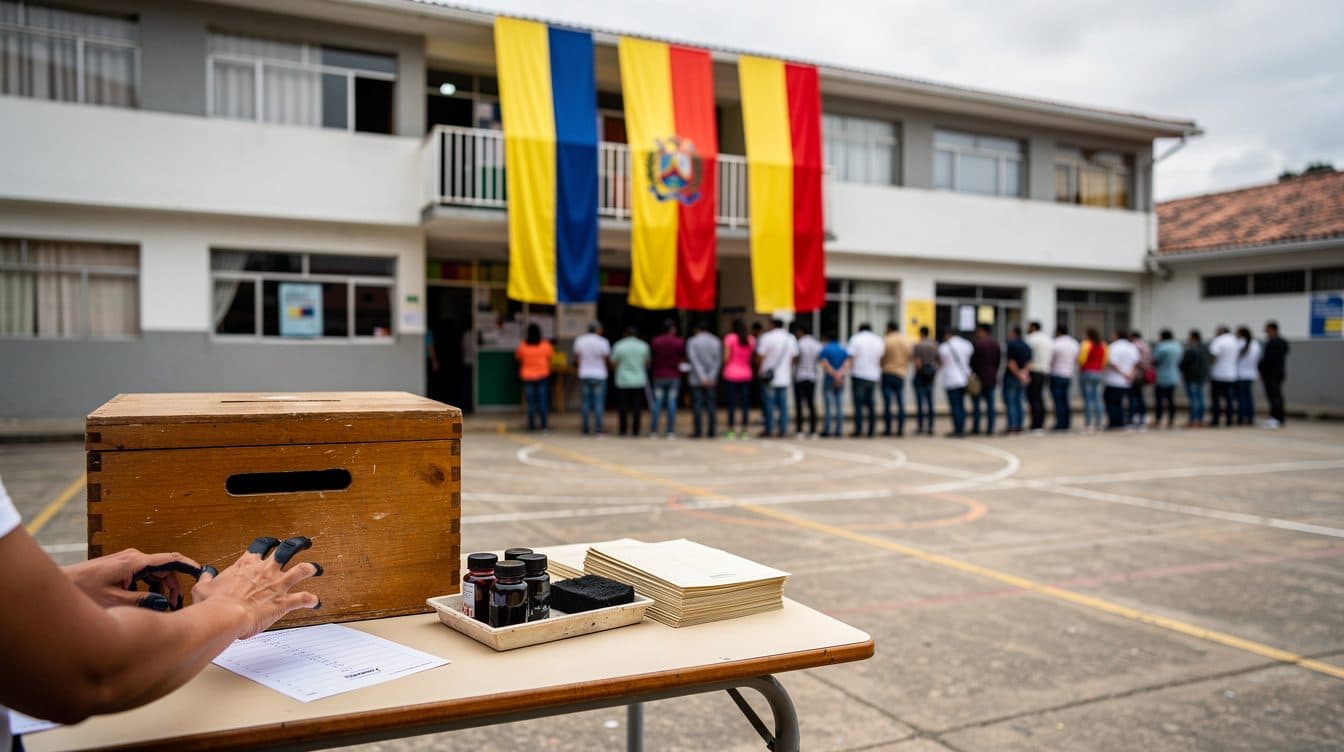
AI-generated image (flux-2/pro-text-to-image via Kie.ai)
Summary
Colombia's roughly 41 million voters are choosing between left-wing senator Iván Cepeda and right-wing lawyer Abelardo de la Espriella in a runoff that will decide the country's direction on security and peace. Analysts describe the contest as a defining choice between continuation of dialogue with armed groups and a militarized response modeled on El Salvador.
Bogotá, 20 June 2026
Around 41 million Colombians were called to vote on Sunday in a presidential runoff between left-wing senator Iván Cepeda of the Pacto Histórico and right-wing lawyer Abelardo de la Espriella of the Defensores de la Patria, with the contest framed by analysts as a decisive choice between negotiations and a hard-line security agenda.
A runoff defined by security
The runoff capped a campaign season that began on 31 May with a first round in which no candidate secured an outright majority. De la Espriella, a 47-year-old criminal defense attorney who has never held elected office, led the first round with about 43 percent of the vote, finishing roughly three percentage points ahead of Cepeda. Polls ahead of the runoff showed de la Espriella, nicknamed "el Tigre" by his supporters, with a slight lead.
Cepeda, a 63-year-old senator and one of the most prominent figures on Colombia's left, secured about 41 percent in the first round. He has pledged to continue the central projects of outgoing President Gustavo Petro's administration and to pursue what he calls an "integral peace," the "paz integral," rather than the "total peace" strategy pursued by his predecessor. Cepeda's background is shaped by his family history: his father, Manuel Cepeda Vargas, a senator from the Marxist Patriotic Union, was assassinated by a right-wing paramilitary squad in 1994.
Sabine Kurtenbach of the German Institute for Global and Area Studies described the runoff as a "directional election" for Colombia. Analysts including Viviana García Pinzón stressed the stakes for the country's internal conflict, which has lasted more than 60 years and pitted Marxist rebels, criminal cartels and successive conservative governments and paramilitary groups against one another. "A new cycle of violence is unfolding," Kurtenbach warned.
The 'Tiger' and his platform
De la Espriella, born in 1978 to a family with ties to Colombia's conservative establishment, has built his campaign around the slogan "steadfast for the homeland." His rallies have featured speakers declaring that "Abelardo has the courage to defeat terrorism," while de la Espriella himself told crowds that "the Tiger has awakened, and he is invincible." At a campaign event in November 2025, a supporter in a tiger costume crossed the stage as the candidate addressed the audience.
The hard-line candidate's policy platform includes ending negotiations with guerrilla groups and orienting Colombia's security strategy toward the models used in El Salvador. De la Espriella has said publicly that he would order military airstrikes on drug camps and treat offenders in the manner he described as exterminating them "like cockroaches and rats." The Trump administration has voiced open support for de la Espriella; U.S. President Donald Trump wrote on Truth Social that "'The Tiger' will not let down the wonderful people of Colombia!" and promised "total support" to the right-wing candidate.
Cepeda's campaign has leaned heavily on his record in Congress and his longstanding advocacy for human rights. García Pinzón characterized him as a politician who has always operated "in institutional and legal spaces." His allies point to his family's history of victimization by paramilitary violence as evidence of his commitment to accountability, while his opponents on the right have dismissed him as a representative of the same left that, in their view, has failed to curb the country's spiral of insecurity.
Trump's endorsement and U.S. ties
The international dimension of the campaign has drawn scrutiny. De la Espriella has contributed roughly 95 million U.S. dollars to U.S. Republican causes, with most of the funds going to figures including Salazar, a Republican lawmaker whom de la Espriella has called a "close personal friend." Salazar represents a Florida district where de la Espriella owns several companies. Analysts noted that the financial ties complicate any future bilateral relationship regardless of who wins.
President Petro, who in 2022 became the first left-wing candidate to win Colombia's presidency, ends his term with a mixed record. Unemployment fell and the minimum wage rose by 75 percent during his four years in office, but his signature "total peace" policy is widely viewed as having fallen short. García Pinzón told DW that the strategy had failed to reduce violence against civilians, and Kurtenbach added that the Petro government's agenda had "promised much but delivered little."
Petro's mixed legacy
The human cost of the unresolved conflict was visible in displacement data: more than 200,000 people were displaced in 2025 alone, the highest figure in a decade, despite the 2016 peace agreement between the government and the FARC guerrilla group. Many regions remain dominated by armed groups, drug trafficking and criminal violence, a backdrop that has fueled demand for tougher security measures among parts of the electorate.
De la Espriella's pitch has resonated with voters disillusioned by persistent insecurity and by what Kurtenbach described as fears triggered by the Petro government, particularly its earlier attempt to change the constitution and alter the country's political rules. The candidate himself abandoned that initiative, but Kurtenbach said the uncertainty it generated remains. The right-wing candidate has also sought to capitalize on fears of "communism," a framing he uses to describe his opponent's platform.
Still, analysts cautioned that de la Espriella's promises may be difficult to implement. Trejos, a security analyst cited in reporting on the runoff, said that "even with U.S. support, he will not be able to fight six or seven wars simultaneously," and will instead need to prioritize specific territories and armed actors. The same analyst noted that the Salvadoran model de la Espriella admires has been credited by its supporters with sharp reductions in gang violence, but its applicability in Colombia, with its multiple armed groups and vast rural territories, remains contested.
Limits of a hard-line approach
Cepeda has framed his closing argument around mobilization in the countryside and in urban slums, betting that a high turnout among poorer voters and those most affected by the conflict can overcome de la Espriella's first-round advantage. "Wut und Enttäuschung" — anger and disappointment — among parts of Petro's base could either push them to support Cepeda in greater numbers or drive some to abstain, a variable that García Pinzón and Kurtenbach both identified as decisive.
The campaign itself produced unusually colorful moments. Colombia's Interior Minister Armando Benedetti, a Cepeda ally, accused de la Espriella during the campaign of having had cosmetic surgery on his buttocks, a claim that drew wide attention but had no apparent impact on voter intentions. De la Espriella, who has cultivated a flashy public image that includes Italian shopping trips by private jet and a wardrobe of luxury watches, dismissed the attack.
Polling stations were scheduled to close at 16:00 local time (23:00 CET) on Sunday, with results expected later that evening. The outgoing Petro government's term is set to end in August, and the winner of the runoff will be inaugurated for a four-year term. Both candidates have pledged a transition of power regardless of the outcome, though de la Espriella's opponents have warned that a victory for the right could mark a sharp break with the political course set since 2022.
A regional shift in view
Beyond Colombia, the vote is being watched across Latin America. In Bolivia, the socialists lost almost all their parliamentary seats in 2025, a development analysts cited as evidence of a broader regional shift to the right. Should de la Espriella prevail, he would become the first Western-style right-wing populist with a realistic chance of taking office in Colombia, a country of 53 million people that has long been governed by a mix of traditional conservative forces and, more recently, by a left-led coalition.
For Cepeda, the runoff represents the chance to consolidate a left-of-center political project that began with Petro's 2022 victory and to vindicate his father's legacy. For de la Espriella, it is the culmination of a political debut that began less than two years ago and that has rapidly drawn comparisons with populist movements elsewhere in the Americas. The result will determine whether Colombia's next government continues to pursue negotiated settlements with armed groups or shifts to a predominantly military approach.
Analysts were divided on the longer-term consequences. Kurtenbach warned that "a new cycle of violence is unfolding" regardless of the outcome, given the weakness of state presence in many regions. García Pinzón emphasized that whichever candidate wins will need to rebuild trust in institutions that have been battered by decades of conflict and by the failures of the recent peace effort. De la Espriella's pledge to act "wie Schaben und Ratten auslöschen" against offenders remains a flashpoint in that debate, with critics warning of human-rights risks and supporters welcoming it as a sign of resolve.
Questions & Answers
Who is Iván Cepeda and what does he stand for?
Iván Cepeda is a 63-year-old Colombian senator from the Pacto Histórico who finished second in the first round with about 41 percent of the vote. He has pledged to continue key projects of the outgoing Petro administration and to pursue what he calls an 'integral peace.'
Who is Abelardo de la Espriella and why is he called 'the Tiger'?
Abelardo de la Espriella is a 47-year-old criminal defense attorney who has never held elected office and who leads the Defensores de la Patria movement. Supporters call him 'el Tigre' for his aggressive political style, and he has pledged a hard-line security agenda modeled on El Salvador.
Why is the 2026 Colombian runoff described as a 'directional election'?
Analysts including Sabine Kurtenbach and Viviana García Pinzón say the runoff will determine whether Colombia continues to negotiate with armed groups or shifts to a militarized security strategy, against the backdrop of more than 60 years of internal conflict.
Colombia 2026 runoff: Cepeda vs de la Espriella | allfacts360